
Buddhist Methods for Managing Emotion forP Violence of Teachers and Educational Personnel in Dusit District, Bangkok
Article Sidebar
Main Article Content
Abstract
This research article focuses on Buddhist approaches to emotion management for preventing violence among teachers and educational personnel in Dusit District, Bangkok. The objectives of the study are: (1) to investigate the issues related to emotion management that contribute to violence among teachers and educational personnel in Dusit District, Bangkok; (2) to examine Buddhist approaches to emotion management for preventing violence as found in Theravada Buddhist scriptures; and (3) to propose Buddhist approaches to emotion management for preventing violence among teachers and educational personnel in Dusit District, Bangkok. The study employs a qualitative research methodology. By interviewing teachers and educational personnel in the Dusit District from four schools, namely Rajabophit Wittayalai School, Rajawinit Secondary School, Chitralada School, and Chitralada Institute of Technology, totaling 10 individuals, and interviewing four qualified individuals in the fields of religion and education from the Ministry of Education.
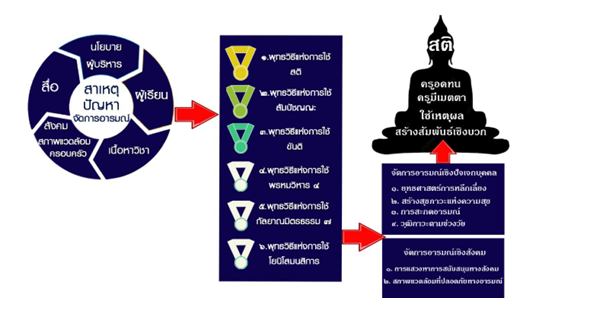
The research findings reveal that the prevalence of violence in educational institutions stems from factors causing stress among teachers and educational personnel. These include top-down policies from central authorities imposed on school administrators, excessive workloads that leave teachers with insufficient time to teach students, and challenges arising from students’ differing attitudes. Additionally, social, familial, and environmental contexts impact well-being, leading to accumulated stress among teachers.
Emotion management at the individual level is essential to prevent and mitigate potential incidents. The application of Buddhist approaches to emotion management, based on the principle of mindfulness (sati), fosters mental discipline, concentration, and awareness of the present moment. Mindfulness and clear comprehension (sampajañña) serve as fundamental doctrines and guiding principles, enabling practitioners to perceive the reality of life, eliminate heedlessness, and cultivate awareness. This leads to inner peace and the development of wisdom. Furthermore, the principle of patience (khanti) serves as a critical foundation for developing other virtues, fostering peaceful coexistence and positive relationships. The practice of the Four Sublime States (Brahmavihara) and analytical reflection (yonisomanasikara) further supports emotion management to prevent violence among teachers and educational personnel.
Article Details

This work is licensed under a Creative Commons Attribution-NonCommercial-NoDerivatives 4.0 International License.
บทความนี้เป็นความคิดเห็นส่วนผู้แต่ง กองบรรณาธิการไม่จำเป็นต้องเห็นด้วยเสมอไป
References
https://www.facebook.com/thaich8news/videos/2397940847232098 [๓ เมษายน ๒๕๖๘].
Khaosod on line. แจ้งจับ ๒ ครู ถุงดำคลุมหัวเด็ก. [ออนไลน์]. แหล่งที่มา: https://www.khaosod.co.th. [๒๓ พฤษภาคม ๒๕๖๗].
PPTV on line. ดราม่า! ครูตบหน้า น.ร. เหตุไม่ยอมเรียกครูว่าแม่. [ออนไลน์]. แหล่งที่มา: https://img.pptvhd36.com/thumbor/2023/09/28/6ab6613.jpg [๒๓ พฤษภาคม ๒๕๖๗].
thaich8news on line. ผอ.ด่าหยาบ ไล่ครูออกห้องประชุม. [ออนไลน์]. แหล่งที่มา: https://www.facebook.com/share/v/14GHurYsUeF/
โชคอนันต์ จึงเจริญรัตน์. “การวิเคราะห์ความเข้าใจและการปฏิบัติงานตามการรับรู้ของครูตามนโยบายการศึกษา”. วิทยานิพนธ์ครุศาสตรมหาบัณฑิต สาขาวิชาวิธีวิทยาการวิจัยการศึกษาภาควิชาวิจัยและจิตวิทยาการศึกษา. (คณะครุศาสตร์: จุฬาลงกรณ์มหาวิทยาลัย,๒๕๕๕).
ไทยรัฐ ออนไลน์. ตร.ฟันครูหญิง เข็มจิ้มปากนักเรียน ทำโทษ ป.2 ยกห้อง ขู่ให้รับสารภาพผิด. [ออนไลน์]. แหล่งที่มา: https://www.thairath.co.th/news/crime/2758441 [๒๗ พฤษภาคม ๒๕๖๗].
พระครูสิทธิวชิรโสภิต (ประสิทธิ์ สมฺมาปญฺโญ). “การยับยั้งชั่งใจโดยใช้หลักธรรมทางพระพุทธศาสนา กรณีศึกษา: การใช้ความรุนแรงต่อเด็กคดีน้องชมพู่เด็กหญิงบ้านกกกอก”. วารสารพุทธปัญญาปริทรรศน์. ปีที่ ๖ ฉบับที่ ๑ (มกราคม - เมษายน ๒๕๖๔): ๑๙๖.
พระพรหมคุณาภรณ์ (ป.อ. ปยุตฺโต). พุทธธรรมฉบับปรับขยาย. พิมพ์ครั้งที่ ๔๐. กรุงเทพมหานคร : มูลนิธิธรรมทานกุศลจิต, ๒๕๕๗.
พิชญธิดา ผิวเหลือง. “ปัจจัยที่มีความสัมพันธ์กับภาวะความเครียดและความวิตกกังวลของครู จังหวัดอุดรธานี หลังโรคติดเชื้อไวรัสโคโรนา 2019 เป็นโรคประจําถิ่น”, วารสารวิทยาศาสตร์สุขภาพแห่งประเทศไทย, ปีที่ ๖ ฉบับที่ ๒ (เมษายน-มิถุนายน ๒๕๖๗): ๖๔.
มหาจุฬาลงกรณราชวิทยาลัย. พระไตรปิฎกภาษาไทย ฉบับมหาจุฬาลงกรณราชวิทยาลัยกรุงเทพมหานคร : โรงพิมพ์มหาจุฬาลงกรณราชวิทยาลัย, ๒๕๓๙.
สำนักงานเลขาธิการสภาการศึกษา. มาตรฐานการศึกษาของชาติ พ.ศ. ๒๕๖๑, ๑๐/๒๕๖๒, พิมพ์ครั้งที่ ๒, (นนทบุรี: บริษัท ๒๑ เซ็นจูรี่ จำกัด, ๒๕๖๒, ๑-๙.
สุชารัตน์ แก้วอุดร. “ความท้อแท้ในการปฏิบัติงานของครูสังกัดสำนักงานเขตพื้นที่การศึกษา
ประถมศึกษาเลย เขต ๒”. วารสารปัญญาปณิธาน. ปีที่ ๙ ฉบับที่ ๑ (มกราคม-มิถุนายน ๒๕๖๗): ๑๒๑.
สุนทร พริกจำรูญ. “ความสุขของครู: กุญแจสู่ความสําเร็จของการจัดการศึกษา”. วารสารครุศาสตร์ปริทรรศน์, ปีที่ ๑๑ ฉบับที่ ๒ (พฤษภาคม-สิงหาคม ๒๕๖๗): ๖๙๘.

