
MINDFULNESS DEVELOPMENT IMPACTING TO BUDDHIST PSYCHOLOGY BASED SELF-AWARENESS OF DHAMMA PRACTITIONER MINDFULNESS DEVELOPMENT IMPACTING TO BUDDHIST PSYCHOLOGY BASED SELF-AWARENESS OF DHAMMA PRACTITIONER
Article Sidebar
Main Article Content
Abstract
The purposes of this research were 1) to study the concept of mindfulness and Buddhist psychology-based self-awareness; 2) to compare the effects
before and after mindfulness development on Buddhist psychology-based
self-awareness of the Dhamma practitioners; and 3) to present the effects of
mindfulness development on Buddhist psychology-based self-awareness of
the Dhamma practitioners. This study was a quasi-experimental. The sample group consisted of 45 Dhamma practitioners who joined the Vipassana meditation
project at the Vipassanadhura Institute, Mahachulalongkornrajavidyalaya University,
Ayutthaya Province. Data was collected using questionnaires and in-depth interviews with 9 Dhamma practitioners. The statistics used in the research consisted of percentage, mean, standard deviation, and t-test
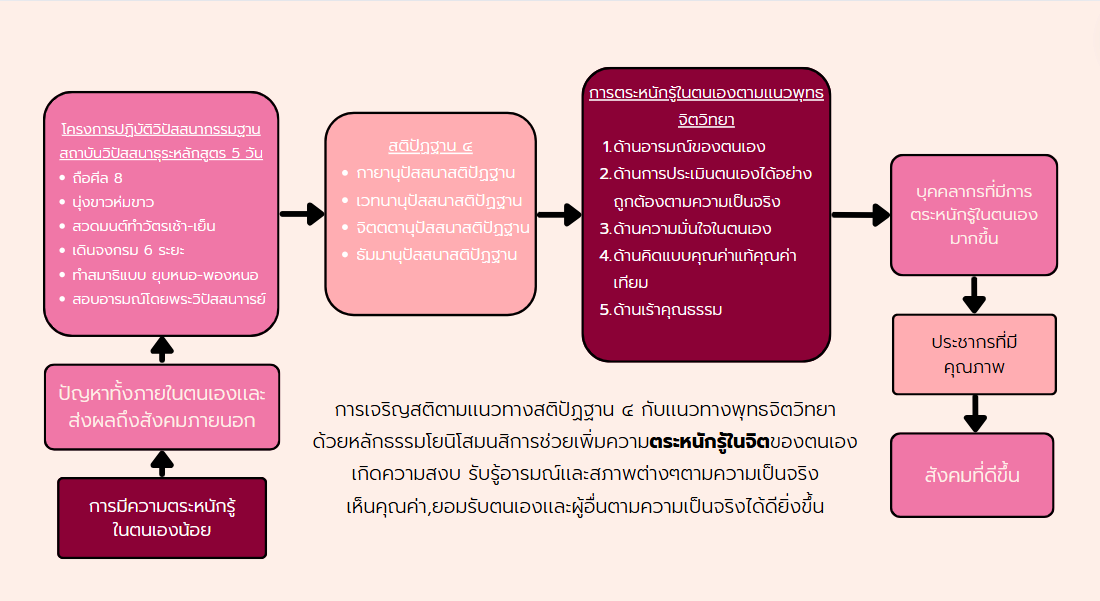
- 1. Concept of mindfulness development and Buddhist psychology-based self-awareness was the developing of mental skills and present-moment awareness encompassing acceptance, attention, and awareness which affected their mindfulness and awareness in various aspects, both internally and in relation to their external environment. The effects of Buddhist psychology-based self-awareness was the applying of the principle of Yonisomanasikara (wise reflection) in mindfully recognizing things as they truly are. This was achieved through careful consideration in being cognizant of one's emotions and thoughts, enabling individuals to perceive various occurrences within themselves. This awareness was essential for leading to self-improvement.
- 2. The result of the comparison of the overall Buddhist psychology-based self-awareness of the Dhamma practitioners after participating in mindfulness meditation was higher than before participating in mindfulness meditation and was at the highest level.
3. The effects of mindfulness development on Buddhist psychology-based self-awareness of the Dhamma practitioners after the practice, the practitioners had higher Buddhist psychology-based self-awareness than before the practice at a statistical significance level of 0.05. This improvement was observed both overall and in all five specifics. Accordingly, the practice of mindfulness in accordance with the Four Foundations of Mindfulness can enhance individuals' self-awareness, thereby fostering the development of virtuous individuals and contributing to the improvement of society as a whole."
Article Details

This work is licensed under a Creative Commons Attribution-NonCommercial-NoDerivatives 4.0 International License.
บทความนี้เป็นความคิดเห็นส่วนผู้แต่ง กองบรรณาธิการไม่จำเป็นต้องเห็นด้วยเสมอไป
References
ภาษาไทย
พระพรมคุณาภรณ์ (ป.อ. ปยุตฺโต). พจนานุกรมพุทธศาสน์ ฉบับประมวลศัพท์. พิมพ์ครั้งที่ ๑๑.กรุงเทพมหานคร: บริษัท.เอส.อาร์.พริ้นติ้ง แมส โปรดักส์ จำกัด, ๒๕๕๑.
มหาจุฬาลงกรณราชวิทยาลัย. พระไตรปิฎกภาษาไทย ฉบับมหาจุฬาลงกรณราชวิทยาลัย. กรุงเทพมหานคร: โรงพิมพ์มหาจุฬาลงกรณราชวิทยาลัย, ๒๕๓๙.
พระโสภณมหาเถระ (มหาสีสยาดอ). มหาสติปัฏฐานสูตร ทางสู่พระนิพพาน. แปลและเรียบเรียงโดย พระคันธ สาราภิวงศ์. กรุงเทพมหานคร: ไทยรายวันการพิมพ์, ๒๕๔๙.
กันต์ ปั้นภู. “ความสัมพันธ์ของการตระหนักรู้คุณค่าในตนเองที่มีต่อเป้าหมายและความสำเร็จในการเรียนตามหลักอิทธิบาท ๔ : กรณีศึกษานิสิตระดับปริญญาตรีคณะมนุษยศาสตร์ มหาวิทยาลัยมหาจุฬาลงกรณราชวิทยาลัย”. วิทยานิพนธ์พุทธศาสตรมหาบัณฑิต สาขาวิชาชีวิตและความตาย. บัณฑิตวิทยาลัย: มหาวิทยาลัยมหาจุฬาลงกรณราชวิทยาลัย, ๒๕๖๐.
ช่อเพชร เบ้าเงิน. “การพัฒนาหลักสูตรฝึกอบรมเพื่อเสริมสร้างความฉลาดทางอารมณ์ด้านการ ตระหนักรู้ ตนเองของผู้บริหารสถานศึกษาสังกัดสำนักงานการประถมศึกษาจังหวัดสมุทรสาคร”. ดุษฎีนิพนธ์การศึกษาดุษฎีบัณฑิต สาขาวิชาการบริหารการศึกษา. บัณฑิตวิทยาลัย: มหาวิทยาลัยศรีนครินทรวิโรฒ, ๒๕๔๕.
คอย ละอองอ่อน และคณะ, “ผลของการใช้กระบวนการจิตตปัญญาศึกษาต่อการตระหนักรู้ในตนเองและการร่วมรู้สึกกับผู้อื่นของนักศึกษาพยาบาล”, วารสารพยาบาลกระทรวงสาธารณสุข, ปีที่ ๓๐ ฉบับที่ ๒ (พฤษภาคม-สิงหาคม ๒๕๖๓): ๔๖-๕๗.
นเรนทร์ฤทธิ์ นันทะสิทธิ์ และคณะ. “ผลการใช้ชุดกิจกรรมแนะแนวร่วมกับการฝึกสติ เพื่อพัฒนาการตระหนักรู้ต่อตนเอง ของนักเรียนชั้นมัธยมศึกษาปีที่ ๓ โรงเรียนแม่สายประสิทธิ์ศาสตร์ จังหวัดเชียงราย”. วารสารราชพฤกษ์. ปีที่ ๑๙ ฉบับที่ ๑ (มกราคม-เมษายน ๒๕๖๔): ๖๗-๗๕.
บุญเลิศ วงศ์วิศิษฏ์ และคณะ. “ผลของการฝึกปฏิบัติธรรมแบบวิปัสสนา ๕ วันต่อระดับการตระหนักรู้ในตัวตนเองของผู้ปฏิบัติธรรม”. วารสารจิตวิทยา จุฬาลงกรณ์มหาวิทยาลัย. ปีที่ ๓๘ ฉบับที่ ๒ (๒๕๖๔): ๑๓๔-๑๕๒.
พระสาธิต โปธาเศษ. “วิธีการเพิ่มสตินทรีย์ให้แก่ผู้ปฏิบัติวิปัสสนากรรมฐานตามแนวสติปัฏฐาน ๔”. วิทยานิพนธ์ศิลปศาสตรมหาบัณฑิต สาขาวิชาพุทธศาสนศึกษา. บัณฑิตวิทยาลัย: มหาวิทยาลัยเชียงใหม่, ๒๕๕๓.
อรวรรณ นาเพ็ชร และคณะ. “การตระหนักรู้ในตนเอง และการรับรู้ประโยชน์ของการตระหนักรู้ในตนเองของนักศึกษาพยาบาลมหาวิทยาลัยเอกชนแห่งหนึ่ง ในจังหวัดอุบลราชธานี”. วารสารราชธานีนวัตกรรมทางวิทยาศาสตร์สุขภาพ. ปีที่ ๒ ฉบับที่ ๒ (เมษายน-มิถุนายน ๒๕๖๑): ๖๐-๗๓.
ธัญยพร จารุไพศาล. การตระหนักรู้ในตนเอง (Self-Awareness) คืออะไร และพัฒนาอย่างไร. [ออนไลน์]. แหล่งที่มา: https://www.workwithpassiontraining.com/17815526 [๑ มกราคม ๒๕๖๗].
ภาษาอังกฤษ
Fitz-Gibbon et al. How to Design a Program Evaluation. Newbury Park: Sagh, 1987.
Goleman, D. Working with Emotional Intelligence. New York: Bantam Books, 1999.
James, W. The Principles of Psychology. New York: Henry Holt and Company, 1890.
Maslow. Motivation and Personality. New York: Harper and Row, 1970.
Rogers, C.R. Client-Centered Therapy: Its Current Practice, Implications, and Theory. Boston: Houghton Mifflin, 1951.
Khoury, N. “Mindfulness and Happiness”. Mindfulness. Vol. 14 (2023): 2824-2828.
Lio Stefanus. “The Effect of Self-Awareness and Personal Responsibility on Life Satisfaction of Seminary Students in Malang”. Turkish Journal of Computer and Mathematics Education. Vol. 12 No. 14 (2021): 5724-5734.
Shonin et al. “The Impact of Mindfulness-Based Stress Reduction (MBSR) on Self-Awareness: A Meta-Analysis”. Psychological Medicine. Vol. 48 (2018): 2157-2170.
Witkiewitz, K. et al. “Mindfulness-Based Relapse Prevention for Alcohol and Substance Use Disorders”. Journal of Cognitive Psychotherapy. Vol. 19
No. 3 (2005): 211-228.
