Factors Strengthening Mental Resilience Based on Buddhist Psychology for Enhancing Mental Well-Being of the Elderly in Thai Society
Article Sidebar
Main Article Content
Abstract
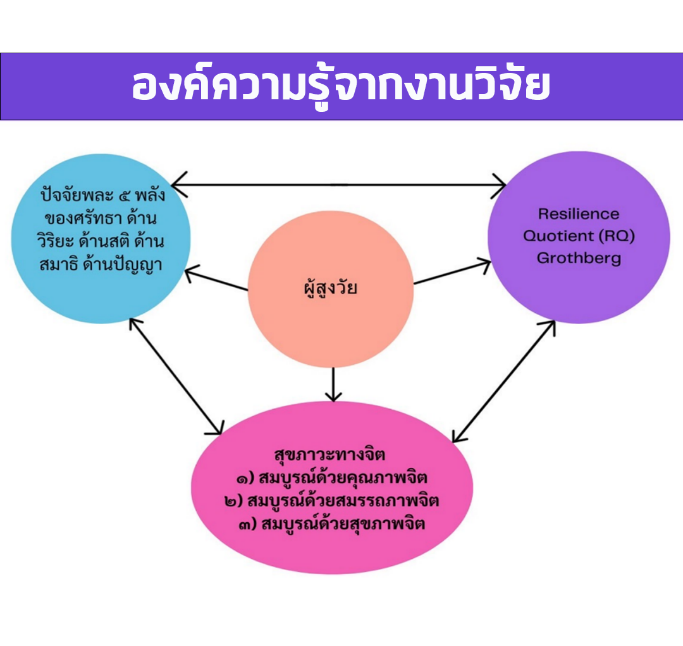
This study aimed ๑) to study the concepts and theories on strengthening mental resilience based on Buddhist psychology for enhancing the mental well-being of the elderly in Thai society; ๒) to investigate the factors strengthening mental resilience based on Buddhist psychology for enhancing the mental well-being of the elderly in Thai society; and ๓) to propose guidelines for strengthening mental resilience based on Buddhist psychology for enhancing the mental well-being of the elderly in Thai society. The study was quantitative research. The sample of the study consisted of ๓๙๙ elderly individuals. The research findings were as follows ๑) The key theoretical concepts related to strengthening mental well-being include Grotberg’s concept of resilience and the Buddhist principles known as the Five Powers (Pañca Bala)—faith, energy, mindfulness, concentration, and wisdom ๒) The Five Powers, as factors in Buddhist psychology, were found to have a high statistically significant correlation (at the .๐๑ level) with mental well-being both overall and each aspects, except for faith, which showed a moderate correlation ๓) Guidelines for strengthening mental resilience should focus on promoting the Five Powers among the elderly, as it plays a crucial role in nurturing resilience and cultivating bravery within the individual and helping them build inner strength, cope with challenges, and ultimately attain better mental well-being. The key knowledge gained from this study is that Grotberg’s concept of resilience can be integrated with the Buddhist Five Powers, which serve as powerful spiritual tools to cultivate inner mental strength.
Article Details

This work is licensed under a Creative Commons Attribution-NonCommercial-NoDerivatives 4.0 International License.
บทความนี้เป็นความคิดเห็นส่วนผู้แต่ง กองบรรณาธิการไม่จำเป็นต้องเห็นด้วยเสมอไป
References
พระพรหมคุณาภรณ์ (ป.อ. ปยุตฺโต). พุทธธรรม ฉบับปรับขยาย. พิมพ์ครั้งที่ 32. กรุงเทพมหานคร: วัดญาณเวศกวัน, 2555.
พระไพศาล วิสาโล. สุขแท้ด้วยปัญญา วิถีสู่สุขภาวะทางปัญญา. กรุงเทพมหานคร: สำนักงานกองทุนสนับสนุนการสร้างเสริมสุขภาพ สสส, 2552.
จ่าสิบตำรวจ กนกวรรณ ขวัญอ่อน. “พุทธจิตวิทยาสร้างความเข้มแข็งทางด้านจิตใจในญาติผู้ดูแลผู้ป่วยโรคไม่ติดต่อเรื้อรัง”. ดุษฎีนิพนธ์พุทธศาสตรดุษฎีบัณฑิต สาขาวิชาพุทธจิตวิทยา. บัณฑิตวิทยาลัย: มหาวิทยาลัยมหาจุฬาลงกรณราชวิทยาลัย, 2561.
ธฤษิดา แก้วภราดัย. “ศึกษาความสัมพันธ์ระหว่างพละ 5 กับอิทธิบาท 4”. วิทยานิพนธ์
พุทธศาสตรมหาบัณฑิต สาขาวิชาพระพุทธศาสนา. บัณฑิตวิทยาลัย: มหาวิทยาลัยมหาจุฬาลงกรณราชวิทยาลัย, 2561.
พระครูประภาสกรสิริธรรม (เกษม สุวณฺโณ). “การศึกษาสุขภาวะของผู้สูงอายุในเขตชุมชนท่าอิฐ
วัดแสงสิริธรรม ตำบลท่าอิฐ อำเภอปากเกร็ด จังหวัดนนทบุรี”. วิทยานิพนธ์พุทธศาสตรมหาบัณฑิต สาขาวิชาพระพุทธศาสนา. บัณฑิตวิทยาลัย: มหาวิทยาลัย
มหาจุฬาลงกรณราชวิทยาลัย, 2560.
พระราชมงคลวิเทศ (น้อม กาละสังข์). “การเสริมสร้างพลังใจของชาวพุทธในสหรัฐอเมริกาตามหลักพละ 5 : กรณีศึกษา วัดมงคลเทพมุนี”. วิทยานิพนธ์พุทธศาสตรมหาบัณฑิต สาขาวิชาสันติศึกษา. บัณฑิตวิทยาลัย: มหาวิทยาลัยมหาจุฬาลงกรณราชวิทยาลัย, 2565.
ศิริพรรณ วีระนันทาเวทย์. “การดำเนินชีวิตของผู้สูงอายุในสังคมไทยในสองทศวรรษหน้าเชิงพุทธบูรณาการ”. ดุษฎีนิพนธ์พุทธศาสตรดุษฎีบัณฑิต สาขาวิชาพระพุทธศาสนา.
บัณฑิตวิทยาลัย: มหาวิทยาลัยมหาจุฬาลงกรณราชวิทยาลัย, 2560.
กมลาศ ภูวชนาธิพงศ์ และคณะ. “พุทธจิตวิทยาเพื่อพลังใจวัยรุ่น”. วารสารพุทธจิตวิทยา.
ปีที่ 7 ฉบับที่ 2 (กรกฎาคม-ธันวาคม 2565): 79-88.
กมลาศ ภูวชนาธิพงศ์ และอำนาจ บัวศิริ. “สุขชีวีวิถีพุทธในชุมชนเมืองยุค 4.0 : กระบวนการมีส่วนร่วมของชุมชน บ้าน วัด โรงเรียน”. วารสารสังคมศาสตร์และมานุษยวิทยา
เชิงพุทธ. ปีที่ 5 ฉบับที่ 11 (พฤศจิกายน 2563): 403-419.
พระสุเทพ สิริธมฺโม (มัจฉา). “ศึกษาเปรียบเทียบคำสอนเรื่องพละ 5 ในพุทธปรัชญาเถรวาทและพุทธปรัชญามหายาน”. วารสารนิสิตวัง. ปีที่ 21 ฉบับที่ 2 (กรกฎาคม-ธันวาคม 2562): 46-54.
กรมกิจการผู้สูงอายุ. สังคมผู้สูงอายุในปัจจุบันและเศรษฐกิจในประเทศไทย. [ออนไลน์]. แหล่งที่มา: https://www.dop.go.th/th/know/15/926 [4 พฤศจิกายน 2566].
ศูนย์สุขภาพใจ ปรึกษาจิตแพทย์. เข้าถึงโลกของผู้สูงอายุด้วยหัวใจ สร้างสุขภาพจิตอย่างไรให้เวิร์ก. [ออนไลน์]. แหล่งที่มา: https://www.vimut.com/article/older-adults-mental-health [4 พฤศจิกายน 2566].
ภาษาอังกฤษ
Erikson, E.H. Childhood and Society. New York: Norton, 1950.
Grotberg, E.H. A Guide to Promoting Resilience in Children: Strengthening
the Human Spirit. Netherlands: Bernard Van Leer Foundation, 1995.
Yamane. Taro Statistic: An Introductory Analysis. New York: Harper & Row, 1967.
Cronbach, L.J. “Coefficient Alpha and the Internal Structure of Tests”. Psychometrika. Vol. 16 (1951): 297-334.
Peck, R. “Psychological Developments in the Second Half of Life. The Journal of Gerontology. Vol. 11 No. 4 (1956): 85-94.
Rovinelli, R.J. & Hambleton, R.K. “On the Use of Content Specialists in the Assessment of Criterion-Referenced Test Item Validity”. Tijdschrift voor Onderwijsresearch. Vol. 2 No. 2 (1977): 49-60.
Windle, G. & Bennett, K.M. “Psychological Resilience and Aging: The Role of Physical Activity”. Journal of Aging and Physical Activity. Vol. 29 No. 3 (2021): 453-470.
Zhang, Z. et al. “Positive Self-perceptions of Aging Increase Physical Resilience to Facilitate Social Re-engagement of Older Adults Who Fall: Analysis Based on Health and Retirement Study Data”. Archives of Physical Medicine and Rehabilitation. Vol. 104 No. 8 (2023): 1253-1259.
Grotberg, E.H. Resilience for Tomorrow. [Online]. Source: http://resilent.uluc.
edu/library/grotberg2005_resilience-for-tommorrow-brazil.pdf [19 February 2014].
