Effects of the Buddhist Peer Counseling Program on Youth Counseling Competencies
Article Sidebar
Main Article Content
Abstract
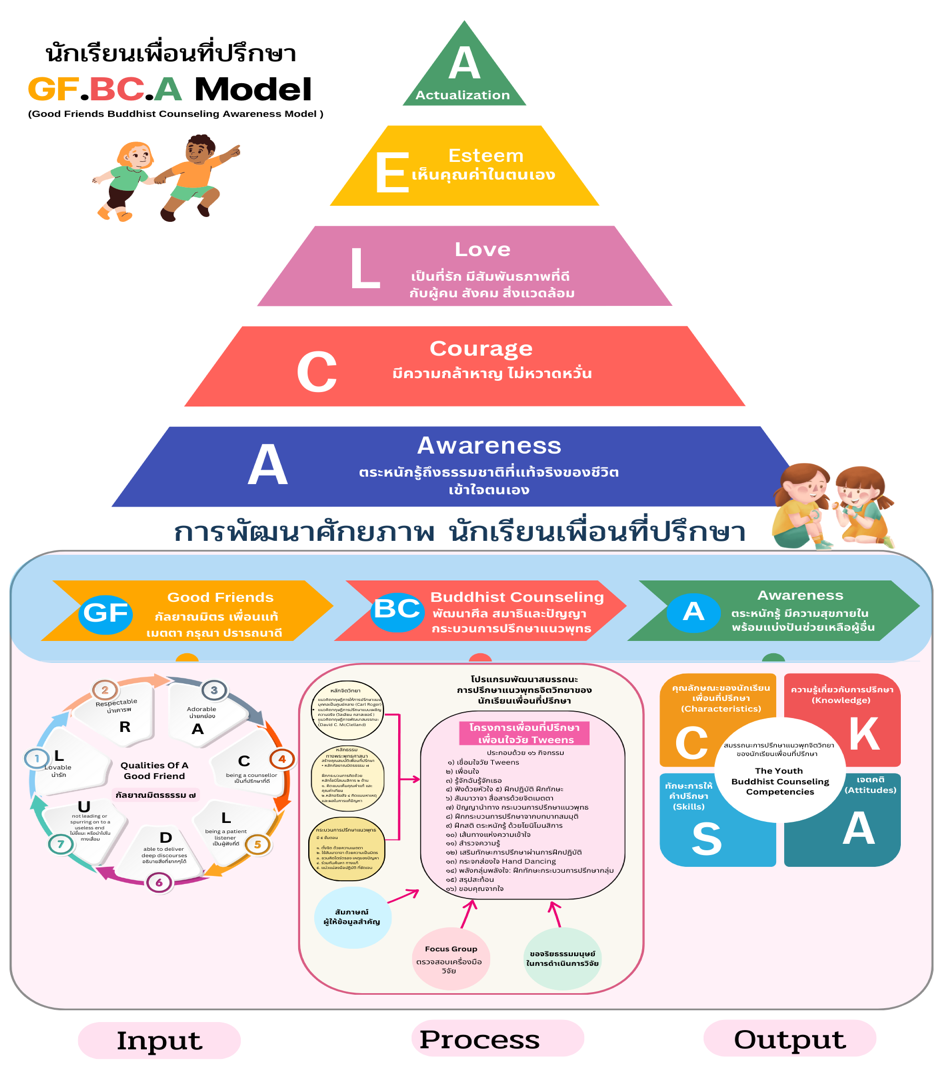
The objectives of this research were: 1) To study the concepts, theories, and development of counseling competencies of youth counselors based on psychological principles and Buddhist principles 2) To develop a program to enhance counseling competencies according to the Buddhist psychological approach of youth counselors 3) To experiment and present the outcomes of the program to enhance counseling competencies according to the Buddhist psychological approach of youth counselors. The mixed methods research combined qualitative approaches and quasi-experimental research. The key informants consisted of 9 qualified individuals and 36 students, divided into
an experimental group and a control group of 18 students each. The data were analyzed using content analysis, frequency, percentage, mean, standard deviation, and a paired t-test. The research revealed that 1) the psychological concepts applied to the development of students' counseling competencies included characteristics of youth counselors, knowledge about counseling, attitude towards counseling, and counseling skills with significant principle for promoting was using the psychology of peer groups 2) The development program integrates psychological concepts, counseling processes, and Buddhist principles based on the Four Noble Truths and Buddhist counseling skills under the program called "Tweens 'Friend of heart" which consisted of 16 activities, each lasting
60-120 minutes, conducted 4 times over a period of 3 months and 3) the Buddhist Peer Counseling Program on Youth Counseling Competencies was significantly higher after participating in the program and after the follow-up period, compared to before the training, at the .05 significance level. Additionally, after the training, the experimental group scored significantly higher than the control group at the .05 significance level."
Article Details

This work is licensed under a Creative Commons Attribution-NonCommercial-NoDerivatives 4.0 International License.
บทความนี้เป็นความคิดเห็นส่วนผู้แต่ง กองบรรณาธิการไม่จำเป็นต้องเห็นด้วยเสมอไป
References
ภาษาไทย
วศิน อินทสระ. อริยสัจ ๔. กรุงเทพมหานคร: สำนักพิมพ์ธรรมดา, ๒๕๔๘.
พระมหาพงศกร ธานงุกโร (สิมพา). “พุทธสันติวิธีการให้การปรึกษาของสามเณรเพื่อนที่ปรึกษา กรณีศึกษา: โรงเรียนวัดไผ่ดำ แผนกสามัญศึกษา”. ดุษฎีนิพนธ์พุทธศาสตรดุษฎีบัณฑิต สาขาวิชาสันติศึกษา. บัณฑิตวิทยาลัย: มหาวิทยาลัยมหาจุฬาลงกรณราชวิทยาลัย, ๒๕๖๓.
พระมหาสุเทพ สุทฺธิญาโณ (ธนิกกุล). “โปรแกรมพัฒนาสมรรถนะการปรึกษาแนวพุทธจิตวิทยาของพระสงฆ์ด้านการเยียวยาจิตใจผู้ป่วย”. ดุษฎีนิพนธ์พุทธศาสตรดุษฎีบัณฑิต สาขาวิชาพุทธจิตวิทยา. บัณฑิตวิทยาลัย: มหาวิทยาลัยมหาจุฬาลงกรณราชวิทยาลัย, ๒๕๖๑.
จันทิมา ทอดสนิท และฉันทนา กล่อมจิต. “ผลของโปรแกรมการพัฒนาความสามารถในการให้คำปรึกษาของเพื่อนที่ปรึกษา”. วารสารศึกษาศาสตร์. ปีที่ ๕ ฉบับที่ ๑ (มกราคม-มีนาคม ๒๕๕๔): ๒๒-๒๖.
นพพร แสงทอง และคณะ. “การเสริมสร้างสมรรถนะการให้คำปรึกษาของนักเรียนเพื่อนที่ปรึกษาโดยการฝึกอบรมเชิงจิตวิทยา”. วารสารวิจัยทางการศึกษา. ปีที่ ๑๖ ฉบับที่ ๑ (มกราคม-มิถุนายน ๒๕๖๔): ๑๔-๒๖.
พระอนันตชัย อภินนฺโท (ขันโพธิ์น้อย). “หลักธรรมที่เกี่ยวกับการให้คำปรึกษาตามแนวพุทธจิตวิทยา”. วารสารพุทธจิตวิทยา. ปีที่ ๓ ฉบับที่ ๑ (มกราคม-มิถุนายน ๒๕๖๑): ๕๒-๖๖.
โสรีช์ โพธิแก้ว. “การสงเคราะห์หลักอริยสัจ ๔ สู่กระบวนการปรึกษาเชิงจิตวิทยา”. เอกสารประกอบการเรียนการสอน สาขาวิชาจิตวิทยาการปรึกษา. คณะจิตวิทยา: จุฬาลงกรณ์มหาวิทยาลัย, ๒๕๕๓. (อัดสำเนา).
ภาษาอังกฤษ
Cowie, H. & Sharp, S. Peer Counselling in Schools a Time to Listen. London: David Fulton, 1996.
Roberts, E.B. & Borders, L.D. “Supervision of School Counselors: Administrative, Program, and Counseling”. The School Counselor. Vol. 41 No. 3 (January 1994): 149-157.
Rogers, C.R. Psychotherapy and Personality Change. Chicago: University Press, 1967.
Rose Mueni Luti-Mallei et al. “Impact of Student Leaders’ Participation in School Peer Counseling Programs on Learners’ Discipline in Public and Private Secondary Schools in Machakos Sub-County, Kenya”. International Journal of Learning and Development, Macro Think Institute. Vol. 13 (2023): 126-147.
Ryan C. Harra & Ivan Vargas. “A Peer-based Mentoring Program for Reducing Anxiety and Depression Symptoms among College Students: A Preliminary Study”. Journal of American College Health. [Online]. Source: DOI: 10.1080/ 07448481. 2023. 2172580 [9 February 2024].
