
THE STUDY OF PROMOTING AWARENESS OF MUSAVADA OF MEDIATATION PRACTITIONERS OF WAT PUNYANUNTARAM PROJECT
Article Sidebar
Main Article Content
Abstract
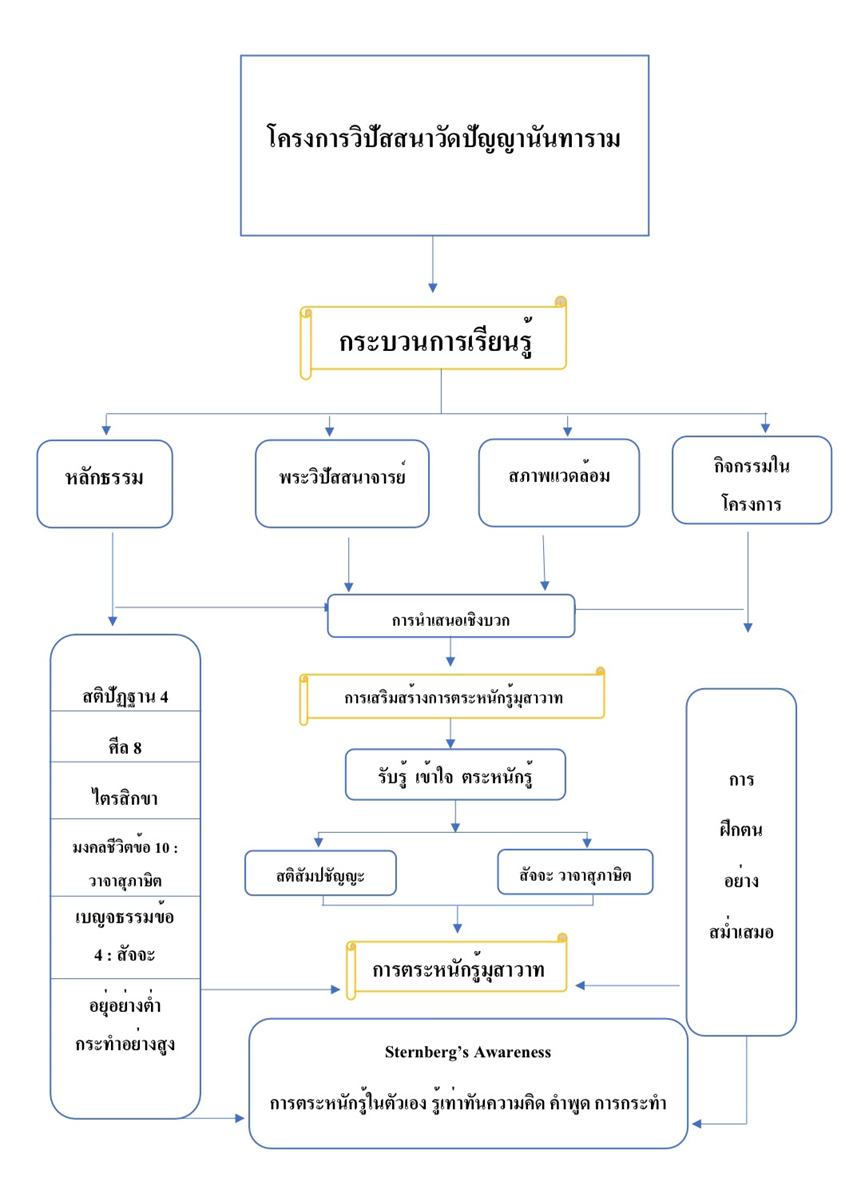
This research articles entitled “A Study of the Musāvāda Awareness Promotion of Meditation Practitioners of Wat Punyanuntaram” concentrated on 3 main objectives including 1) to study the moral teaching process of the meditation project of Wat Punyanuntaram 2) to study the Musāvāda Awareness Promotion of meditation practitioners of Wat Punyanuntaram 3) to present the model of the Musāvāda awareness promotion of meditation practitioners participated in meditation project of Wat Punyanuntaram. This study is a qualitative research that reviewed the related documents from primary and secondary sources as well as collected the in-dept interview data from 25 key informants including 7 teaching Monks and 18 practitioners, and 2 focus group interview of 16 participants, the result found that: 1) The moral principles to promote the awareness of Musāvāda of Wat Punyanuntaram are emphasized by the basic of “living simply while aspiring to higher virtues.” The program employs foundational doctrinal frameworks, including the Four Foundations of Mindfulness (Satipatthana), the Eight Precepts, the Threefold Training (Trisikkha), the ethical precept of righteous speech (Vaca-sappurisa), the fourth principle of the Five Universal Virtues (Pañcadhamma), and the concept of truthfulness (Sacca). Practitioners are encouraged to embody humility while striving for moral excellence. 2) The Musāvāda Awareness Promotion of Wat Punyanuntaram Project that the meditation practitioners cultivated were based the practitioners’ comprehension and application of Buddhist principles in their daily lives, contributing to a tangible reduction in deceptive speech. This transformation aligns with Steven J. Breckler’s theory of attitude formation, which encompasses cognitive, affective, and behavioral dimensions of speech, thereby facilitating behavioral modification and a progressive decline in false speech tendencies.
3) The Model of The Musāvāda Awareness Promotion of Meditation Practitioners of Wat Punyanuntaram Project was derived from the process of moral teaching including 1) The Learning Process – incorporating doctrinal instruction, guidance from Vipassana instructors, environmental influences, and structured program activities. 2) Positive Reinforcement – fostering awareness through mindfulness, clear comprehension (Sampajañña), truthfulness (Sacca), and ethical speech (Vaca-sappurisa). 3) Sustained Awareness of Musāvāda – cultivated through constant adherence to the principles introduced during the program.
Article Details

This work is licensed under a Creative Commons Attribution-NonCommercial-NoDerivatives 4.0 International License.
บทความนี้เป็นความคิดเห็นส่วนผู้แต่ง กองบรรณาธิการไม่จำเป็นต้องเห็นด้วยเสมอไป
References
James Patterson and Peter Kim, The Day America Told the Truth, (New York :Prentice Hall), 1991.
Steven J. Breckler. Handbook of Motivation and Cognition : Foundations of Social
Behavior. New York : Johns Hopkins University. Guilford Press, 1986.
Sternberg, R. J. (1997). The concept of intelligence and its role in lifelong learning and success. American Psychologist, 52, 1030-1037.
