
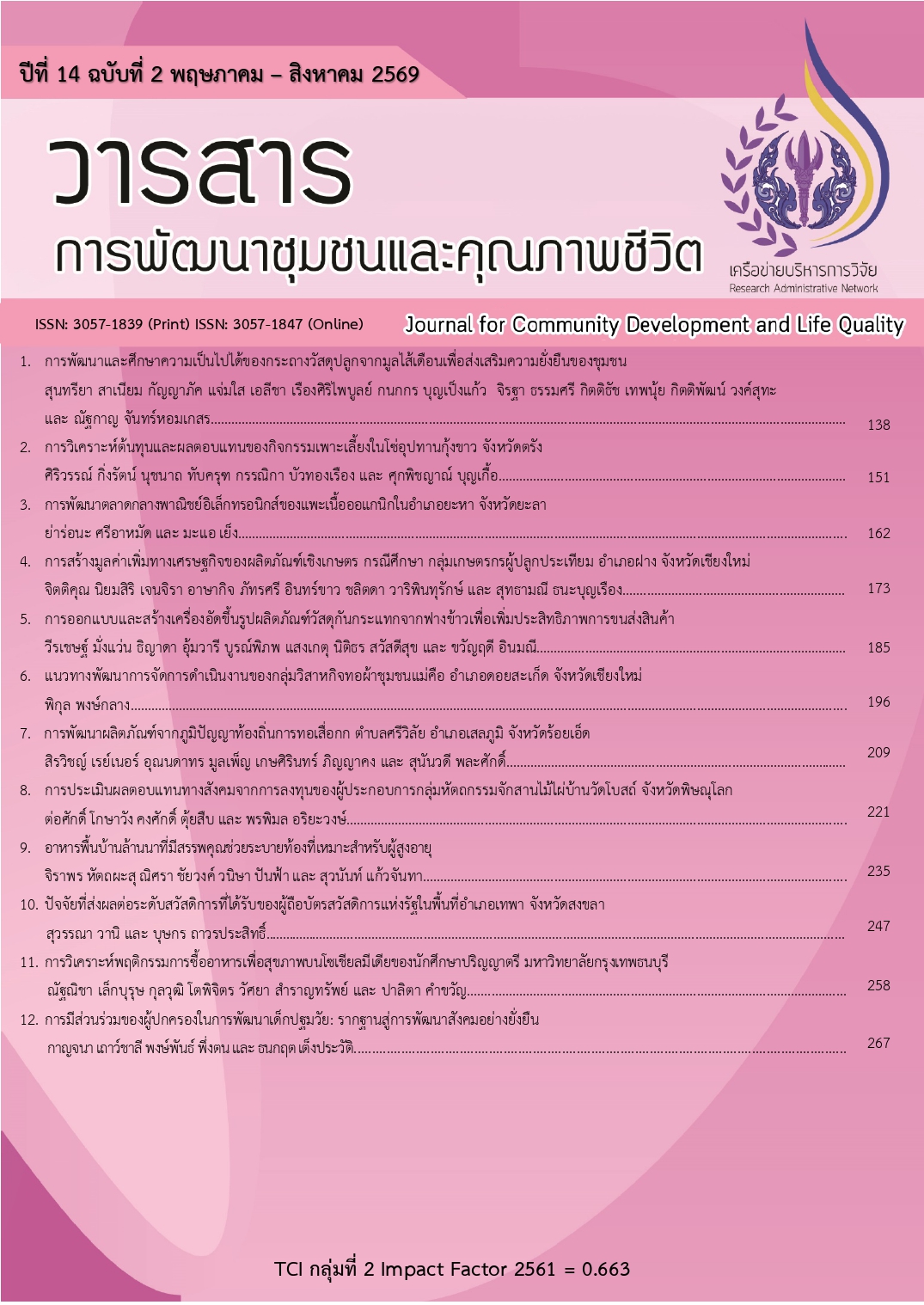
Factors Affecting the Level of Welfare Received by State Welfare Cardholders in Thepha District, Songkhla Province
Keywords:
Welfare Level, state welfare card, Thepha district, Songkhla provinceAbstract
The study of factors affecting the level of welfare received by state welfare cardholders in Thepha district, Songkhla province aimed to 1) study the level of welfare received by state welfare cardholders and 2) identity factors affecting this level of welfare. Data were collected from a sample of 400 respondents. The statistics used for data analysis included percentage, frequency, mean, standard deviation, and ordinal logistic regression. The results found that the overall level of welfare received by state welfare cardholders was high. The highest levels were found in the area of benefits, which was equal to the economic situation, followed by the quality of life and government support, respectively. The factors affecting the level of welfare received by state welfare cardholders were as follows: in the areas of benefits, significant factors were age, marital status, and education level; in the area of quality of life, significant factors were gender, marital status, and education level; in the area of support from the government significant factors were marital status and education level; and in the area of economic situation included marital status, education level, and occupation. All results were statistically significant at the 0.05 level.
References
Che-ubong, I. and A. Chelong. 2024. Quality of life of youth amid unrest in three southern border provinces. Journal for Community Development and Life Quality 12(3): 248-260. (in Thai)
Juthaphiw, R. 2023. Factors influencing the success or failed of implementation of the government welfare card policy. Journal of Social Science and Culture 7(8): 191-200. (in Thai)
Kanmalay, N., M. Sawatwong, T. Chanphong, P. Pholson and N. Kodkong. 2022. State benefit card holders of population. Journal of Legal Entity Management and Local Innovation 8(9): 362-372. (in Thai)
Office of the National Economic and Social Development Council. 2024. Poverty and inequality report 2023. (Online). Available: https://www.nesdc.go.th/wordpress/wpcontent/uploads/2025/04/article_20241003144258.pdf (September 10, 2024). (in Thai)
Office of the Prime Minister. 2024. Report on the monitoring of the civil state welfare project providing assistance through the state welfare card. (Online). Available: http://www.pmi.opm.go.th:8081/inspect_main/uploadfiles/(September 8, 2024). (in Thai)
Porncharoenkitkul, A. 2021. People’s quality of life whom posses state welfare card case study, Don Tum district, Nakhonpathom province. Journal of MCU Buddhapanya Review 6(2): 120-131. (in Thai)
Rakungthong, A. and W. Intaprom. 2024. Implementation of the state welfare card policy by Bangkhen district office, Bangkok. PNRU Academic Journal 3(2): 1-14. (in Thai)
Siriphanpanya, J. 2022. The satisfaction of people with the government welfare card project in Maha Sarakham province. Journal of Research and Development Institute, Rajabhat Maha Sarakham University 9(1): 287-298. (in Thai)
Songkhla Provincial Governor’s Offices. 2024. History and data. (Online). Available: https://www.songkhla.go.th/content/history (October 14, 2024). (in Thai)
Thepha District Agricultural Extension Office, Songkhla Province. 2024. District agricultural development plan, Thepha district, Songkhla province 2023-2027. (Online). Available: https://storage2.me-qr.com/pdf/2aa13a7b-6d09-47bc-9b98-3e6218ec02ab.pdf (October 14, 2024). (in Thai)
Vanichbuncha, K. 2019. Advanced Statistical Analysis with SPSS for Windows. 14th ed. Chulalongkorn University Press, Bangkok. (in Thai)
Yaempai, S. and P. Nakfon. 2019. An evaluation of state welfare policy: A case study Lad Krabang district. Nakhon Lampang Buddhist College’s Journal 8(1): 136-145. (in Thai)
Downloads
Published
How to Cite
Issue
Section
License
Copyright (c) 2026 Journal for Community Development and Life Quality

This work is licensed under a Creative Commons Attribution-NonCommercial-NoDerivatives 4.0 International License.
The Editorial Board claims a right to review and correct all articles submitted for publishing


