
Environmental Attitude and Perceived Behavioral Control Affecting Pro-Environmental Behavior Among Residents in Pathum Thani Province
Keywords:
Environmental attitude, Perceived behavioral control, Pro-environmental behavior, Theory of Planned Behavior, Pathum Thani ProvinceAbstract
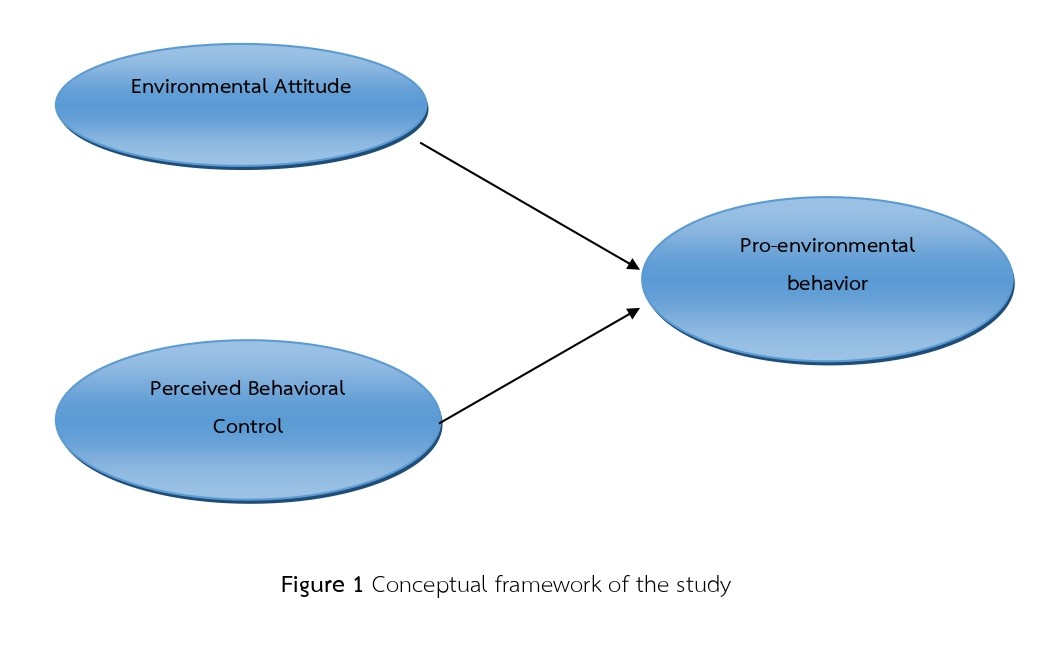
The objectives of this study were to (1) examine the levels of environmental attitude, perceived behavioral control, and pro-environmental behavior among residents in Pathum Thani Province, and (2) analyze the influence of environmental attitude and perceived behavioral control on pro-environmental behavior. This quantitative research employed a five-point Likert-scale questionnaire to collect data from 400 residents selected through purposive sampling. Data were analyzed using descriptive statistics and multiple regression analysis. The results revealed that all variables were at a high level. Environmental attitude and perceived behavioral control significantly influenced
pro-environmental behavior. The regression analysis indicated that environmental attitude (β = 0.48, p < .001) and perceived behavioral control (β = 0.35, p = .001) had significant positive influences on pro-environmental behavior. The model explained 57.2% of the variance in pro-environmental behavior (R² = 0.572). These findings are consistent with Ajzen's (1991) Theory of Planned Behavior, which suggests that attitude and perceived behavioral control are important determinants of actual behavior. The study indicates that promoting environmental values and strengthening individuals' confidence in their ability to perform environmentally responsible actions can enhance sustainable pro-environmental behavior among the public.
References
Ajzen, I. (1991). The theory of planned behavior. Organizational Behavior and Human Decision Processes, 50(2), 179 - 211. https://doi.org/10.1016/0749-5978(91)90020-T
Gadenne, D., Sharma, B., Kerr, D., & Smith, T. (2011). The influence of consumers’ environmental beliefs and attitudes on energy-saving behaviours. Energy Policy, 39(12), 7684 - 7694. https://doi.org/10.1016/j.enpol.2011.09.002
Gao, L., Wang, S., Li, J., & Li, H. (2017). Application of the extended theory of planned behavior to understand individuals energy saving behaviors. in workplaces. Resources, Conservation and Recycling, 127, 107 - 113. https://doi.org/10.1016/j.resconrec.2017.08.030
Hines, J.M., Hungerford, H.R., & Tomera, A.N. (1987). Analysis and synthesis of research on responsible environmental behavior: A meta-analysis. The Journal of Environmental Education, 18(2), 1 - 8. https://doi.org/10.1080/00958964.1987.9943482
Huo, X., Zou, X., Zhang, Y., & Ma, R. (2025). Driving factors of pro-environmental behavior among rural tourism destination residents-considering the moderating effect of environmental policies. Scientific Reports, 15, 7663. https://doi.org/10.1038/ s41598-025-92457-z.
Kinzig, A.P., Ehrlich, P.R., Alston, L.J., Arrow, K., Barrett, S., Buchman, T.G., Daily, G.C., Levin, B., Levin, S., Oppenheimer, M., Ohtrom E., & Saari, D. (2013). Social norms and global environmental challenges: The complex interaction of behaviors, values, and policy. Bio Science, 63(3), 164 - 175. https://doi.org/10.1525/bio.2013.63.3.5
Krejcie, R.V., & Morgan, D.W. (1970). Determining sample size for research activities. Educational and Psychological Measurement, 30(3), 607 – 610. https://doi.org/10.1177/001316447003000308
Lin, Y., Li, J., & Xiang, L. (2022). Exploring the role of green government publicity influencing people’s pro-environmental behaviors. Frontiers in Psychology, 13, 973160. https://doi.org/10.3389/fpsyg.2022.973160
Schwartz, S.H. (1977). Normative influences on altruism. Advances in Experimental Social Psychology, 10, 221 - 279. https://doi.org/10.1016/S0065-2601(08)60358-5
Downloads
Published
How to Cite
Issue
Section
License
Copyright (c) 2026 Journal for Community Development and Life Quality

This work is licensed under a Creative Commons Attribution-NonCommercial-NoDerivatives 4.0 International License.
The Editorial Board claims a right to review and correct all articles submitted for publishing


