
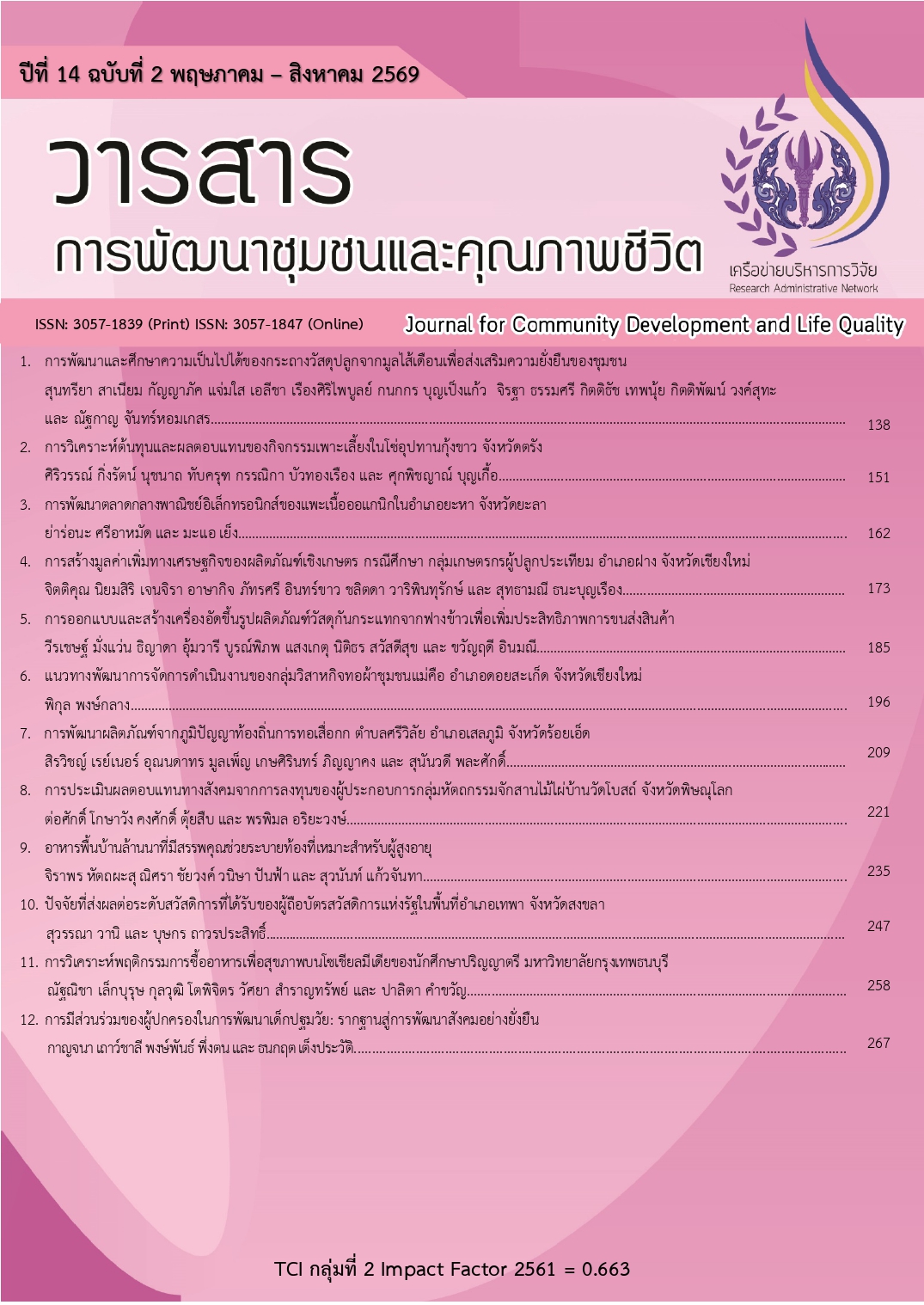
การพัฒนาและศึกษาความเป็นไปได้ของกระถางวัสดุปลูกจากมูลไส้เดือน เพื่อส่งเสริมความยั่งยืนของชุมชน
คำสำคัญ:
มูลไส้เดือน, กระถาง, การพัฒนาผลิตภัณฑ์, ความยั่งยืน, ชุมชนบทคัดย่อ
การวิจัยครั้งนี้มีวัตถุประสงค์เพื่อ 1) พัฒนากระบวนการผลิตกระถางปลูกพืชย่อยสลายได้จากมูลไส้เดือนร่วมกับวัสดุอินทรีย์ ได้แก่ ขุยมะพร้าวและดิน 2) ประเมินคุณสมบัติทางกายภาพ ทางเคมี และการใช้งานเบื้องต้นของกระถางที่พัฒนาขึ้น และ 3) ศึกษาการยอมรับของผู้บริโภคต่อกระถางจากมูลไส้เดือนในฐานะทางเลือกทดแทนกระถางพลาสติกเพื่อส่งเสริมความยั่งยืนของชุมชน โดยใช้รูปแบบการวิจัยแบบผสมผสาน สูตรวัสดุที่เหมาะสมประกอบด้วย มูลไส้เดือน 80 กรัม แกลบ 100 กรัม ขุยมะพร้าว 100 กรัม ดินมาตรฐาน 100 กรัม และแป้งมันสำปะหลัง 200 กรัมเป็นตัวประสาน การวิเคราะห์เชิงปริมาณครอบคลุมการทดสอบคุณสมบัติทางเคมี ได้แก่ ค่าความเป็นกรด–ด่าง (pH) ความชื้น และค่าการนำไฟฟ้า (EC) และการทดสอบคุณสมบัติทางกายภาพ ได้แก่ การสูญเสียน้ำหนักหลังการอบ และความแข็งแรงเชิงกลด้วยเครื่อง universal testing machine พร้อมทั้งทดสอบการเจริญเติบโตของต้นกล้าคะน้าเป็นเวลา 7 วัน ข้อมูลการยอมรับผลิตภัณฑ์จากกลุ่มตัวอย่าง 42 คน วิเคราะห์ด้วยสถิติเชิงพรรณนา ผลการวิจัยพบว่า กระถางจากมูลไส้เดือนมีคุณสมบัติทางเคมีเหมาะสมต่อการเจริญเติบโตของพืช (pH = 7.43, EC = 227 ppm) สามารถรักษาความชื้นได้ดี และมีความแข็งแรงเพียงพอต่อการใช้งานจริง การเจริญเติบโตของต้นกล้าใกล้เคียงกับกลุ่มควบคุม ผู้บริโภคมีการยอมรับผลิตภัณฑ์โดยรวมในระดับยอมรับได้ โดยด้านการอนุรักษ์สิ่งแวดล้อมมีค่าเฉลี่ยสูงสุด (M = 4.55, S.D. = 0.68) สะท้อนศักยภาพของผลิตภัณฑ์ในการย่อยสลายได้ ลดการใช้กระถางพลาสติก และส่งเสริมการใช้ทรัพยากรอย่างยั่งยืนในระดับชุมชน
เอกสารอ้างอิง
Abad, Q. and S. Shafiqi. 2024. Vermicompost: Significance and benefits for agriculture. Journal for Research in Applied Sciences and Biotechnology 3(2): 202-207.
Chantanapelin, S., A. Jaisaleaow and K. Anora, 2023. Marketing strategies for promoting organic community products: A case study of agricultural Product management learning center (farmer's market) in Chiang Rai province. Journal of Community Development and Life Quality 11(2): 123-134. (in Thai)
Edwards, C. A., N. Q. Arancon and R. L. Sherman. 2011. Vermiculture Technology: Earthworms, Organic Wastes, and Environmental Management. CRC Press, Boca Raton, FL.
Geissdoerfer, M., P. Savaget, N. M. P. Bocken and E. J. Hultink. 2017. The circular economy - A new sustainability paradigm? Journal of Cleaner Production 143: 757-768.
Gupta, R., A. Yadav and V.K. Garg. 2014. Influence of vermicompost application in potting media on growth and flowering of marigold crop. International Journal of Recycling of Organic Waste in Agriculture 3: 47, doi: 10.1007/s40093-014-0047-1.
Jaya, J.D., A. Nugroho, M. Elma and S. Sunardi. 2023. Review on biodegradable pot: A new promising approach for sustainable agriculture. AIP Conference Proceedings 2682(1): 030009 doi: 10.1063/5.0118270.
Katiyar, R. B., S. Sundaramurthy, A. K. Sharma, S. Arisutha, A. Pratap-Singh, S. Mishra, R. Ayub, B.H. Jeon and M. A. Khan. 2023. Vermicompost: An eco-friendly and cost-effective alternative for sustainable agriculture. Sustainability 15(20): 14701, doi: 10.3390/su152014701.
Khaldoon, S., J. Lalung, U. Maheer, M. A. Kamaruddin, M. F. Yhaya, E. S. Alsolami, H. S. Alorfi, M. A. Hussein and M. Rafatullah. 2022. A review on the role of earthworms in plastics degradation: Issues and challenges. Polymers 14(21): 4770, doi: 10.3390/
polym14214770.
Pretty, J. 2003. Social capital and the collective management of resources. Science 302(5652): 1912-1914.
Surrage, V. A., C. Lafrenière, M. Dixon and Y. Zheng. 2010. Benefits of vermicompost as a constituent of Growing Substrates Used in the Production of Organic Greenhouse Tomatoes. HortScience 45(10): 1510-1515
United Nations. 2015. Transforming our world: The 2030 agenda for sustainable development. (Online). Available: https://wedocs.unep.org/xmlui/handle/20.500.11822/9824 (January 9, 2025).
ดาวน์โหลด
เผยแพร่แล้ว
รูปแบบการอ้างอิง
ฉบับ
ประเภทบทความ
สัญญาอนุญาต
ลิขสิทธิ์ (c) 2026 วารสารการพัฒนาชุมชนและคุณภาพชีวิต

อนุญาตภายใต้เงื่อนไข Creative Commons Attribution-NonCommercial-NoDerivatives 4.0 International License.
กองบรรณาธิการขอสงวนสิทธิ์ในการตรวจและแก้ไขบทความที่เสนอเพื่อตีพิมพ์ในวารสารการพัฒนาชุมชนและคุณภาพชีวิต
บทความหรือข้อความคิดเห็นใด ๆ ที่ปรากฏในวารสารการพัฒนาชุมชนและคุณภาพชีวิต เป็นวรรณกรรมของผู้เขียนโดยเฉพาะคณะผู้จัดทำไม่จำเป็นต้องเห็นด้วย และไม่ใช่ความรับผิดชอบของมหาวิทยาลัยและคณะผู้จัดทำ / บรรณาธิการ


