
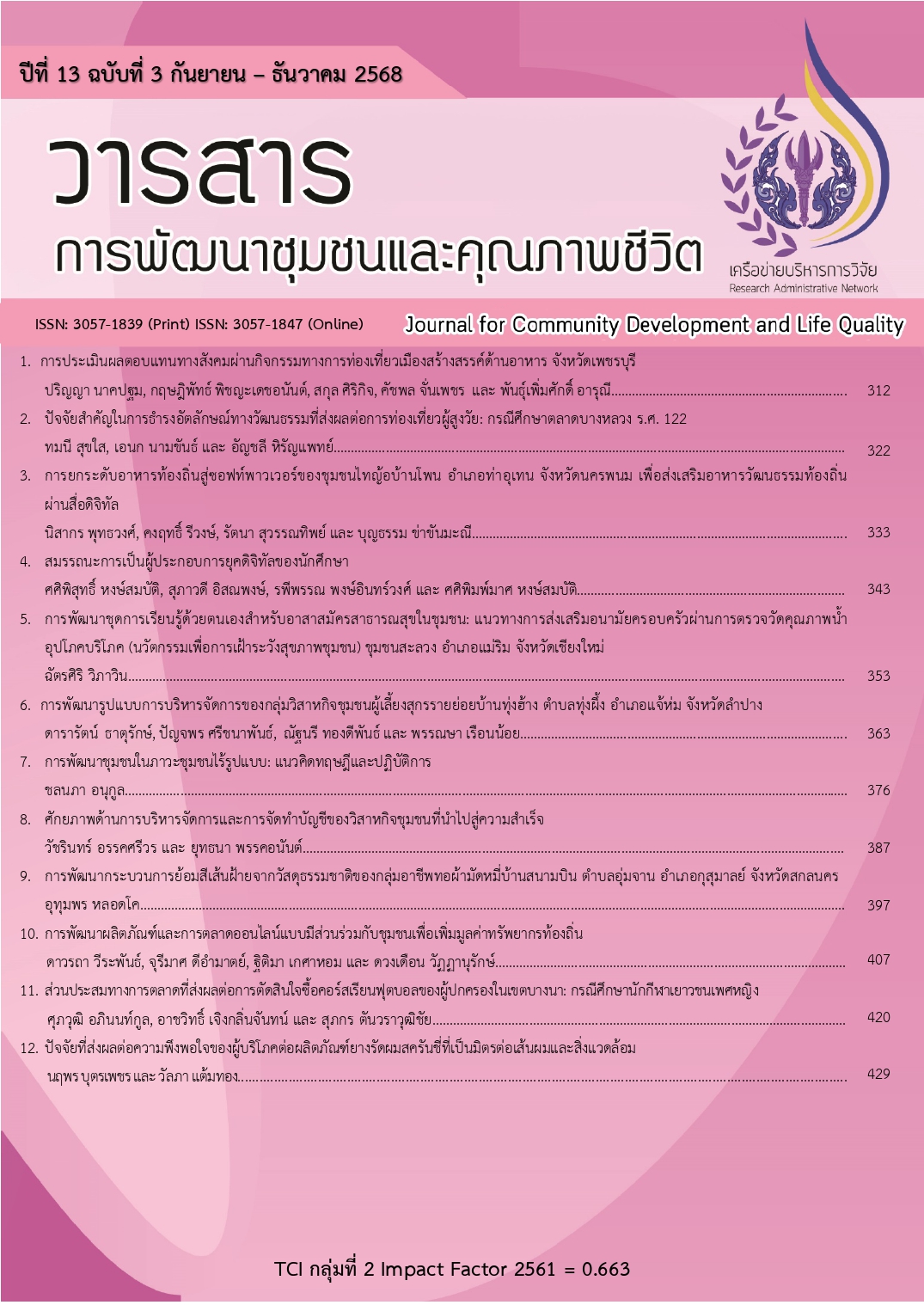
Development of a Self-learning Kit for Community Public Health Volunteers: Strategies for Promoting Family Health through Consumption and Utility Water Quality Assessment (Community Health Surveillance Innovation) in Saluang Community, Mae Rim District, Chiang Mai Province
Article Sidebar
Main Article Content
Abstract
This research aimed to develop a self-learning kit for community health volunteers and to promote family health through the monitoring of domestic water quality in Saluang Community, Mae Rim District, Chiang Mai Province, using a mixed-methods approach. The sample consisted of 40 community health volunteers and 120 households in the community, selected through purposive sampling. The research instruments included the self-learning kit, a knowledge questionnaire, a behavioral assessment form, and a user satisfaction questionnaire. All instruments were validated, with content validity indices ranging from 0.72 to 0.85 and a reliability coefficient of 0.82. The results showed that the self-learning kit significantly enhanced the capacity of health volunteers in water quality analysis. The volunteers were able to accurately and precisely assess water quality. The quality of domestic water in the community was markedly improved, with the proportion of substandard water decreasing from 65.4% to 8.3% after the implementation of the self-learning kit. Moreover, the incidence of gastrointestinal diseases in the community decreased by 78.3%. The innovation received an excellent performance rating, with an average score of 4.85 out of 5, and can potentially be extended to neighboring communities. These findings demonstrate the feasibility of applying this innovation to strengthen the capacity of community health volunteers and sustainably promote community health.
Article Details

This work is licensed under a Creative Commons Attribution-NonCommercial-NoDerivatives 4.0 International License.
The Editorial Board claims a right to review and correct all articles submitted for publishing
References
Chiang Mai Provincial Public Health Office. 2021. Situation report on water in Chiang Mai province. (Online). Available: http://www.chiangmaihealth.go.th (December 15, 2024) (in Thai)
Chutrakul, S. 2022. Development approach for community-based tourism in travel TV shows content in support of community-based tourism. Journal of Community Development and Life Quality 10(1): 35-44. (in Thai)
Department of Health Service Support. 2020. Roles and duties of village health volunteers. Department of Health Service Support, Bangkok. (in Thai)
Department of Environmental Quality Promotion. 2021. Environmental Literacy in Rural Communities: A Practical Guide. Department of Environment Quality Promotion, Bangkok. (in Thai)
Department of Health. 2021. Water quality report in rural areas. Department of Health, Bangkok. (in Thai)
Jaitae, S. 2024. Household wastewater management of people in Mae Lor Watersheds, Mae Rim District, Chiang Mai Province. Advanced Science Journal 24(2): 137-147. (in Thai)
Jewjinda, B. 2018. The development model Village Health Volunteers (VHV) with Participation. Journal of Administrative and Management 6(2): 1-9 (in Thai)
Knowles, M.S. 1984. Self - directed learning A neglected species. (3rd. ed). Houston: Gulf Publishing Co,.
National Health Commission Office. 2022. Community health innovation. National Health Commission Office, Bangkok. (in Thai)
Nutchanart, N. 2018. A Competencies development of the village health volunteers of Suphan Buri Province. Journal of MCU Peace Studies 6(2): 769-779. (in Thai)
Saluang Health Promoting Hospital. 2022. Preliminary survey report on household water quality in Saluang subdistrict, Mae Rim district, Chiang Mai province. Saluang Health Promoting Hospital, Chiang Mai (in Thai)
Thanomthap, N. 2025. The effect of the potential development program for village health volunteers by applying the self-efficacy theory and social support on health behavior of village health volunteers in Kong Thu Subdistrict, Nong Phai District, Phetchabun Province. Primary Health Care Journal (Northern Region) 35(1): 19-31. (in Thai)
Thianjuruwatthana, W. 2021. Office of the permanent secretary for public health, Ministry of public health. Journal of Health Science 30(2): 353-366. (in Thai)
World Health Organization (WHO). 2022. Drinking water. (Online). Available: https://www.who.int/news-room/fact-
sheets/detail/drinking-water (December 15, 2024).
