
Comparison of Active Ageing in Ageing Society in a Community in Metropolitan Province
Article Sidebar
Main Article Content
Abstract
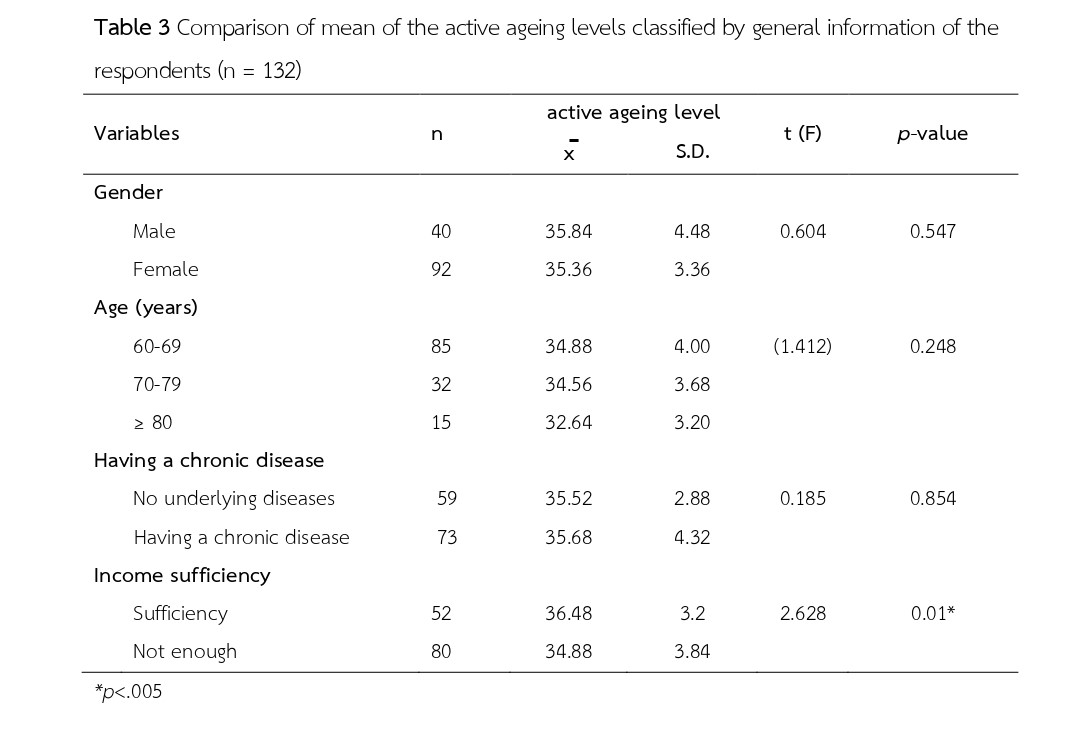
This research aimed to 1) study the active ageing of the elderly in a community in Nonthaburi province and 2) compare the active ageing of the elderly in the same community, based on their personal information. The sample group consisted of 132 older people in a community in Nonthaburi province. The research instrument was a questionnaire developed by the researcher based on the concept of active ageing. Data were analyzed using percentage, mean, standard deviation, t-test, and ANOVA (F-test). The research results found that the overall level of active ageing of the elderly was at a moderate level (x̅ = 2.22, S.D. = 0.52), with the dimensions of health, participation and conditions conducive to active ageing dimensions at a moderate level (x̅ = 2.32, S.D = 0.77; x̅ = 2.43, S.D = 0.52 x̅ =1.63,S.D. = 0.39, respectively), while the security dimension was at a high level (x̅ = 2.60,S.D. = 0.29). When comparing the active ageing of the elderly by gender, age and presence of a chronic disease, it was found that there were no differences, but the elderly with sufficient income had significantly higher active ageing scores than those with insufficient income at the statistical level of 0.05 (P<0.05).
Article Details

This work is licensed under a Creative Commons Attribution-NonCommercial-NoDerivatives 4.0 International License.
The Editorial Board claims a right to review and correct all articles submitted for publishing
References
Benjapongs, S., Chaowsangrat, C., & Samart, P. (2024). Active ageing: concept review under the context of Thailand. Rajapark Journal 18 (61), 504 - 515. https://so05.tci-thaijo. org/index.php/RJPJ/article/view/274194
Best, J. W. 1977. Research in Education. (3rd ed.). NJ: Prentice-Hall.
Chananin, Y., Jullamate, P., & Piphatvanitcha, N. (2020). Active ageing among community dwelling older adults in Ubon Ratchathani province. Nursing Journal of The Ministry of Public Health, 30(2), 83 - 92. https://he02.tci-thaijo.org/index.php/tnaph/article/view/244864
Chansarn, S. (2012). Active ageing of Thai elderly people, the demographic dividends and Thailand’s economic prospect in an ageing society. Srinakharinwirot Research and Development Journal of Humanities and Social Sciences, 4(7), 201 - 214. https://so04.tci-thaijo.org/index.php/swurd/article/view/32504
Fahamnuaypol, P. (2023, July). Development of active ageing assessment tool for the Thai elderly. https://thainhf.org/wpcontent/uploads/2020/11/
Insin, N., Vongsawat, K., Wangtaha, S., Senagung, Y., Weanwan, C., & Tatong, T. (2021). Active ageing of older adults in Amphoe Mueang Sakhon Nakhon. Journal for Public Health Research, 14(3), 94 - 103. https://he01.tci-thaijo.org/index.php/ kkujphr/article/view/247423
Jantapo, A., & Kusoom, W. (2021). Lifestyle and cultural factors related to longevity among older adults in the northeast of Thailand. Journal of Transcultural Nursing, 32(3), 248 - 255. https://doi.org/10.1177/1043659620921225
Krejcie, R. V., & Morgan, D.W. (1970). Determining sample size for research activities. Educational and Psychological Measurement, 30(3), 607 - 610. https://doi.org/10. 1177/001316447003000308
Kunjaethong, K., Auemaneekul, N., Amnatsatsue, K., Rawiworrakul, T., & Satitvipawee, P. (2019). Factors related to active aging in Surin province. Journal of Public Health Nursing, 33(3), 78 - 94. https://he01.tci-thaijo.org/index.php/phn/article/view/241695
Makmai, P. (2022). Exercise behaviors of elderly people in Maetor subdistrict, Maueng district, Tak province. Academic Journal of Community Public Health, 8(1), 60 - 72. https://he02.tci-thaijo.org/index.php/ajcph/article/view/253397
Malai, C., Sritarapipat, P., Duangchinda, A., & Wanchai, A. (2024). Active aging among older persons in aged society of the area based context of Thailand: A situational analysis of Chai Nat province in central region of Thailand. Journal of Nursing and Health Science Research, 16 (1), e268710. https://he01.tci-thaijo.org/index.php/unc/article/view/e268710
National Statistical Office. (2014). Preliminary results on the elderly population survey in Thailand. Population Division, Bureau of Social Statistic.
National Statistical Office. (2017). September 26). Active ageing index of Thai elderly. https://www.nso.go.th/nsoweb/nso/survey_detail/92
Podhisita, C. (2009). Prelude. What happened to the Thai family? In Podhisita, C., & Thaweesit, S. (eds.). “The Thai Family" in the Context of Socialand Demographic Transition. (p. 1-15). Institute of Population and Social Research, Mahidol University, Nahkon Pathom.
Pradubmook Sherer, P., Theerasilp, U., & Phetchai, P. (2023). The elderly’s life situations and determinants of elderly violence: The quantitative survey in 5 provinces. Journal of Roi Kaensarn Academi, 8(5), 472 - 489. https://so02.tcithaijo.org/index.php/JRKSA/article/view/260219
Saengprachaksakula, S. (2015). The determinants of Thai active ageing level. Journal of Social Sciences and Humanities Research in Asia, 21(1), 139 – 167. https://so05. tci- thaijo.org/index.php/psujssh/article/view/43397
Soonthorndhada, K., & Khumsuwan, K. (2010). Level and trend of Thai active ageing. Proceeding of the National Conference on Demography. (p. 26 – 38). Thai Population Association, Nakhon Pathom.
World Health Organization (2002). Active Ageing: A Policy Framework. Author.
