
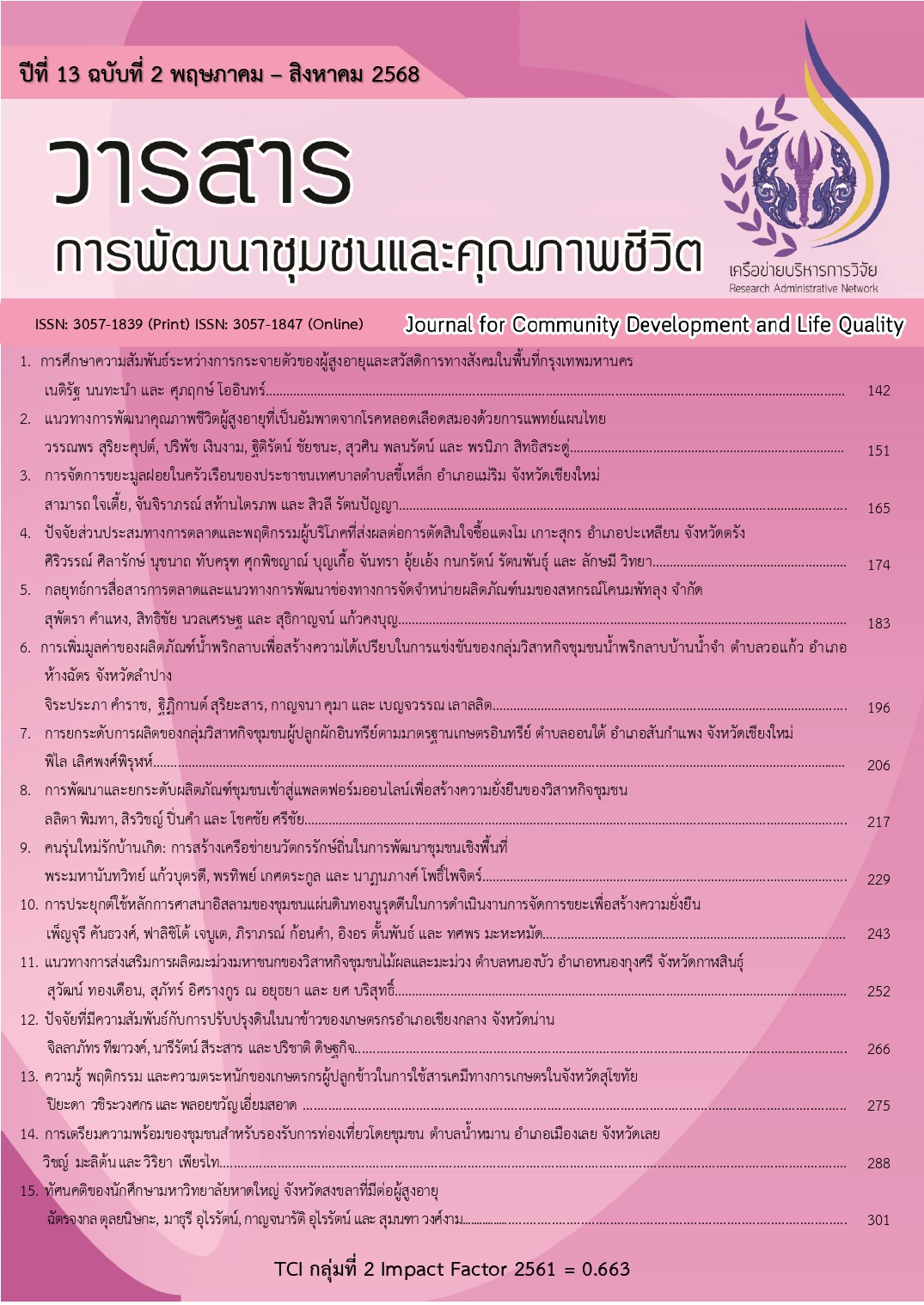
People’s Household Waste Management in Keelek Subdistrict Municipality, Mae Rim District, Chiang Mai Province
Keywords:
Household waste, management, peopleAbstract
The purpose of using mixed methods was to examine the utilization of and participation in the conservation of wild edible plants. Sample size was 382 households and 37 Interested people in Keelek Subdistrict municipality, Mae Rim district, Chiang Mai province. Data collected by questionnaires, non-structured interviews and focus group were administered. Data was analyzed by descriptive statistics, correlation analysis and content analysis. It was found that the public lacks support for equipment in household waste management, and the mechanisms to promote the utilization of waste have not been effectively implemented. Overall, the public's household waste management is at a moderate level (mean = 2.18 ± 0.32). The influencing factors are the age (r= - 0.112, P–value = 0.046) and monthly household income (r= 0.146 P–value = 0.011) that were significantly household waste management. Stakeholders have suggested activities to support the provision of equipment for the collection and sorting of waste, utilizing waste for income generation and agricultural benefits, as well as enhancing public knowledge on waste utilization.
References
Adefris, W., S. Damene and P. Satyal. 2023. Household practices and determinants of solid waste segregation in Addis Ababa city, Ethiopia. Humanities and Social Sciences Communications 10: 516, doi:10.1057=/s41599-023-01982-7.
Cataldo, N.L., M. Oyinlola, S. Sigdel, D. Nguyen and A. Galligo-Schmid. 2024. Waste management in Nepal: Characterization and challenges to promote a circular economy. Circular Economy and Sustainability 4: 439-457.
Chaiyarit, J. and P. Intarasaksit. 2021. Factors influencing appropriate management of household waste in developing country. Asia-Pacific Journal of Science and Technology 26(01): APST-26-01-06.
Cronbach, L.J. 1951. Coefficient alpha and the internal structure of tests. Psychometrika 16: 297-334.
Daniel, W. W. 2010. Biostatistics:Basic Concepts and Methodology for the Health Sciences 9th ed. John Wiley & Sons, Hoboken, NJ.
Fadhullah, W., N.I.N. Imran, S.N.S. Ismail, M.H. Jaafar and H. Abdullah. 2022. Household solid waste management practices and perceptions among residents in the East Coast of Malaysia. BMC Public Health 22: 1, doi:10.1186/s12889-021-12274-7.
Jaitae, S. 2015. Knowledge in vegetables safety factors management of famers: Saluang - Keelek, Maerim district, Chiangmai province. RMUTI Journal Humanities and Social Sciences 2(1): 59-66. (in Thai)
Jaitae, S., S. Rattanapunya, J. Stantripob and E. Tajai. 2023. Review of health impact assessment guidelines for municipal solid waste management for local administrative organizations. Advanced Science Journal 23(1): A11-A26. (in Thai)
Kayode A.M. and F.K. Omole. 2011. Some socio-economic factors affecting solid wastes generation and disposal in Ibadan Metropolis, Nigeria. Journal of Environmental Issues and Agriculture in Developing Countries 3(1): 55-64.
Kunta, K. and Nophaket, N. 2018. Waste management using the philosophy of sufficiency economy in Phra Samut Chedi district, Samut Prakan province. Journal of Community Development and Quality of Life 6(3): 497 – 524. (in Thai)
Phattharaphakinworakun, A., T. Intajak and P. Khongsri. 2023. Factors predicting household behaviors on management of solid waste reduction by pakhayo ethnic group in Mae Hong Son, Thailand. Journal of Southern Technology 16(1): 88-98. (in Thai)
Pottinger-Glass, C., F. Vanhuyse, R. Asvanon and D. Archer. 2022. Household waste and the circular economy in Bangkok. SEI policy report: Stockholm Environment Institute. Stockholm. 12p.
Sirikhaeng, P. and J. Proarmat. 2024. The knowledge, behaviors, and active participation of residents in the domestic waste management at Ban Piman, Village No. 3, Piman subdistrict, Na Kae district, Nakhon Phanom province. Journal of Nakhon Phanom Provincial Health Office 2(1): 2267875. (in Thai)
Sudcharee, K., N. Turnbull and T. Phajan. 2019. Factors of associated with solid waste management in community of administrative organization Tambon Nong Kham, At Samat district, Roi–Et province. Mahasarakham Hospital Journal 16(2): 13-22. (in Thai)
Sukyang, T., R. Sillaparassamee and T. Chusak. 2024. Factors associated with behavior of household hazardous waste segregation in Na Mueang Petch sub-district, Sikao district, Trang province. Singburi Hospital Journal 33(1): B1-B10. (in Thai)
Treesoon, T. and C. Charoensap. 2018. Administration rubbish kitchen behaviour of people in administrative organization of Tombon Chumphae, Muang Chumphae, Khorn Kaen province. Journal of Mani Chettha Ram Wat Chommani 1(2): 22-29. (in Thai)
Thanawaro, P.S., P. Chimhad and D. Khaenamkhaew. 2021. Guidelines of household solid waste management. Journal of Human Society 11(2): 80-96. (in Thai)
Yapang, P., S. Jaitae and S. Rattanapunya. 2023. Knowledge, attitude and practice for solid waste management with zero waste concept of Thung Hua Chang subdistrict municipality, Thung Hua Chang district, Lamphun province. Journal for Social Sciences Research 14(2): 36-49. (in Thai)
Downloads
Published
How to Cite
Issue
Section
License
Copyright (c) 2025 Journal for Community Development and Life Quality

This work is licensed under a Creative Commons Attribution-NonCommercial-NoDerivatives 4.0 International License.
The Editorial Board claims a right to review and correct all articles submitted for publishing


