
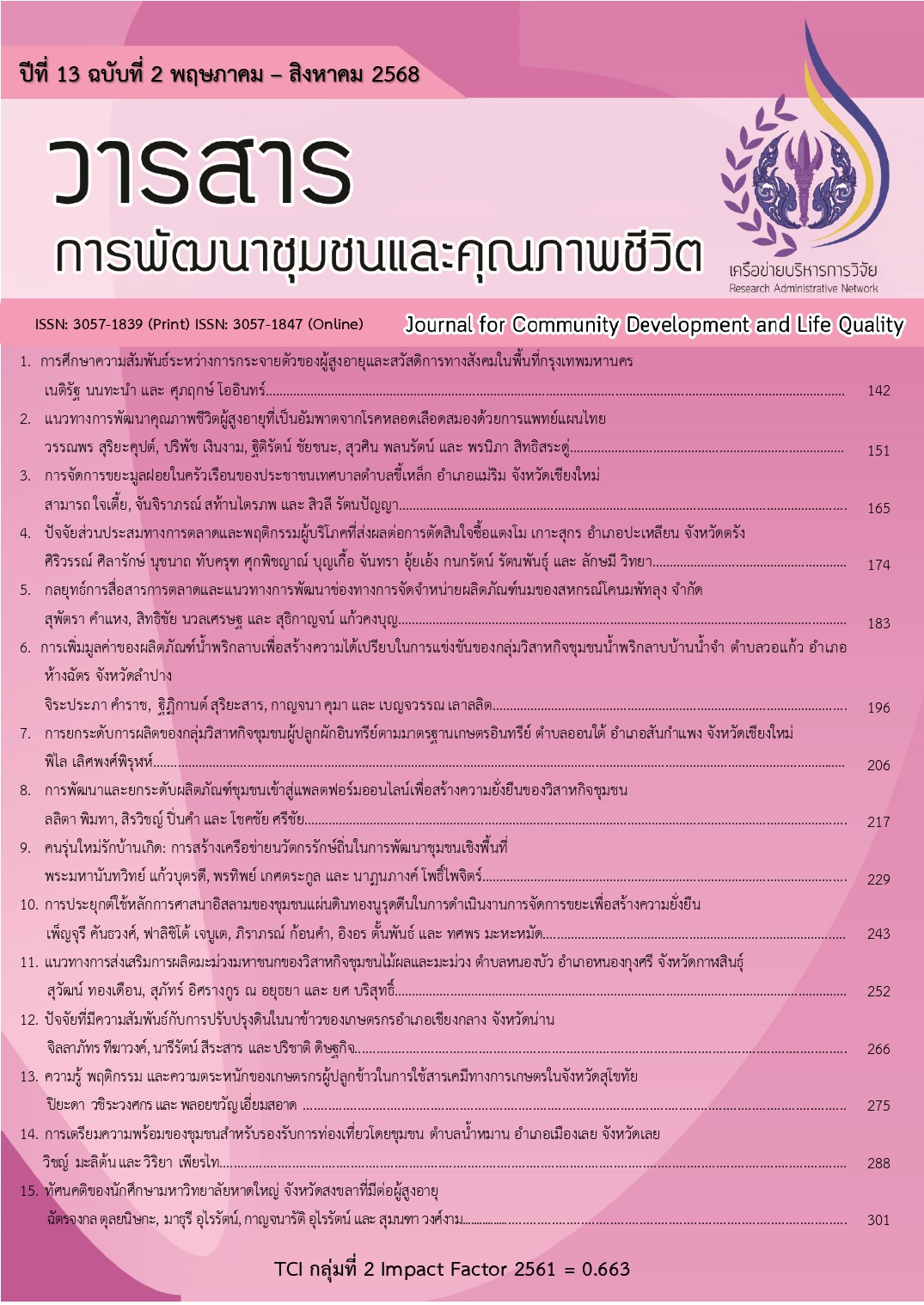
Application of Islamic Principles of Phaen Din Thong Nuruddeen Community to Conducting Sustainable Waste Management
Keywords:
Waste management, principles of Islam, SustainabilityAbstract
This research aims to study the application of Islamic principles to waste management in the Phaen Din Thong Nuruddeen community, focusing on environmental sustainability and reducing waste that impacts the community. This action research study used in-depth interviews, focus group discussions, and observations to collect data about community waste management. The research findings show that the community can apply Islamic principles such as *Khalifah* (stewardship of the earth) and *Ihsan* (doing good) to waste segregation, reducing resource waste, and recycling. This resulted in reduced community waste and increased recycling by approximately 20%. Furthermore, community member participation in waste management and the application of Islamic principles to waste management in the Phaen Din Thong Nuruddeen community proved to be an effective approach for promoting environmental sustainability. Community members were able to apply religious principles to practical operations thereby fostering sustainable participation and environmental conservation.
References
Achmad, F. S. 2022. Waste management an Islamic perspective. Journal of Advanced Research in Social Sciences and Humanities 7(4): 164-174.
Foltz, R.C. 2003. Does nature have historical agency? World history, environmental history, and how historians can help save the planet. The History Teacher 37(1): 9-28
Ismail, A. 2016. Islamic approach on public awareness campaign of solid waste management. Journal of Contemporary Islamic Studies 2(2): 55-74.
Kula, E. 2001. Islam and environmental conservation. Environmental Conservation 28(1): 1-9.
Nusran, M., H. Hasibuddin, A. Darmawangsa, A. Ardi, A. Henny, Y. Herdianzah and N. I. Safutra. 2023. Halal aware community model based on Masjid: Analysis of level of care, awareness, and satisfaction of Muslim tourists in Makassar. Journal of Industrial Engineering Management 8(1): 79-85.
Pollution Control Department. 2021 Thailand state of pollution report 2019. (Online). Available: https://www.pcd.go.th/publication/10650/(April 4, 2024) (in Thai)
Saniotis, A. 2012. Muslims and ecology: Fostering Islamic environmental ethics. Contemporary Islam 6(2): 155-171.
Sirisawat, K.M and S. Suwan. 2024. Developing community learning resources in the modern world. Journal of community development and life Quality 12(3): 201-211. (in Thai)
Tucker, M. E., and J. A. Grim. 2001. Introduction: the emerging alliance of world religions and ecology. Daedalus 130(4): 1-22.
Yahprung, M.I. 2022. The constitutional process in the conflict resolution between state and minority: A study of the role of religious leaders in the democratic process in the southern border provinces of Thailand. Journal of Humanities and Social Sciences Prince of Songkla University 18(1): 10-47. (in Thai)
Downloads
Published
How to Cite
Issue
Section
License
Copyright (c) 2025 Journal for Community Development and Life Quality

This work is licensed under a Creative Commons Attribution-NonCommercial-NoDerivatives 4.0 International License.
The Editorial Board claims a right to review and correct all articles submitted for publishing


