
Waste Management Guidelines for Lampang Provincial Administrative Organization: A Case Study of Pichai Town Municipality
Keywords:
Community wastes management, beginning wastes, midway wastes, end-point wastes, Pichai Town municipalityAbstract
This research aims to investigate and derive insights from waste management scenario in Pichai Town municipality, Lampang Province. Employing a qualitative research approach, the study involved two distinct sample groups: 1) municipal officials responsible for waste management; and 2) community leaders and representatives, totaling 58 participants. Data collection employed in-depth interviews and focus group sessions, with subsequent analysis and presentation of findings grounded in inductive reasoning. It was found that key success factors in waste management must involve handling waste across various stages, from initiation to completion. The outcomes not only contribute valuable insights but also identify community scholars capable of disseminating knowledge to other locales, fostering the creation of a waste-free community network. Recommendations include strengthening collaboration with provincial administrative bodies and private sectors, developing environmental education initiatives in partnership with other agencies, and proposing policy enhancements to elevate the overall level of solid waste management. The study underscores the importance of disseminating lessons widely and advocates for the establishment of a sustainable waste management model.
References
Atthakorn, S. 2016. Management: its body of knowledge and the development of theoretical model. Panyapiwat Journal 8(2): 215–226. (in Thai)
Boonyawat, W. 2020. Community participatory waste management of community prototype, “Muang Wan community (Sam Sun Huda Mosque)”, Mahaphram sub-district Bang Ban district, Phra Nakhon Si Ayutthaya. Integrated Social Science Journal, Mahidol University 7(1): 116–134. (in Thai)
Community Development Department. 2017. Guidelines for Establishing and Developing Professional Groups. Community Development Department, Bangkok. 31 p. (in Thai)
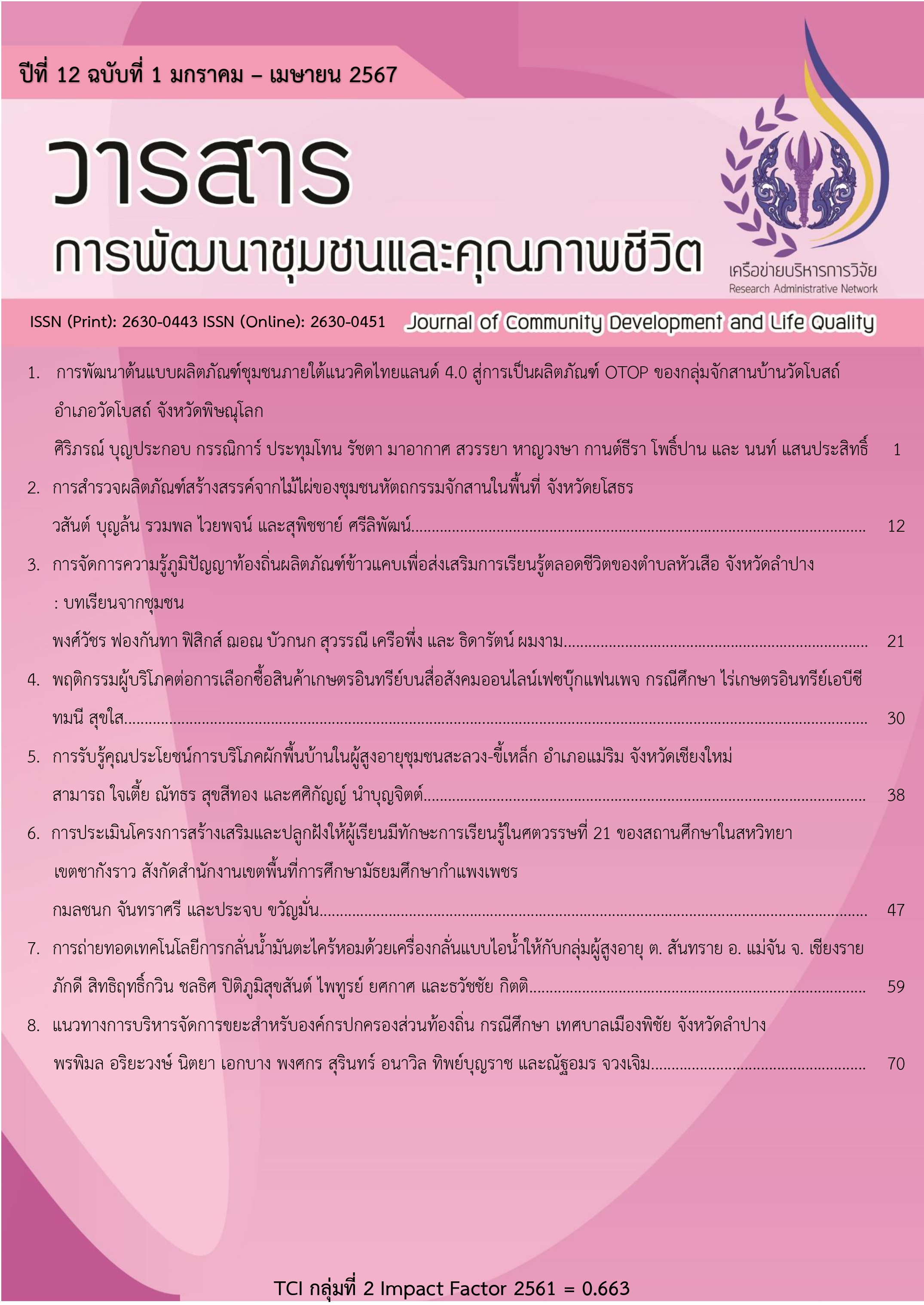
Department of Environmental Quality Promotion. 2019. Community Based Solid Waste Management: CBM. Department of Environmental Quality Promotion, Bangkok. 34 p. (in Thai)
Department of Local Administration and Pollution Control Department. 2016. Action plan “Thailand Zero Waste” according to the Participatory “Civil State” Principle 2016 - 2017. Department of Local Administration and Pollution Control Department. Bangkok. 34 p. (in Thai)
Faijumpa, A. 2020. The model development of participation waste management in Jomsi sub-district Administrative Organization, Chiangkhan district Loei province. Journal of Council of Community Public Health 2(1): 1-17. (in Thai)
Incharoen, S., V. Tanvatanakul, K. Rudtanasudjatum and W. Sipon. 2020. Studies related to inspection of municipal solid waste management in Thailand, compared with foreign countries: A systematic review. The Southern College Network Journal of Nursing and Public Health 7(2): 152-166. (in Thai)
Kinnares, P. 2021. Development of participatory waste management model in the cultural tourism of Wat Mahathat community Nakhon Phanom province. Journal of Community Development and Life Quality. 9(3): 366–376. (in Thai)
Kongjun, S., P. Mahasatto, T. Duangpansing,T. Sujaree, and P. Phosing. 2021. Integrated management model of community-based waste. Panya journal 28(2): 137-153. (in Thai)
Office of the National Economic and Social Development Council. 2017. The 12th National Economic and Social Development Plan (2017-2021). Office of the National Economic and Social Development Council, Bangkok. 215 p. (in Thai)
Pollution Control Department. 2016. The Master Plan on National Solid Waste Management B.E. 2559-2564. Pollution Control Department, Bangkok. 238 p. (in Thai)
Pollution Control Department. 2018. Operational manual for 3r (reduce, reuse, recycle) community waste management. Pollution Control Department, Bangkok. 20 p. (in Thai)
Pollution Control Department. 2022. National waste management plan, 2nd edition (B.E. 2565 - 2570). (Online). Available: https://www.pcd.go.th/publication/28745 (July 05, 2023). (in Thai)
Pollution Control Department. 2023. Report on the situation of community solid waste management facilities in Thailand, year 2022. (Online). Available: https://www.pcd.go.th/publication/29509 (July 05, 2023). (in Thai)
Promsit, S. 2019. The large, middle and small sizes of municipality waste management of local government organization in northeast region of Thailand. NEU Academic and Research Journal 9(1): 67–81. (in Thai)
Promsit, S., V. Sanpugdee, S. Kenaphoom, and P. Chaiseeha. 2019. The waste management model and the suitability of the local government organization. Journal of Graduate MCU KhonKaen Campus 6(2): 459–483. (in Thai)
Sankum, P. and N. Sanphoti. 2022. Key success factors in solid waste management of the local government organization at Nakhon Phanom province. UBRU Journal for Public Health Research 11(2): 165–175. (in Thai)
Taweethomjarean, T. 2010. A study of community lifestyle based on the concepts of the social structure theory and community theories. University of the Thai Chamber of Commerce Journal 30(1): 104-116. (in Thai)
Thanawaro (Thipbunthong) P. S., P. Chimhad and D. Khaenamkhaew. 2021. Guidelines of household solid waste management. Journal of Human Society, Nakhon Si Thammarat Rajabhat University 11(2): 80–96. (in Thai)
Thuvanuti, P. and W. Phueakbuakhao. 2018. Waste management guielines of mueang municipality of Prachuab Khiri Khan. Kasem Bundit Journal 19(2): 141-149. (in Thai)
Tongkum, S. and S. Chenchan. 2019. Supply chain management of solid waste of Phaniat sub district, Khok Samrong district, Lopburi province. Journal of Community Development and Life Quality. 7(1): 105–114. (in Thai)
Downloads
Published
How to Cite
Issue
Section
License
Copyright (c) 2024 Journal of Community Development and Life Quality

This work is licensed under a Creative Commons Attribution-NonCommercial-NoDerivatives 4.0 International License.
The Editorial Board claims a right to review and correct all articles submitted for publishing


