
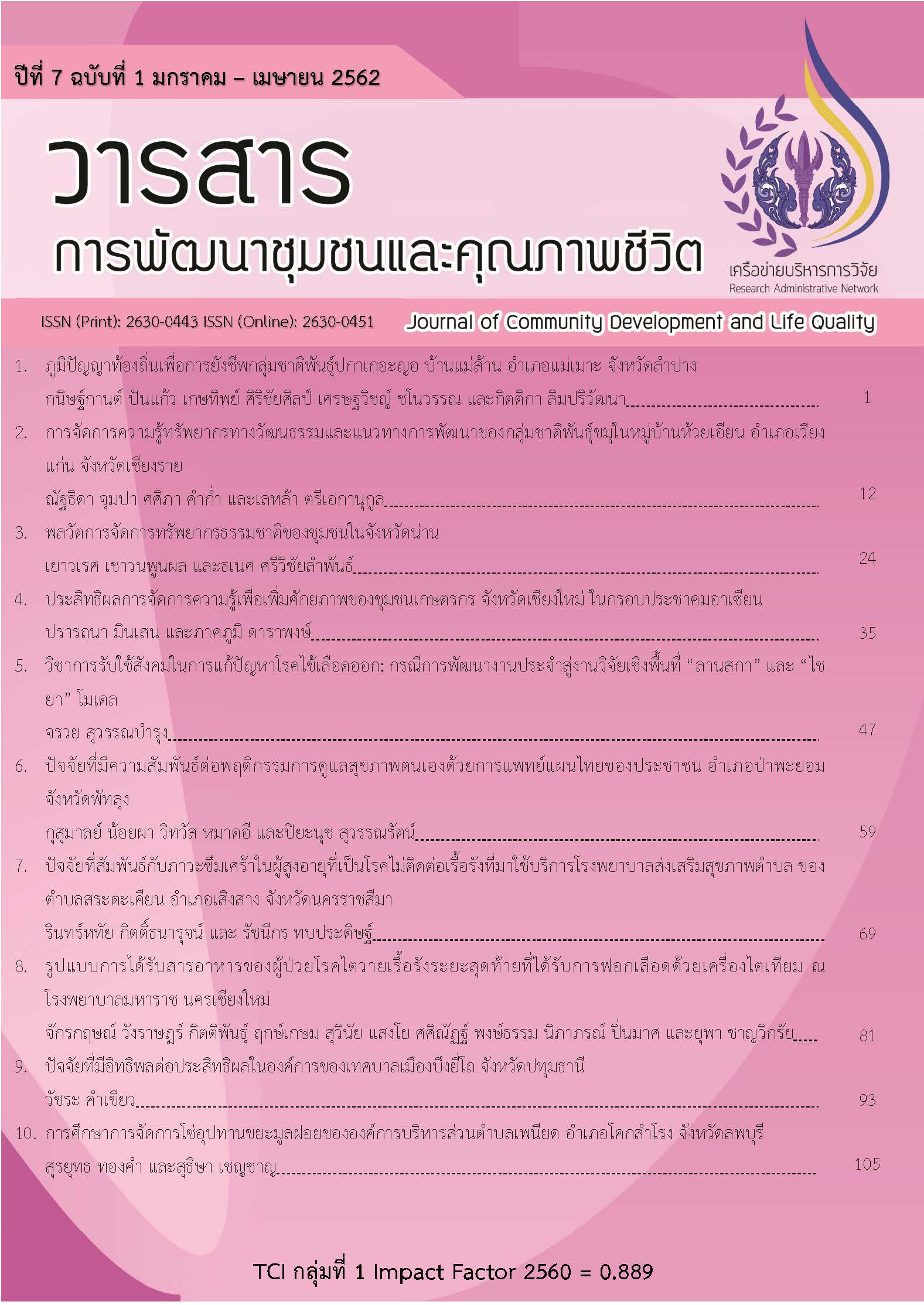
The Factors Related to Depression of the Elders Who Had Non-Communicable Diseases in Health Promoting Hospital, Satakien, Soeng-sang, Nakhonratchasima Province
Article Sidebar
Main Article Content
Abstract
This research aims to : 1) the level of depression among the elderly are chronic non-communicable diseases on the Service Health Promotion Hospital District 2) study the relationship between personal factors. Physical health and social depression in the elderly are chronic non-communicable diseases on the Service Health Promotion Hospital District 3) study the predictive power of individual factors. Physical health and social depression in the elderly is chronic non-communicable diseases at the health district hospitals. The subjects of this study include the elderly, both male and female 275 people can talk communication. No impaired cognition. And is used in hospitals to promote health. District Swimming Showcase Soeng Sang, Nakhon Ratchasima. The researchers used health assessment of older people and a measure of depression among the elderly of Thailand (Thai Geriatric Depression Scale : TGDS) is a tool used in the research. Check the reliability of the questionnaire using the coefficient alpha of Akron destinations is equal to 0.679 Data were analyzed using descriptive statistics. Pearson's correlation coefficient. And multiple regression analysis The research found that The elderly in the parish pool Showcase is depressed percent, 41.45, no depression, 58.5 percent were depressed, a 29.8 percent depression mediocre 10.5 percent and depression is 1.1 percent of personal factors did not correlate with depression. Sadly the elderly Health factors that are associated with depression were statistically significant at the 0.05 level, including medical and health perception are correlated with depression among the elderly. A correlation coefficient of 0. If there are 198 elderly people with underlying health conditions and perceived levels will suffer depression at a high level as well. Social health factors that are associated with depression were statistically significant at the 0.05 level, including the right to maintain a positive relationship with depression in the elderly. A correlation coefficient of 0.134 shows that if the right treatment is highly problematic to cause depression. The variables that can predict depression. A significant statistical factors, including the financial aspects. Family relationship Medical care and the right, which could predict depression was 35.0 percent, a statistically significant level of 0.05 (= 0.350, p < .05). 134 provides that if the issue is high on the right treatment, it can cause depression. The variables that can predict depression. A significant statistical factors, including the financial aspects. Family relationship Medical care and the right, which could predict depression was 35.0 percent, a statistically significant level of 0.05 (= 0.350, p < .05). 134 provides that if the issue is high on the right treatment, it can cause depression. The variables that can predict depression. A significant statistical factors, including the financial aspects. Family relationship Medical care and the right, which could predict depression was 35.0 percent, a statistically significant level of 0.05 (= 0.350, p < .05).
Article Details
The Editorial Board claims a right to review and correct all articles submitted for publishing
References
2. กัตติกา ธนะขว้าง. 2558. การวิจัยภาวะซึมเศร้าในผู้สูงอายุโรคเบาหวานในประเทศไทย. นครราชสีมา : สำนักวิชาพยาบาลศาสตร์ มหาวิทยาลัยเทคโนโลยีสุรนารี, นครราชสีมา. 144 หน้า.
3. กาญจนา ไทยเจริญ. 2543. ปัจจัยที่เป็นตัวทำนายภาวะสุขภาพจิตของผู้สูงอายุในจังหวัดชลบุรี. วิทยานิพนธ์ปริญญาพยาบาลศาสตร์มหาบัณฑิต. สาขาวิชาการพยาบาลผู้สูงอายุ. บัณฑิตวิทยาลัย. มหาวิทยาลัยบูรพา, ชลบุรี. 126 หน้า.
4.ชัดเจน จันทรพัฒน์. 2543. ความสัมพันธ์ระหว่างปัจจัยคัดสรรกับภาวะซึมเศร้าของผู้สูงอายุในโรงพยาบาล. วิทยานิพนธ์พยาบาลศาสตร์มหาบัณฑิต. บัณฑิตวิทยาลัยมหาวิทยาลัย สงขลานครินทร์, สงขลา. 131 หน้า.
5. ปราโมทย์ วังสะอาด. 2530. ปัจจัยที่มีความสัมพันธ์ต่อสุขภาพจิตของผู้สูงอายุในเขตเทศบาลเมืองกาฬสินธุ์. วิทยานิพนธ์ปริญญาศึกษาศาสตร์มหาบัณฑิต. สาขาวิชาประชากรศึกษาบัณฑิตวิทยาลัย. มหาวิทยาลัยมหิดล, กรุงเทพฯ. 97 หน้า. ุ
6. สุจรรยา แสงเขียวงาม. 2560. ปัจจัยที่สัมพันธ์กับภาวะซึมเศร้าในผู้สูงอายุที่เป็นโรคไม่ติดต่อเรื้อรังที่มาใช้บริการในโรงพยาบาลส่งเสริมสุขภาพ ตำบลบึงคำพร้อย หมู่ 11 อำเภอลำลูกกา จังหวัดปทุมธานี. คณะพยาบาลศาสตร์วัชรพล มหาวิทยาลัยเวสเทิร์น, ปทุมธานี. 221 หน้า.
7. Archana Singh and Nishi Misra. 2009. Depression and Sociability in old age. Ind PsychiatryJ. Jan-Jun; 18(1): 51-55.
8. Fiske, A. Wetherell, JL. and Gatz, M. 2009. Depression in older adults. Annu Rev ClinPsychol. 5 : 363-89.
9. SangNam Ahn, Seonghoon Kim and Hongmei Zhang. 2017. Changes in Depressive Symptoms Older Adults with Multiple Chronic Condition : Role of Positive and Negative Social Support. Int J Environ Res Public Health. 14(1) : 16.
