
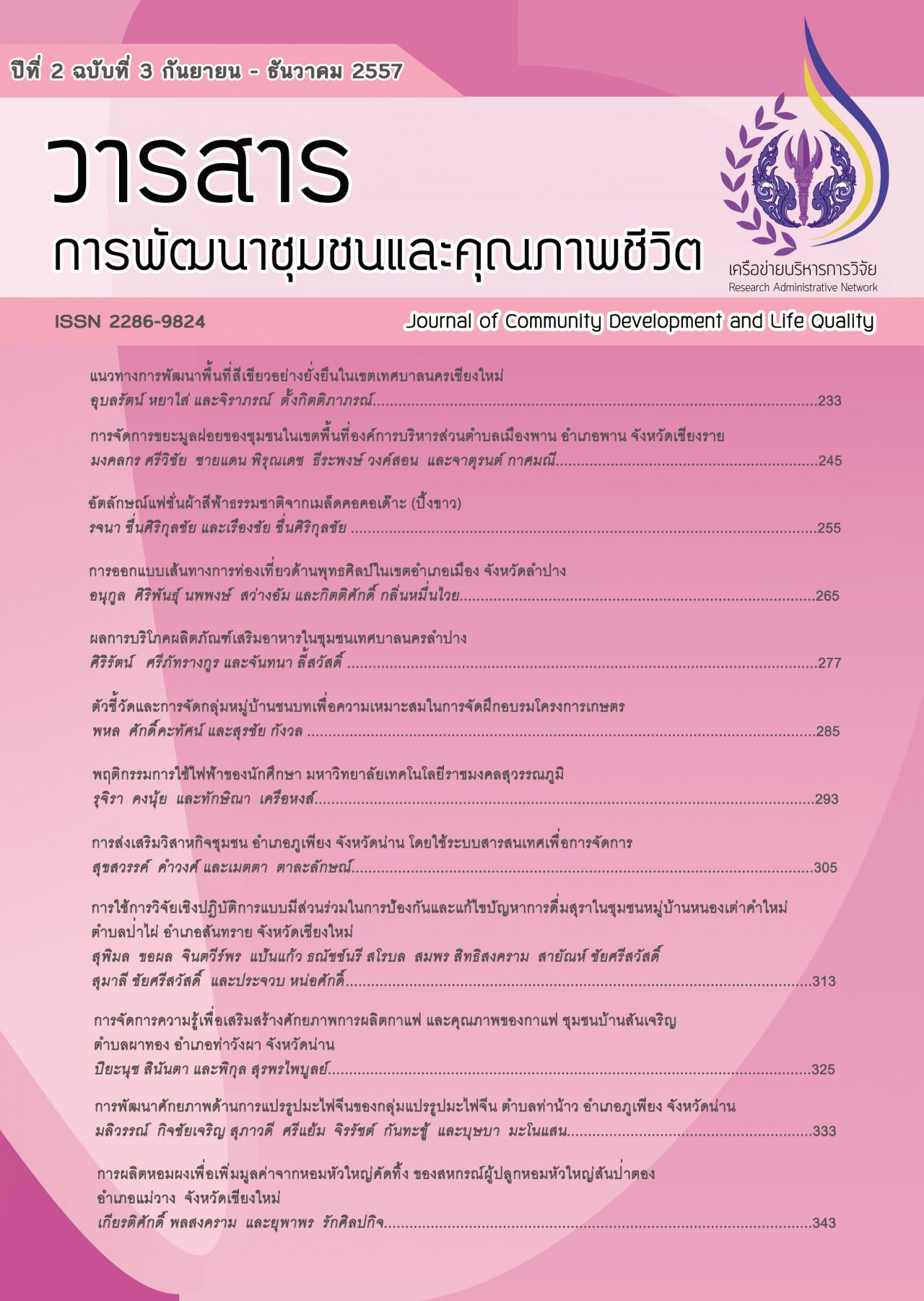
Use of Participatory Action Research (PAR) in Preventing and Solving Problems Caused by Alcohol Consumption in the Community of Nong Toa Kammai Village, Pa Phai Sub-district, San Sai District, Chiang Mai Province
Article Sidebar
Main Article Content
Abstract
Alcohol consumption in Thailand has recently increased to a high level. It has caused huge problems in Thailand especially during Thai’s festival and religious ceremonies. Many research projects have been conducted to solve this problem but it still persists and worsens by the day. In Nong Toa Kam Mai village in Chiang Mai province 40 alcoholics were identified from 177 families. The effects of this abuse that have caused premature death, medical complications, neuropsychological deficits, psychological distress, divorce and unemployment had a significant impact on family and friends. This situation has become a big burden for the communities. In order to find solutions for this problem, Participatory Action Research (PAR) was applied to encourage the people to find strategies to improve quality of life. A PAR project within the community of Nong Toa Kam Mai village was undertaken. The objectives of this study were to assess and analyze the effects of alcohol drinking and to develop a prevention program. Two research teams were established: a local research team and a facilitator research team. Six steps of research were conducted: (i) sharing and analyzing the situation of alcohol drinking problem with the community; (ii) performing the local research team;
(iii) training local research team regarding research tools (questionnaire and interview form); (iv) collecting data (survey and problem analysis); (v) developing prevention program; and (vi) Implementing and evaluating prevention program. Community participation, collaboration and empowerment were measured. The community recognized their drinking problem and developed strategies to solve the problem. Alcohol-free funerals were conducted to reduce alcohol drinking in Nong Toa Kam Mai village and later extended to other 14 villages in the district. In addition, a small number of villagers had stopped drinking alcohol for a period of one year. It was effective to implement PAR in the community of Nong Toa Kam Mai as it empowered community and encouraged them to solve their problems effectively.
Article Details
The Editorial Board claims a right to review and correct all articles submitted for publishing
References
ไกรสุข สินศุข. 2543. กระบวนการมีส่วนร่วมของชุมชนในการป้องกันยาเสพติดโดยการวิจัยเชิงปฏิบัติการแบบมีส่วนร่วม. มหาวิทยาลัยปทุมธานี, ปทุมธานี.
ชัชวาลย์ ทัตศิวัช. 2550. การวิจัยเชิงปฏิบัติการแบบมีส่วนร่วม (Participatory Action Research- PAR): มิติใหม่ของรูปแบบวิธีวิจัยเพื่อการพัฒนาชุมชนระดับท้องถิ่น. มหาวิทยาลัยรามคำแหง, กรุงเทพฯ.
พันธ์ทิพย์ รามสูตร. 2540. การวิจัยเชิงปฏิบัติการอย่างมีส่วนร่วม. สถาบันพัฒนาการสาธารณสุขอาเซียน มหาวิทยาลัยมหิดล, กรุงเทพฯ.
ศูนย์วิจัยปัญหาสุรา (ศวส.). 2548. รายงานสถานการณ์สุราประจำปี 2548. (ระบบออนไลน์). แหล่งข้อมูล: http://www.thaiemsinfo.com/autopagev4/show_page.php?topic_id=232&auto_id=9&TopicPk= (16 พฤษภาคม 2557).
สถานีอนามัยศรีบุญเรือง. 2555. สถิติผู้ป่วยที่มารับบริการ ณ สถานีอนามัย พ.ศ.2555. สถานีอนามัยศรีบุญเรือง, เชียงใหม่.
The Salvation Army in India. 2004. Summary Report of the Participatory Action Research carried out in India, October 2001 to January 2004.
Gosin M. N., P.A. Dustman, A.E. Drapeau and M.L. Harthun. 2003. Participatory action research: creating an effective prevention curriculum for adolescents in the Southwestern US. Health Education Research 18 (3) : 363 – 379.
Masotti P., M.A. George, K. Szala-Meneok, A.M. Morton C., Loock, M. Van Bibber, J. Ranford, M. Fleming and S. Mac Leod. 2006. Preventing fetal alcohol spectrum disorder in aboriginal communities: a methods development project. PLoS Medicine, San Francisco, CA.
Williams, J.B., M.A. Zizzo, L.S. Aldrich and R.T. Bowman. 2006. Participatory action research, a community mobilization srategy to reduce alcohol and drug use. The 134 th Annual Meeting & Exposition (November 4-8, 2006) of APHA.
