
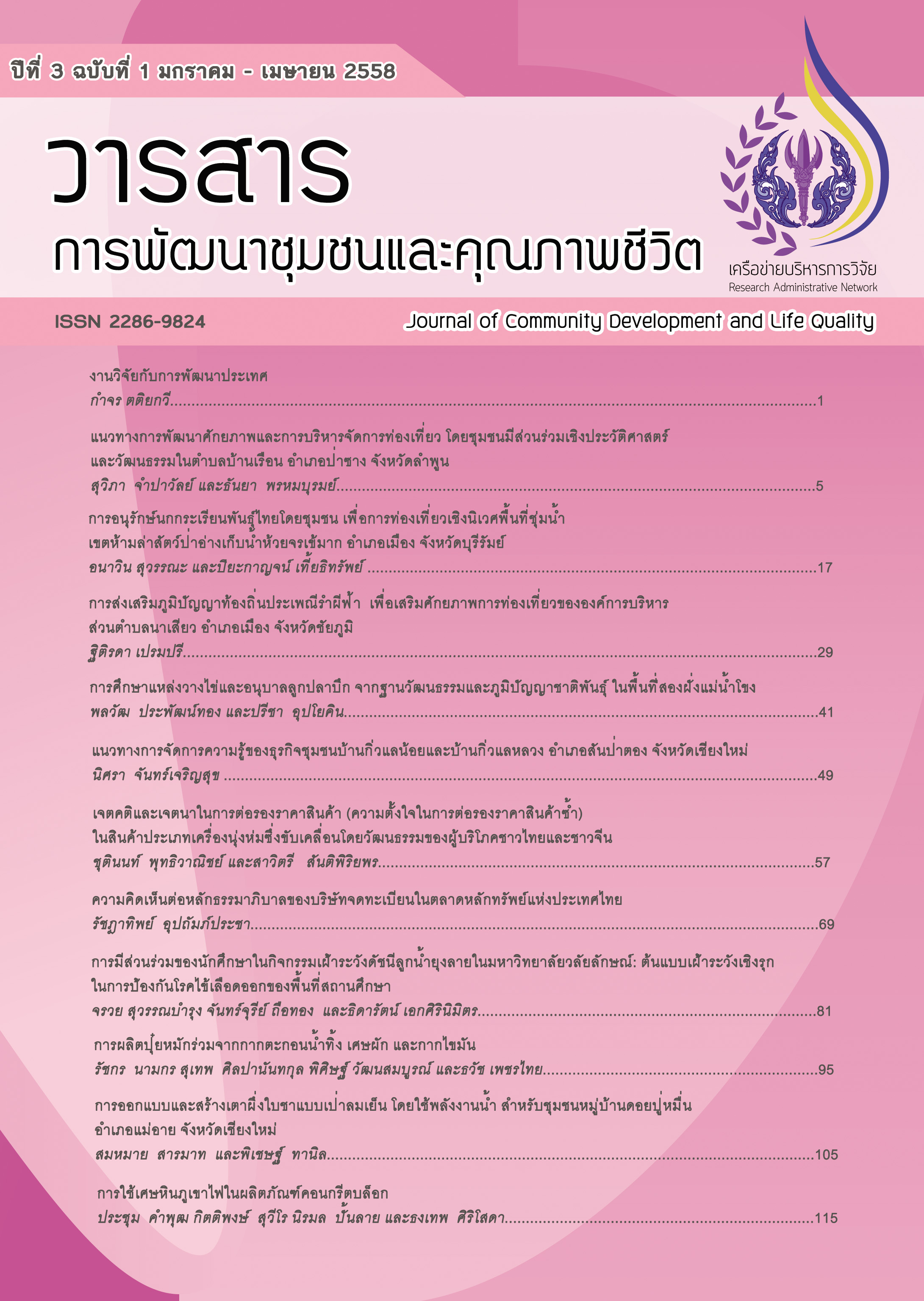
Community-based Conservation of Eastern Sarus Cranes for Wetland Ecotourism at Huai Jorakae Mak Reservoir Non-hunting Area, Muang District, Buri Ram Province
Keywords:
Community-based conservation, eastern sarus crane, wetland ecotourismAbstract
The aims of the research are to study the eastern sarus cranes conservation by community participations and provide opportunities as well as challenges of ecotourism in wetland. Interviewing questionnaires of household representatives from local communities around Huai Jorakae Mak reservoir non-hunting areas in Muang district, Buri Ram province, which were 9 villages. The study used 244 total respondents. Frequency, percentage, means, standard deviations, and content analysis were used to analyze the data. The result found that local people around wetland were aware of eastern sarus crane conservation plan and policies, they also perceived the importance of eastern sarus cranes conservation for ecotourism in wetland, and expected the development of Huai Jorakae Mak reservoir non-hunting area as an ecotourism site, which was implemented by local community. Moreover, eastern sarus cranes conservation had positive impact on household income from the local trade but the negative impact involved cultivated areas. The opportunities and challenges of ecotourism in wetland development criteria were developed by UNWTO need to be considered into 4 criteria which were 1) wetland management to ecotourism 2) raising awareness about eastern sarus cranes and wetland conservation 3) Integration of conservation and ecotourism to local, regional and national plans and 4) encoaurage local community participation in eastern sarus cranes conservation and wetland ecotourism. Consequently, the collaboration between the ecotourism committee and local government was offered to practical policy and policy suggestions for eastern sarus crane conservation and sustainable wetland ecotourism development
References
คณะวิทยาศาสตร์. 2552. การประเมินพื้นที่ชุ่มน้ำที่เหมาะสมสำหรับเตรียมปล่อยนกกระเรียนพันธุ์ไทย. โครงการเตรียมความพร้อมเพื่อทดลองปล่อยนกกระเรียนพันธุ์ไทยจากการเพาะเลี้ยงกลับคืนสู่พื้นที่ชุ่มน้ำธรรมชาติในประเทศไทย. คณะวิทยาศาสตร์. มหาวิทยาลัยมหาสารคาม, มหาสารคาม. 53 หน้า.
ไชยวัฒน์ รุ่งเรืองศรี. 2550. ระเบียบวิธีวิจัยทางวิทยาศาสตร์สังคม. โอเดียนสโตร์, กรุงเทพฯ. 325 หน้า.
สถาบันการท่องเที่ยวโดยชุมชน. 2556. คู่มือมาตรฐานการท่องเที่ยวโดยชุมชน. สถาบันการท่องเที่ยวโดยชุมชน มหาวิทยาลัยพายัพ, เชียงใหม่. 64 หน้า.
สมนึก ปัญญาสิงห์ เศกสรรค์ ยงวณิชย์ และพุทธรักษ์ ปราบนอก. 2557. ตัวแบบการจัดการการพัฒนาเพื่อความอยู่ดีมีสุขของครอบครัวเกษตรกรที่ใช้ปรัชญาของเศรษฐกิจพอเพียงในภาคตะวันออกเฉียงเหนือ. วารสารการพัฒนาชุมชนและคุณภาพชีวิต 2(1): 11-22.
สำนักงานคณะกรรมการพัฒนาการเศรษฐกิจและสังคมแห่งชาติ. 2554. แผนพัฒนาเศรษฐกิจและสังคมแห่งชาติ ฉบับที่สิบเอ็ด พ.ศ. 2555-2559. สำนักงานคณะกรรมการพัฒนาการเศรษฐกิจและสังคมแห่งชาติ, กรุงเทพฯ. 137 หน้า.
องค์การบริหารส่วนตำบลเสม็ด. 2552. แผนพัฒนาสามปี ประจำปี พ.ศ. 2553-2555. องค์การบริหารส่วนตำบลเสม็ด, บุรีรัมย์. 84 หน้า.
องค์การบริหารส่วนตำบลบ้านบัว. 2552. แผนพัฒนาสามปี ประจำปี พ.ศ. 2553-2555. องค์การบริหารส่วนตำบลบ้านบัว, บุรีรัมย์. 64 หน้า.
องค์การบริหารส่วนตำบลสะแกโพรง. 2552. แผนพัฒนาสามปี ประจำปี พ.ศ. 2553-2555. องค์การบริหารส่วนตำบลสะแกโพรง, บุรีรัมย์. 69 หน้า.
Suwanna, A. 2012. Factors affecting community paradigms for eastern sarus crane reintroduction at Huai Jorakae Mak non-hunting area, Buri Ram province. Mahidol University, Nakhon Pathom. 88 p.
Archibald, G.W., K.S. Gopi Sundar and J. Barze. 2003. A review of the three subspecies of sarus crane Grus antigone. Journal of Ecological Society 16: 5-15.
Adam, A. and M. Kaosa-ard. 2008. Mekong Tourism: Competitiveness & Opportunities. Social Research Institute. Chiang Mai University, Chiang Mai. 277 p.
IUCN. 2012. IUCN Red List for birds. (Online). Available: http://www.iucn redlist.org/apps/ redlist/search (January 12, 2012).
Meine, C., D. and G.W. Archibald. 1996. The Cranes: Status Survey and Conservation Action Plan. IUCN, Gland, Switzerland and Cambridge. 294 p.
Northcote, E. M. 1984. Crane Grus fossils from the Maltese Pleistocene. Palaeontology 27: 729-735.
Pain, D.J., R. Gargi, A. Cunningham, A. Jones and V. Prakash. 2004. Mortality of globally threatened sarus cranes Grus antigon from monocrotophos poisoning in India. Science of the Total Environment 326: 55-61.
Sanguansombat, W. 2005. Thailand Red Data: Birds. Office of Natural Resources and Environmental Policy and Planning, Bangkok. 158 p.
The Secretariat of the Ramsar Convention on Wetlands and the World Tourism Organization (UNWTO). 2012. Destination Wetlands: Supporting Sustainable Tourism. Secretariat of the Ramsar Convention on Wetlands, Gland, Switzerland & World Tourism Organization (UNWTO), Madrid.
Van Der Schans, M.L. 2006. An ecosystem approach to fire and water management in Tram Chim National Park, Vietnam. MWBP. Vientianne. 29 p.
Walkinshaw, L.H. 1973. Cranes of the world. Winchester Press, New York.
Yamane, T. 1973. Statistics: An Introductory Analysis. Harper International Edition, Tokyo.
Downloads
Published
How to Cite
Issue
Section
License
The Editorial Board claims a right to review and correct all articles submitted for publishing


