
Good Governance for Community Enterprise Management and Development
Article Sidebar
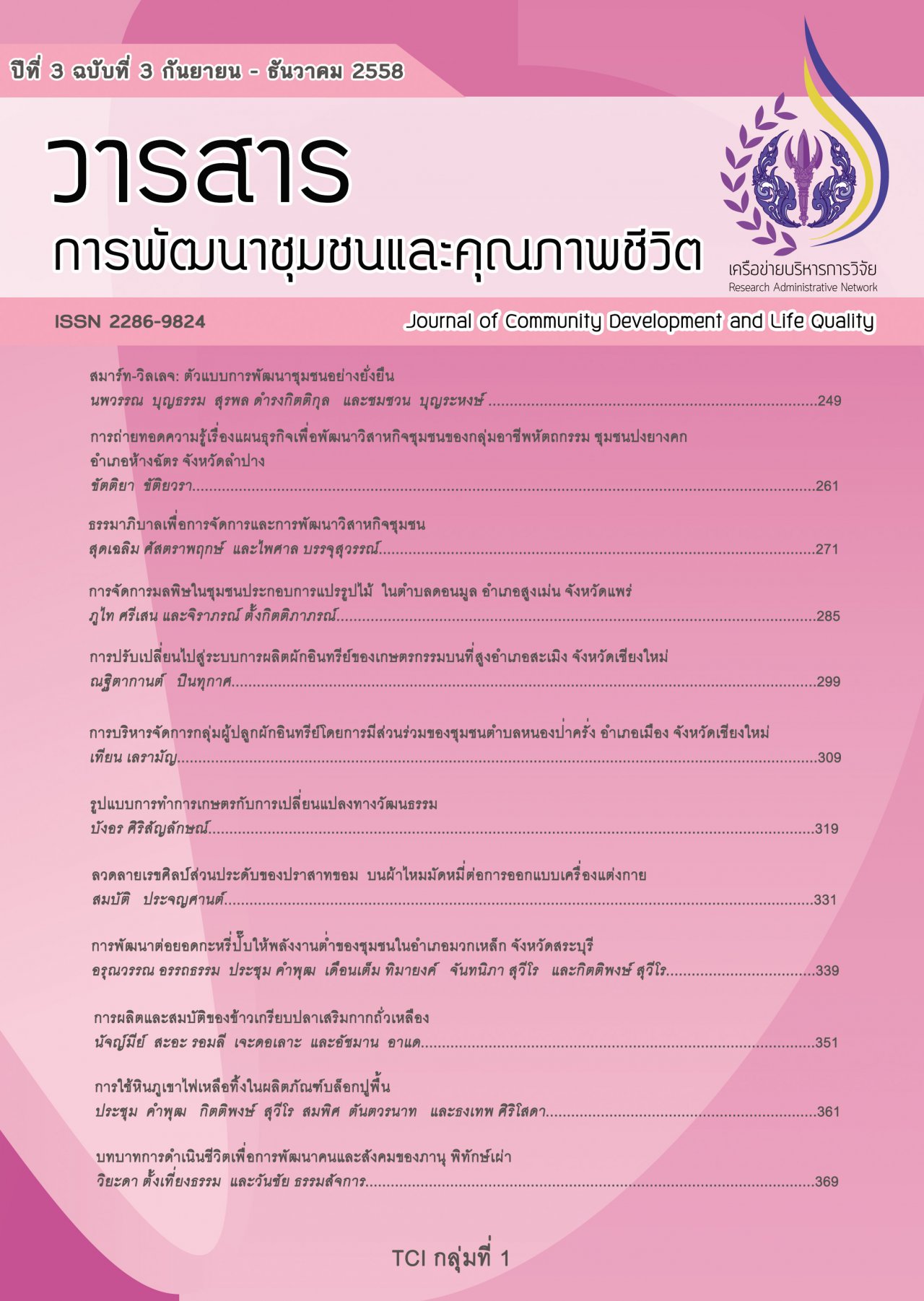
Main Article Content
Abstract
This research project aims to study the general management of the Sonthiwat Community Enterprise, to analyze its operating process within the framework of good governance to create sustainability, and to identify problems and challenges in management of the community enterprise. Qualitative research methodology was used for this research project by means of documentary research, in-depth interview, and focus group. This target group includes the board (chairman, vice chairman, consultants, secretary-treasurer and committee) 8 people and 22 members, a total of 30 people in all. The result found that the management of the community enterprise was in accordance with the principles of good governance. The research project explored the four aspects of management: human management, production management, marketing, and financial management. Firstly, in terms of human capital, there is a strong bond among people with public minds and potentials to improve their working skills. Secondly, the production process meets the required standard of quality. Thirdly, with regards to marketing, most of the products are sold in the community and by orders from customers outside the community. Lastly, for financial management, there is sufficient fund in circulation but the community enterprise is not oriented towards saving. Concerning sustainable development, the research found that there are a community learning center, a variety of networks with flexible participation, and business continuity according to customers’ order, although it is not ready to be upgraded. After synthesizing the information, this research suggests a concept as a guide to the management and development of the community enterprise, “PEACEACT” (participation/ equality/ agreement/ creativity/ economy/ awareness/ carefulness/ transparency). The challenges and problems appear to be that most members are in their old age with lack of new members from the younger generations who want to come and work in the future. The business model is more similar to semi family business and there are few markets to sell products. Moreover, the financial capital is quite limited with lack of a systematic management process.
Article Details
The Editorial Board claims a right to review and correct all articles submitted for publishing
References
ธเนศ ศรีวิชัยลำพันธ์. 2544. การจัดการกลุ่มสะสมทุนเพื่อพัฒนาเศรษฐกิจชุมชนแบบยั่งยืน: กรณีศึกษาจังหวัดเชียงใหม่.วารสารเศรษฐศาสตร์ มหาวิทยาลัยเชียงใหม่ 5(1): 37-62.
นวลน้อย ตรีรัตน์. 2549. สังคมที่มีความสุขอย่างยั่งยืน กับแผนการพัฒนาฯ ฉบับที่ 10. (ระบบออนไลน์). แหล่งข้อมูล: http//:www.matichon.co.th/ matichon/ma tichon_detial (20 ตุลาคม 2557).
ศุภชัย เมืองรักษ์ และสุรีพันธุ์ เสนานุช. 2546. คู่มือเทคนิคการเพิ่มผลผลิตในชุมชนเข้มแข็ง: ธุรกิจชุมชน. สำนักงานปลัดกระทรวงอุตสาหกรรม กระทรวงอุตสาหกรรม, กรุงเทพฯ. 26 หน้า.
ศุภธณิศร์ เติมสงวนวงศ์. 2556. ปัจจัยสู่ความสําเร็จทางธุรกิจของผู้ประกอบการที่ได้รับ การคัดสรรสุดยอดสินค้าหนึ่งตําบลหนึ่งผลิตภัณฑ์ ระดับ 5 ดาว อําเภอสันทราย จังหวัดเชียงใหม่. วารสารการพัฒนาชุมชนและคุณภาพชีวิต 1(1): 31-41.
สุกัญญา ดวงอุปมา. 2557. แนวทางการพัฒนาศักยภาพการจัดการที่ดีของวิสาหกิจชุมชนในจังหวัดกาฬสินธุ์. วารสารการพัฒนาชุมชนและคุณภาพชีวิต 2(2): 133-139.
สุดเฉลิม ศัสตราพฤกษ์ และไพศาล บรรจุสุวรรณ์. 2557. ธรรมาภิบาลเพื่อการจัดการและการพัฒนาวิสาหกิจชุมชน. รายงานวิจัย. มหาวิทยาลัยสงขลา นครินทร์ วิทยาเขตสุราษฎร์ธานี, สุราษฎร์ธานี. 99 หน้า.
Drucker, P.F. 2002. The Effective Executive. Haper & Row, New York. 182 p.
Marquardt, M.J. 2002. Building the Learning Organization. 2nd ed. Davies-Black Publishing, Palo Alto, CA. 287 p.
