
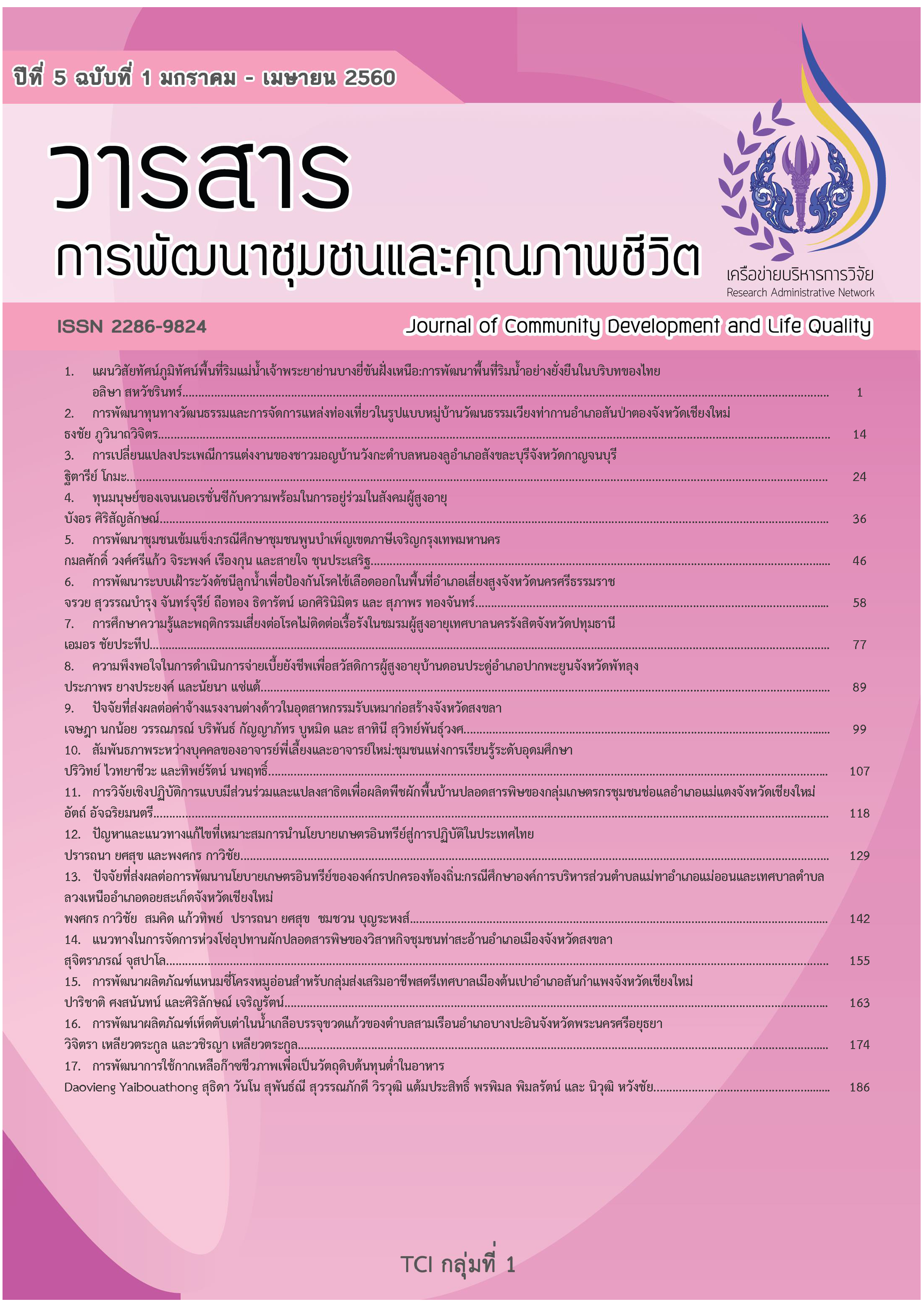
The Study of Knowledge and Behavior Risk Factors on Chronic Non-communicable Diseases in the Elderly Club, Rangsit City Municipality, Pathum Thani Province
Article Sidebar
Main Article Content
Abstract
This research aims to study the elderly’s knowledge and risk behaviors of chronic NCDs. The sample consisted of 60 people who were members of the elderly club at Rangsit city municipality. The research found that the elderly’s knowledge and understanding of food consumption of chronic NCDs were at high level. The average score of the test was 9 out of 10 points. They had appropriate behaviors; most elderly cooked their own meals. They had breakfast as their main meal of the day. They loved to eat foods with light flavors. They ate vegetables and fruits every day, meanwhile more than half of the sample group had a positive behavior to reduced risk factors of chronic NCDs. For example, they did not eat snacks, fast food, or frozen food and they did not drink alcohol. However, they had the average body mass index in the overweight (25.0±3.8 kg/m2), the most activities were inactive. The results showed that the elderly who were members of the elderly club were trained in healthcare and wellness constantly therefore, they have a greater understanding in undesirable behavior to avoid. So, family and local state agency which are the most closer to elderly. These organizations need to play a role in promoting and improving the elderly quality of life.
Article Details
The Editorial Board claims a right to review and correct all articles submitted for publishing
References
ณิชารีย์ ใจคำวัง. 2558. พฤติกรรมเสี่ยงของกลุ่มเสี่ยงโรคเบาหวานและโรคความดันโลหิตสูง: กรณีศึกษาโรงพยาบาลส่งเสริมสุขภาพตำบลบ้านปากคะยางจังหวัดสุโขทัย. วารสารการพัฒนาชุมชนและคุณภาพชีวิต 3(2): 173-184.
เทศบาลนครรังสิต. 2557. สถิติจำนวนประชากรในเขตเทศบาลนครรังสิต จำแนกตามช่วงอายุ. 2557. (ระบบออนไลน์). แหล่งข้อมูล: http://www.rangsit.org/New/index.php/th/2014-11-26-03-57-42/105-2014-11-07-07-57-30?start=8 (3 มีนาคม 2559)
เพ็ญจันทร์ แสนประสาน ดวงกมล วัตราย์ และ กนกพร แจ่มสมบูรณ์. 2558. การแปลผลคลื่นไฟฟ้าหัวใจและการพยาบาลผู้ป่วยโรคหัวใจ. สุขุมวิทการพิมพ์, กรุงเทพฯ. 383 หน้า.
ศันสนีย์ กระจ่างโฉม และสุวิภา จำปาวัลย์. 2557. การบริโภคอาหารที่ทำให้มีอายุยืนยาวของผู้สูงอายุ กลุ่มชาติพันธุ์ไทยวน ในอำเภอแม่แจ่ม จังหวัดเชียงใหม่. วารสารการพัฒนาชุมชนและคุณภาพชีวิต 2(2): 161-170.
วิไลวรรณ ทองเจริญ จันทนา รณฤทธิวิชัย สมจินต์ เพชรพันธุ์ศรี ณัฐสุรางค์ บุญจันทร์ และวรวรรณ วาณิชย์เจริญชัย. 2554. ประสิทธิผลของกระบวนการจัดการความรู้ต่อความรู้และการจัดการปัญหาความดันโลหิตสูงของผู้สูงอายุ. วารสารพยาบาลศาสตร์ 29(2): 103-113.
สถาบันวิจัยและประเมินเทคโนโลยีทางการแพทย์. 2557. การทบทวนวรรณกรรม: สถานการณ์ปัจจุบันและรูปแบบการบริการด้านโรคไม่ติดต่อเรื้อรัง (ครั้งที่ 1). อาร์ต ควอลิไฟท์, นนทบุรี. 66 หน้า.
สถาบันเวชศาสตร์ผู้สูงอายุ.2549. แนวทางเวชปฏิบัติ การดูแลโภชนบำบัดในโรคเบาหวาน โรคความดันโลหิตสูง และภาวะไขมันในเลือดผิดปกติ. ชุมชนสหกรณ์การเกษตรแห่งประเทศไทย, กรุงเทพฯ. 59 หน้า.
สมใจ จางวาง เทพกร พิทยภินัน และนิรชร ชูติพัฒนะ. 2559. ปัจจัยที่มีความสัมพันธ์กับพฤติกรรมการดูแลตนเองเพื่อป้องกันโรคเบาหวานและความดันโลหิตสูงของประชาชนกลุ่มเสี่ยง. วารสารเครือข่ายวิทยาลัยพยาบาลการสาธารณสุขภาคใต้ 3(1): 111-128.
สำนักงานสถิติแห่งชาติ. 2552. การสำรวจพฤติกรรมการดูแลสุขภาพของประชากร พ.ศ. 2552 (พฤติกรรมการบริโภคอาหาร). (ระบบออนไลน์).แหล่งข้อมูล:http://service.nso.go.th/nso/nsopublish/service/survey/healthCare_52.pdf (29 มีนาคม 2559).
สำนักงานสาธารณสุขจังหวัดนครราชสีมา. 2558. นโยบายด้านสุขภาพ ปีงบประมาณ 2558. (ระบบออนไลน์). แหล่งข้อมูล: http://203.157.161.4/koratbox/%CB%B9%D1%A7%CA%D7%CD%E1%BC%B958/%E1%BC%B9%C2%D8%B7%B8%C8%D2%CA%B5%C3%EC%CA%D8%A2%C0%D2%BE%20%BB%D5%202558(%E1%A1%E9%E4%A25%BE%C257).pdf (1 มีนาคม 2559).
สุกิจ แย้มวงษ์. 2549. การพัฒนาแบบประเมินความเสี่ยงต่อโรคหลอดเลือดหัวใจ. รายงานวิจัยฉบับสมบูรณ์. เครือข่ายวิจัยสุขภาพ มูลนิธิสาธารณสุข, กรุงเทพฯ. 18 หน้า.
อรวรรยา ภูมิศรีแก้ว. 2553. ปัจจัยเสี่ยง และการรับรู้ปัจจัยเสี่ยง ของโรคหัวใจขาดเลือดในผู้ป่วยเบาหวาน. วารสารวิทยาลัยพยาบาลบรมราชชนนี นคราราชสีมา 16(2): 34-47.
Cronbach, L. J. 1970. Essentials of Psychological Testing. 4th ed. Harper and Row Publishers, New York. 342 p.
Escott-Stump, S. 1988. Nutrition and Diagnosis-Related Care. 8th ed. Wolters Kluwer, Philadelphia. 1064 p.
WHO. 2008. Waist circumference and waist-hip ratio report(Online). Available: http://apps.who.int/iris/bitstream/10665/44583/1/9789241501491_eng.pdf (January 16, 2016)
WHO. 2012. Sodium intake for adults and children. 2012. (Online). Available: http://www.who.int/nutrition/publications/guidelines/sodium_intake/eng.pdf (August 28, 2016).
WHO. 2014. Global status report on non-communicable diseases. 2014. (Online). Available: http://apps.who.int/iris/bitstream/10665/148114/1/9789241564854_eng.pdf (January 1, 2016).
