
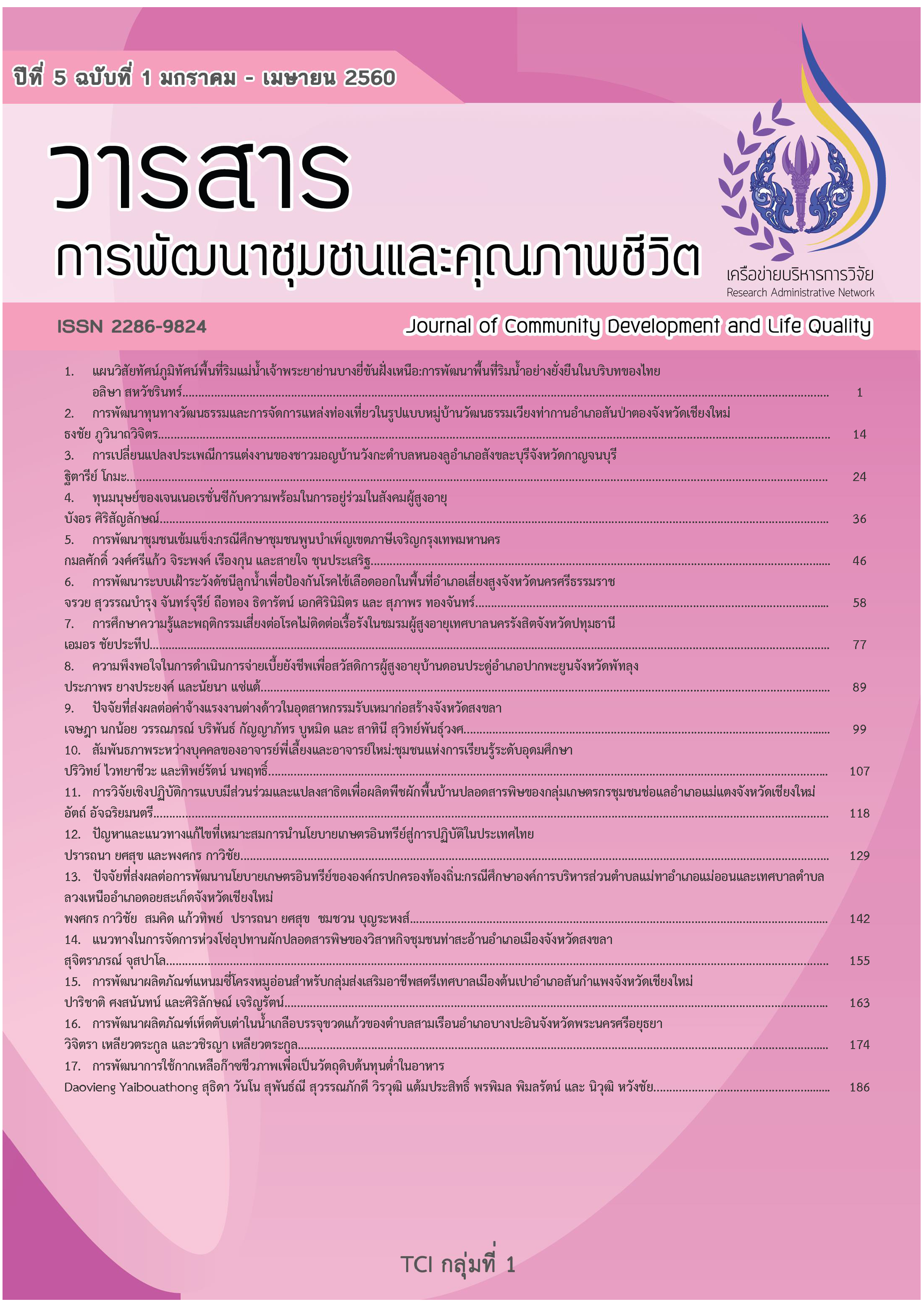
Development of Strong Community: A Case Study of Poonbumphen Community, Phasi Charoen District, Bangkok
Article Sidebar
Main Article Content
Abstract
This research aims to study the characteristics of a strong community and the factors contributing to a strong community. The study also proposes the development model of a strong community. Based on qualitative research, Poonbumphen community was selected as a case study. The data were gathered by document research, in-depth interviews, focus group discussion and nonparticipant observation. Data were analyzed using content analysis. The results showed that characteristics of a strong community were the ability to be self-reliant, the security of community, the vision of community and the love for community. The factors that promote a strong community were closed social relations, learning to improve people’s lives in the community, networking of community, natural leader, and the self-reliance economy. The suggestion for the development of a sustainable strong community is continuation of farmland, promoting awareness of newcomers, creating an ongoing community development activities, implementing proactive community public relations, and creating next generation leaders and establishing a community network to carry on the mission.
Article Details
The Editorial Board claims a right to review and correct all articles submitted for publishing
References
ประไพพิมพ์ สุธีวสินนนท์ และประสพชัย พสุนนท์. 2559. กลยุทธ์การเลือกตัวอย่างสำหรับการวิจัยเชิงคุณภาพ. วารสารปาริชาต มหาวิทยาลัยทักษิณ 29(2): 31-48.
ปาริชาติ วลัยเสถียร. 2551. พลวัตรของแนวคิดและปฏิบัติการพัฒนาชุมชน. วารสารพัฒนาสังคมและชุมชน 1(1): 29-54.
ปัญญา เทพสิงห์ และธงพล พรหมสาขา ณ สกลนคร. 2556. แนวทางการฟื้นฟูชุมชนเพื่อการพัฒนาที่ยั่งยืน. มนุษยศาสตร์ สังคมศาสตร์ 30(2): 43-64.
วรรณธรรม กาญจนสุวรรณ. 2553. กระบวนการจัดการชุมชนเข้มแข็ง: รูปแบบปัจจัยและตัวชี้วัด. รัฐประศาสนศาสตร์ 8(2): 119-158.
วิสุทธิ์ ใบไม้. 2558. เครือข่ายการวิจัยความหลากหลายทางชีวภาพ วัฒนธรรมและภูมิปัญญาท้องถิ่น. Rajabhat Journal of Sciences, Humanities & Social Sciences 16(2): 253-267.
สมบูรณ์ ธรรมลังกา. 2556. รูปแบบการเสริมสร้างความเข้มแข็งของชุมชนโดยใช้ภูมิปัญญาท้องถิ่นเป็นฐานในจังหวัดเชียงราย. วารสารศึกษาศาสตร์ มหาวิทยาลัยนเรศวร 15(2): 58-66.
สุปราณี จันทร์ส่ง บุญทัน ดอกไธสง สอาด บรรเจิดฤทธิ์ และบุญเรือง ศรีเหรัญ. 2558. การพัฒนาทุนทางสังคมเพื่อสร้างชุมชนเข้มแข็ง. วารสารวิจัยและพัฒนาวไลยอลงกรณ์ในพระบรมราชูปถัมภ์ 10(3): 273-283.
Creswell, J. W. 2009. Research Design: Qualitative, Quantitative, and Mixed Methods Approaches. SAGE Publications, Thousand Oaks, CA. 273 p.
Holiday, A. 2002. Doing and Writing Qualitative Research. SAGE Publications, Thousand Oaks, CA. 211 p.
Miles, M. B., A. M., Huberman, and J., Saldaña. 2013. Qualitative Data Analysis: A Methods Sourcebook 3rded. SAGE Publications, London. 408 p.
Srinivas, H. 2003. The Five Es of Sustainability. (Online). Available: http://www.gdrc.org/sustdev/indicators.html (September 5, 2015)
