
The Priority Needs for Development of Training Curriculum to Enhance English Teachers’ Competency on Research and Development of Teaching and Learning Innovation in Savannakhet University Lao PDR
Article Sidebar
Main Article Content
Abstract
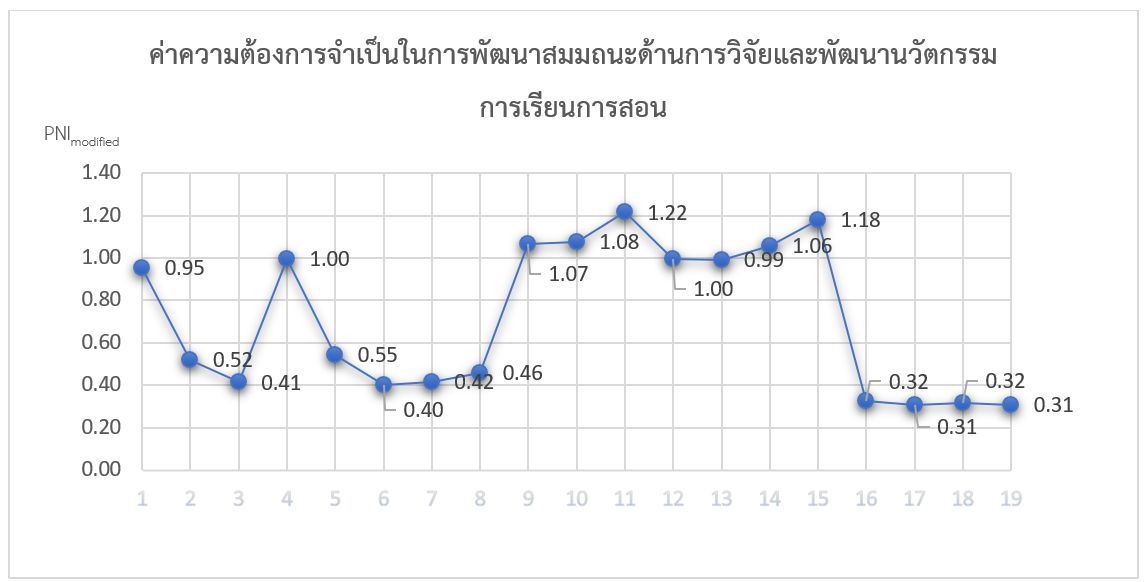
The purpose of this study was to study the actual status and expectations regarding the development of training curriculum and prioritize the needs to develop English teachers’ competency on research and development of teaching and learning innovation. The sample were 41 teachers of Savannakhet University Lao PDR which determined by using Krejcie and Morgan table. The research instrument was a 5 scale-ratings of dual response format questionnaire. The data were analyzed by descriptive statistics methods including frequency, percentage, means, standard deviation, and its priority in terms of need was also set by using Modified Priority Needs Index (PNImodified). The research findings were as follows: the sample assessed the actual status of their competency on research and development of teaching and learning innovation for development training curriculum at a moderate level ( =3.00, S.D. =0.30) and expectation at a highest level ( =4.94, S.D. =0.06). The PNImodified of the needs for teaching and learning innovation competency was 0.65 which was a critical need for development as greater than 0.30. For analyzing in each aspect of the needs, the most critical of the needs for research and development of teaching and learning innovation were skills competency (PNImodified = 1.07), followed by the knowledge (PNImodified = 0.56) and the attributes for research and development of teaching and learning innovation (PNImodified = 0.32) respectively. Therefore, training curriculum development for enhancing English teachers’ competency on research and development of teaching and learning innovation in Savannakhet University Lao PDR should stipulate the development of these competencies in training curriculum as the main academic development. Moreover, the competency of research and development of teaching and learning innovation should continuously be practiced and promoted.
Article Details

This work is licensed under a Creative Commons Attribution-NonCommercial-NoDerivatives 4.0 International License.
References
กระทรวงศึกษาธิการและกีฬา. (2008). แผนยุทธศาตร์การประติรูประบบการศึกษาแห่งชาติ 2006-2015. เวียงจันทน์: กระทรวงศึกษาธิการและกีฬา.
กระทรวงศึกษาธิการและกีฬา. (2015). วิสัยทัศน์ถึงปี 2030 ยุทธศาสตร์ถึงปี 2025 และแผนพัฒนาแขนงการศึกษาและกีฬา 5 ปี ครั้งที่ (2016-2020). เวียงจันทน์: กระทรวงศึกษาธิการและกีฬา.
กรมการศึกษาชั้นสูง. (2011). ท่าแรงด้านการวิจัยใน ส.ป.ป. ลาว. เวียงจันทน์: กระทรวงศึกษาธิการและกีฬา.
ชูชัย สมิทธิไกร. (2542). การฝึกอบรมบุคลากรในองค์กร. พิมพ์ครั้งที่ 2. กรุงเทพฯ:จุฬาลงกรณ์มหาวิทยาลัย.
ชนาธิป พรกุล. (2547). ระบบและนวัตกรรมการเรียนการสอน. กรุงเทพฯ: โรงพิมพ์คุรุสภาลาดพร้าว.
ทิศนา แขมมณี. (2553). ศาสตร์การสอน. องค์ความรู้เพื่อการจัดกระบวนการเรียนรู้ที่มี ประสิทธิภาพ (พิมพ์ครั้งที่ 13). กรุงเทพฯ: จุฬาลงกรณ์มหาวิทยาลัย.
บัวดำ แสงคำคุคลาวงษ์ (2557). รูปแบบการพัฒนานักวิจัยของมหาวิทยาลัยที่สาธารณรัฐประชาธิปไตยประชาชนลาว. วารสารศึกษาศาสตร์ มหาวิทยาลัยขอนแก่น, 2(37). 59-67.
มหาวิทยาลัยสะหวันนะเขต (2019). รายงานผลงานในระยะ 10 ปี และแผนงาน 5 ปี การนำพาและคุ้มครองมหาวิทยาลัยสะหวันนะเขต. ส.ป.ป. ลาว.: มหาวิทยาลัยสะหวันนะเขต.
ไพวัน ดวงพะจัน. (2561). สังเคราะห์ตัวบ่งชี้สมรรถนะการวิจัยของครูระดับมัธยมศึกษาตอนปลาย มีสาธารณรัฐประชาธิปไตยประชาชนลาว. วารสารการวัดผลการศึกษา มหาวิทยาลัยมหาสารคาม, 24(1). 208-255
พิชิต ฤทธิ์จรูญ. (2550). การวิจัยและพัฒนานวัตกรรม. กรุงเทพฯ: สํานักพิมพ์จุฬาลงกรณ์ มหาวิทยาลัย.
สุรสิทธิ์ สิทธิอมร. (2558). การพัฒนาสมรรถนะด้านการวิจัยและพัฒนาด้วยการเสริมสร้างพลังและการรับรู้ความสามารถของตนสำหรับครูมัธยมศึกษา. วิทยานิพนธ์ ค.ม. สกลนคร: มหาวิทยาลัยราชฏสกลนคร.
สุคนธ์ สินธพานนท์. (2552). นวัตกรรมการเรียนการสอนเพื่อพัฒนาคุณภาพของเยาวชน. กรุงเทพฯ: 9119 เทคนิคพริ้นติ้ง.
สุวิมล ว่องวานิช. (2550). การวิจัยประเมินความต้องการจําเป็น. พิมพ์ครั้งที่ 2. กรุงเทพฯ: โรงพิมพ์จุฬาลงกรณ์มหาวิทยาลัย.
สุวิมล ว่องวานิช. (2558). การวิจัยประเมินความต้องการจำเป็น. พิมพ์ครั้งที่ 3. กรุงเทพฯ: สำนักพิมพ์แห่งจุฬาลงกรณ์มหาวิทยาลัย.
สมคิด บางโม. (2544). เทคนิคการฝึกอบรมและการประชุม. กรุงเทพฯ : วิทยพัฒน์.
สมชัย เทพสมบัติ และคณะ. (2020). ยุทธศาสตร์การพัฒนาสมรรถนะด้านการวิจัยของครูในวิทยาลัยครู สาธารณรัฐประชาธิปไตยประชาชนลาว. วารสารสันติศึกษาปริทรรศน์, 8(4). 1380-1393.
สมชาติ กิจยรรยง. (2545). เทคนิคการจัดการฝึกอบรมอย่างมีประสิทธิภาพ. กรุงเทพฯ : สมาคมส่งเสริมเทคโนโลยี (ไทย-ญี่ปุ่น).
Best, J. W. (1981). Research in Education. 4th Ed. New Delhi: Prentice Hall of India Pvt. Ltd
GÖKER S. D., & Ürün Göker, M. (2021). Rethinking Innovative Learning Opportunities for Teachers in Educational Organizations toward Education 4.0. IntechOpen. doi: 10.5772/intechopen.93153
Elizabeth, J. E. (2015). The Relationship between English and Employability in the middle east and north Africa. British Council. ISBN 978-0-86355-778-1
Harkins, A. M. (2008). Leapfrog Principles and Practices: Core Components of Education 3.0 and 4.0. Futures Research Quarterly, 24(1). 1-15.
McCaslin, N. L., & Tibezinda, J. P. (1998) Assessing Target Group Needs. In: Swanson et al., Eds., Improving Agricultural Extension, a Reference Manual, F. A. O., Rome. http://www.fao.org/docrep/w5830e00.htm
Mcclelland, D. C. (1974). Testing for competence rather than for “Intelligence”. American Psychologist, 29(1). 59-59.
Spencer, L. M., & Spencer, S. M. (1993). Competence at Work: Models for Superior Performance. New York: John Wiley & Sons.
Taba, H. (1962). Curriculum Development Theory and Practice. USA: HARCOURT, BRACE & WORLD Inc.
Witkin, B. R., & Altschuld, J. W. (1995). Planning and conducting needs assessments: A practical guide. CA: Thounsand Oaks.
