
A Study of The Bangkok Elementary School Teacher’s Training under the Thai School of Excellence Project
Article Sidebar
Main Article Content
Abstract
Training is one way to develop teacher’s career. Teachers can bring knowledge and skill from the training applying in their work. Therefore, in this research, we studied the implementation of the Bangkok primary school teachers’ training under the Thai School of Excellence project based on the child-centered education concept, identified implementational challenges, and synthesized success of this training using a mix-methods methodology.
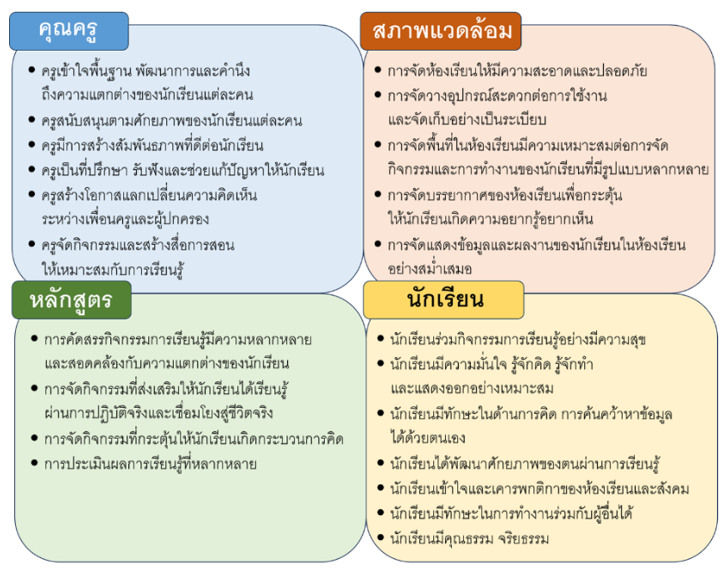
Of the following fours aspects-namely teachers, students, curriculum and teaching environment, we found that knowledge of this training was implemented regularly in general, and with the highest intensity on students and with less intensity on teachers, teaching environment and curriculum in this order. Specifically, the implementation on students focused on emboldening their participation, developing their confidence and logical thinking, and strengthening their morals and ethical values. Regarding implementational challenges, we found that curriculum was the most taxing, especially in terms of organizing activities for engaging students’ group-learning, and for teaching students’ life skills and for developing students’ investigative and analytical thinking skills. In terms of success, we found that the training allowed teachers to recognize both the influences of students’ diversities on their developments and characteristics of a good teacher, which in turn enhanced teachers’ positive attitudes towards themselves, their students and colleagues and led to teachers creating a better environment conducive to learning.
Article Details

This work is licensed under a Creative Commons Attribution-NonCommercial-NoDerivatives 4.0 International License.
References
กองทุนเพื่อความเสมอภาคทางการศึกษา. (2565). เปิดชั้นเรียนสร้างสุข เมื่อปลายทางของการเรียนคือ ‘ความสุข’ ของผู้เรียน.
ดำรงค์ โตใย ปรีชา อ่วมปัญญา และธีระ ภักดี. (2549). แนวทางการพัฒนาการดำเนินงานการบริหารงบประมาณของ สถานศึกษาขั้นพื้นฐาน สังกัดสำนักงานเขตพื้นที่การศึกษาตาก เขต 2. ค้นเมื่อ 18 สิงหาคม 2566, จาก https://so05.tci- thaijo.org/index.php/tgt/article/view/7941/6899?fbclid=IwAR2pBLVwWdEFUqP4WuYL_72xBSKII4DsUK8qxOK14IcjmA4FxgawB7mZ69A
ผู้จัดการออนไลน์. (2557). สั่งเลิกอบรมครูในโรงแรม ใช้โรงเรียน-วัดประหยัดงบ. ค้นเมื่อ 4 พฤศจิกายน 2566, จาก
https://mgronline.com/daily/detail/9570000117946
ภคพร เลิกนอก และเอกราช โฆษิตพิมานเวช. (2564). บทบาทผู้บริหารสถานศึกษาที่มีผลต่อการพัฒนาหลักสูตรและการจัดการเรียนรู้. วารสารบัณฑิตศึกษามหาจุฬาขอนแก่น, 3(8), 1-13.
ภาวิณี โสธายะเพ็ชร. (2563). ครุศาสตร์ ต้องรอด! : “จะเป็นครู ต้องไม่หยุดเรียนรู้”. ค้นเมื่อ 18 สิงหาคม 2566,จาก https://www.the101.world/education-must-survive-post/
ภริมา วินิธาสถิตกุล และ ชนินันท์ แย้มขวัญยืน. (2565). การเรียนรู้เชิงรุก: แนวทางการเรียนการสอนที่เป็นเลิศใน ศตวรรษที่ 21. วารสารนวัตกรรมการศึกษาและการวิจัย, 6(3), 921-932.
สถาบันส่งเสริมการสอนวิทยาศาสตร์และเทคโนโลยี. (2563). การให้ความช่วยเหลือและสนับสนุนของครูส่งผลต่อผลการประเมินด้านการอ่านของนักเรียนอย่างไร. ค้นเมื่อ 10 กันยายน 2566, จาก https://pisathailand.ipst.ac.th/issue-2020-57/
สมศักดิ์ ภู่วิภาดาวรรธน์. (2544). การยึดผู้เรียนเป็นศูนย์กลางและการประเมินตามสภาพจริง. พิมพ์ครั้งที่ 2. เชียงใหม่: เดอะโนว์เลจ เซ็นเตอร์.
หวน พินธุพันธ์. (2552). การเรียนรู้โดยเน้นผู้เรียนเป็นสำคัญ : ปฏิรูปการศึกษาที่สำคัญยิ่ง. ค้นเมื่อ 9 กันยายน 2566 จาก https://www.moe.go.th/การเรียนรู้โดยเน้นผู้เ/
อานนท์ เรืองวุฒิ. (2548). ปัญหาและแนวทางแก้ปัญหาการบริหารงบประมาณของสถานศึกษาขั้นพื้นฐาน สังกัดสำนักงานเขตพื้นที่การศึกษานครนายก. สารนิพนธ์ปริญญามหาบัณฑิต สาขาวิชาการบริหารการศึกษา บัณฑิตวิทยาลัย มหาวิทยาลัยศรีนทรวิโรฒ.
อัญญมณี บุญซื่อ. (2558). มุมห้องเรียน. วารสารครุศาสตร์, 43(4), 111-116.
The Potential. (2564). ครูต้องเชื่อว่าตัวเองมีเสรีภาพที่จะสร้างหลักสูตรในระดับปฏิบัติการ’ แนวคิดที่จะทำให้หลักสูตรฐานสมรรถนะใช้ได้อย่างมีประสิทธิภาพ: คุยกับ ดร.ออมสิน จตุพร. ค้นเมื่อ 5 พฤศจิกายน 2566, จาก https://thepotential.org/social-issues/omsin-jatuporn/
Wati, H. (2011). The effectiveness of Indonesian English teachers training programs in improving confidence and motivation. International Journal of Instruction, 4(1), 79-104.
