
The Developments of The Phonological Short-Term Memory Innovation Test for Healthy Children
Article Sidebar
Main Article Content
Abstract
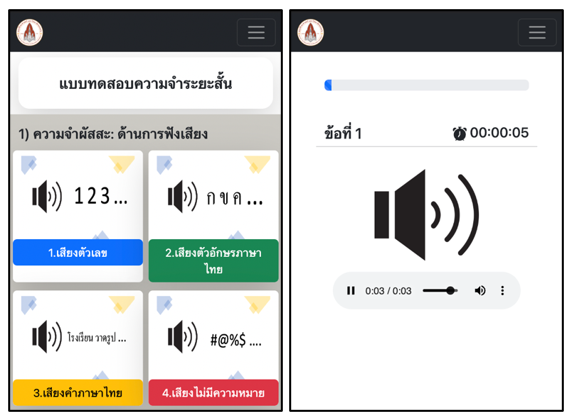
The purpose of this research is to develop the Phonological short-term memory innovation test for healthy children. Developmental research was implemented to get the information from 127 thirteen-fifteen-year students to take four tests of the innovation consisting of 1) Phonological digit task, 2) Phonological letter task, 3) Phonological word task, and 4) Phonological non-word task. The results show that (1) the innovation consists of 4 tests each has one own stimulus to show, numeric, Thai alphabet, Thai word, and non-word sound, respectively. The information from taking the tests which involve accuracy and time dimension was recorded. And The test was assessed in content validity by three experts. (2) The average score and time interval of each test was 29.66, 27.37, 29.56, and 24.00, respectively, and 250.82, 248.34, 242.23, and 256.23 seconds, respectively. Lastly, (3) The interpreted result of the satisfaction assessment was the most level.
Article Details

This work is licensed under a Creative Commons Attribution-NonCommercial-NoDerivatives 4.0 International License.
References
ทัศนีย์ บุญเติม, จตุภูมิ เขตจัตุรัส, จักรกฤษณ์ สําราญใจ, จุติมา เมทนีธร, จินตนาภรณ์ วัฒนธร, สถภาพร มัชฌิมะปุระ และคณะ. (2557). การพัฒนาเครื่องมือวัดทางพุทธิปัญญา (ฉบับภาษาไทย). กรุงเทพฯ: สํานักงานคณะกรรมการวิจัยแห่งชาติ.
ศานิตย์ ศรีคุณ. (2562). การตรวจสอบความตรงเชิงทฤษฎีของซอฟต์แวร์แบบวัดความสามารถเชิงพุทธิปัญญาในมิติความถูกต้อง. วารสารศึกษาศาสตร์ มหาวิทยาลัยขอนก่น, 42(4), 103-117.
ศานิตย์ ศรีคุณ. (2563). การตรวจสอบความตรงเชิงโครงสร้างของซอฟต์แวร์แบบวัดความสามารถเชิงพุทธิปัญญา ในมิติเวลาของนักเรียนระดับชั้นมัธยมศึกษาปีที่ 3. วารสารปัญญาภิวัฒน์, 12(3), 229 - 243.
Alamargot, D., Lambert, E., Thebault, C., & Dansac, C. (2007). Text composition by deaf and hearing middle-school students: The role of working memory. Reading and Writing, 20(4), 333 - 360.
Andersson, U., & Lyxell, B. (2007). Working memory deficit in children with mathematical difficulties: A general or specific deficit?. Journal of Experimental Child Psychology, 96(3), 197 - 228.
Baddeley, Alan. (2003). Working memory: looking back and looking forward. Nature Reviews Neuroscience, 4, 829 - 839.
Colom, R., Abad F. J., Rebollo I. & Chun Shih, P. (2005). Memory span and general intelligence: A latent-variable approach. Intelligence, 33(6), 623 - 642.
Isaki, E., Spaulding T. J., & Plante E. (2008). Contributions of language and memory demands to verbal memory performance in language-learning disabilities. Journal of Communication Disorders,
(6), 512 - 530.
Sousa, D. (2006). How the Brain Learns 3rd Edition. CA: Corwin Press, Thousand Oaks.
Spapé, M., Verdonschot, R. G., & Steenbergen, V. H. (2014). The E-Primer: An Introduction to Creating Psychological Experiments in E-Prime. Netherlands: Leiden University Press.
Sweatt J. David. (2003). Mechanisms of Memory: Introduction the Basic of Psychological Learning and Memory Theory. United Kingdom: Elsevier.
Wager, T.D., & Smith E. E. (2003). Neuroimaging studies of working memory: A meta-analysis. Cognitive, Affective, & Behavioral Neuroscience, 3(4), 255 - 274.
