
The Development of Web-Based Learning Environment Model Based on Constructivist Theory to Enhance Digital Literacy for Higher Education Students
Article Sidebar
Main Article Content
Abstract
The purpose of this research was to design and develop a constructivist learning environment model to enhance digital literacy for higher education students. This type-1 developmental research comprised of 3 phases: 1) Model Development 2) Model Validation, and 3) Model Use. The target audience was divided into 3 phases: Phase 1 consisting of 12 model quality experts, Phase 2 consisting of 9 model quality experts and 30 learners, and Phase 3 consisting of 3 model quality experts to examine the quality of the tools used for data collection and 30 learners. The study collected both quantitative and qualitative data and analyze the data with basic statistics including percentages, means, and standard deviations. The results showed that:
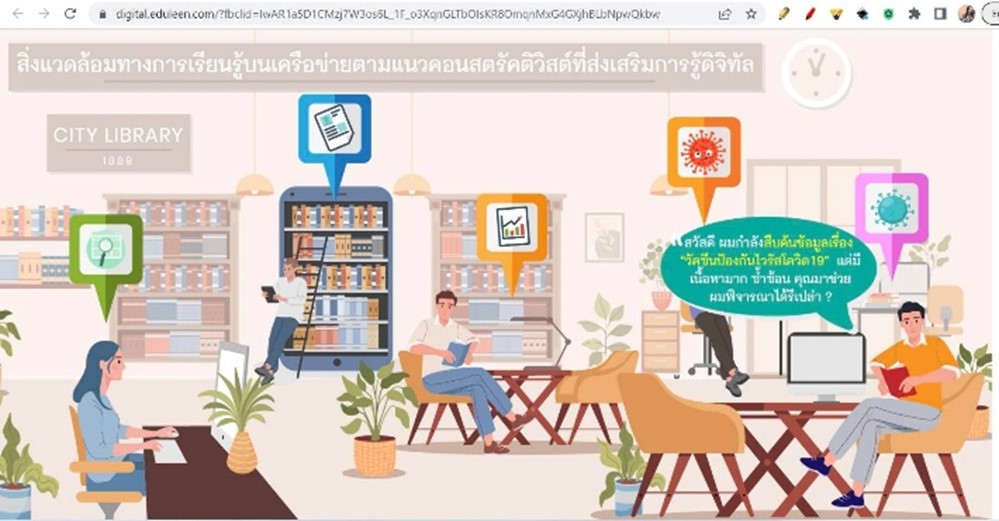
1) The design and development of the constructivist learning environment model consisted of 7 components: (1) Problem Bases, (2) Digital Literacy Center (3) Resources Center, (4) Cognitive Tools, (5) Collaboration Center (6) Scaffolding Center, and (7) Coaching Center.
2) The knowledge in digital literacy of the learners was at an excellent level with 84.86 percent of the learners passing the 80-percent criterion. The learners gained 3 main digital literacy skills: 1) Use, 2) Understand, and 3) Create.
3) 86.67 percent of the learners met the specified criterion with an average learning achievement score of 84.13 percent.
4) The correlation coefficient (r) was 0.765 with a statistically significant correlation at the .01 level, indicating that digital literacy was positively and strongly correlated with student achievement.
5) It was found from the learners ‘opinions that the content, media, and design were appropriate and supported digital literacy learning.
Article Details

This work is licensed under a Creative Commons Attribution-NonCommercial-NoDerivatives 4.0 International License.
References
ชุติมา ยิ่งสุขวัฒนา. (2547). ความรู้ความสามารถด้านการรู้สารสนเทศและคอมพิวเตอร์ขั้นพื้นฐาน สำหรับการศึกษาระดับปริญญาตรี ตามความคิดเห็นและความคาดหวังของผู้ใช้บัณฑิต มหาวิทยาลัยขอนแก่น. วิทยานิพนธ์ศึกษาศาสตรมหาบัณฑิต สาขาวิชาบรรณารักษศาสตร์และสารสนเทศศาสตร์ บัณฑิตวิทยาลัย มหาวิทยาลัยขอนแก่น.
นิตยา วงศ์ใหญ่. (2560). แนวทางการพัฒนาทักษะการรู้ดิจิทัลของดิจิทัลเนทีฟ. Veridian E-Journal Silpakorn University, 10(2), 1630-1642.
ปณิตา วรรณพิรุณ และ นำโชค วัฒนานัณ. (2560). ความฉลาดทางดิจิทัล. วารสารพัฒนาเทคนิคศึกษา, 104(34), 12–20.
แววตา เตชาทวีวรรณ และ อัจศรา ประเสริฐสิน. (2559). การพัฒนาแบบวดัการรู้ดิจิทัลสําหรับนักศึกษาระดับปริญญาตรี. กรงุเทพฯ: ภาควิชาบรรณารักษศาสตร์และสารสนเทศศาสตร์ คณะมนุษยศาสตร์มหาวิทยาลัยศรีนครินทรวิโรฒ.
ศิริรัตน์ จันทร์ใต้. (2561). ระบบสอนเสริมอัจฉริยะเพื่อทดสอบความรู้ด้านเทคโนโลยีสารสนเทศของนิสิตปริญญาตรี มหาวิทยาลัยมหาสารคาม. ภาควิชาเทคโนโลยีสารสนเทศ. คณะวิทยาการสารสนเทศ. มหาวิทยาลัยมหาสารคาม.
สํานักงานคณะกรรมการการอุดมศึกษา. (2559). กรอบมาตรฐานคุณวุฒิระดับอุดมศึกษา. ค้นเมื่อ 18 มีนาคม 2562, จาก http://www.mua.go.th/users/tqf-hed
สุมาลี ชัยเจริญ. (2559). การออกแบบการสอน หลักการ ทฤษฎี สู่การปฏิบัติ. พิมพ์ครั้งที่ 2. ขอนแก่น: สาขาวิชาเทคโนโลยีการศึกษา คณะศึกษาศาสตร์. มหาวิทยาลัยขอนแก่น.
American Library Association. (2012). Digital literacy, libraries, and public policy. Retrieved 2 March 2023, from http://www.districtdispatch.org/ wp-content/uploads/2013/01/2012_OITP_digilitreport_ 1_22_13.pdf
Bawden, D. (2008). Origins and Concepts of Digital Literacy. In Digital Literacies: Concepts, Policies and Practices. Ed. by C. Lankshear & M. Knobe. pp. 17-32. New York: Peter Lang.
Canada. Media Awareness Network. (2010). Digital Literacy in Canada: From Inclusion to Transformation. Ottawa: The Network.
Martin, A. (2008). Digital Literacy and the “Digital Society”. In Digital Literacies: Concepts, Policies and Practices. Ed. By C. Lankshear & M. Knobe. pp. 151-176. New York: Peter Lang.
UNESCO. (2013). Global Media and Information Literacy Assessment Framework: Country Readiness and Competencies. France. Retrieved March 18, 2020, from https://unesdoc.unesco.org/ark:/48223/pf0000224655
