
An Evaluation of Senior High School on English Mathematics Science Program (SEMS Program) at Demonstration School of Khon Kaen University (Mo Din Daeng) implementing CIPPI Model Approach
Article Sidebar
Main Article Content
Abstract
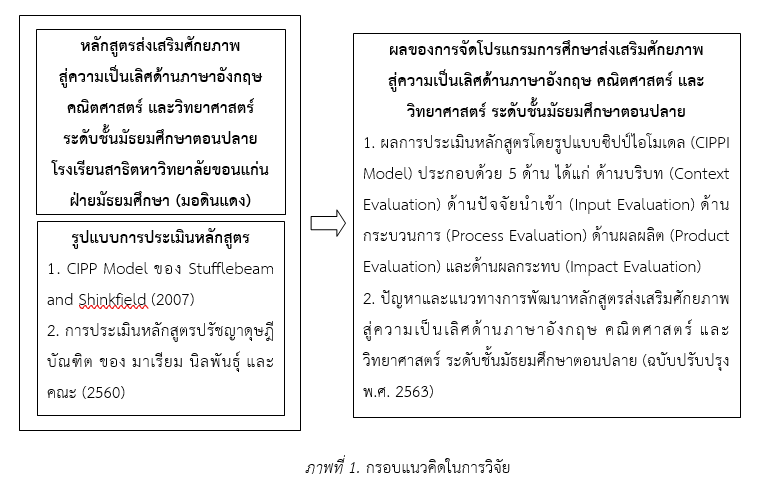
The purpose of this research were to: 1) evaluate senior high schools on the English Mathematics Science Curriculum (revised edition 2020) of The Demonstration School of Khon Kaen University, Secondary Level
(Mo Din Daeng) in terms of context, input, process, product, impact and 2) to study the problems and guidelines for developing and implementing the CIPPI Model Evaluation. The samples of this research were 34 students who enrolled in the academic year 2020, 18 guardians, 7 school administrators, 36 lecturers and 15 university lecturers, in total of 110 people. Research instruments were: 1) 3 sets of questionnaires, 2) a focus group interview form and 3) the survey. The data was analyzed using mean and standard deviation and content analysis. The research findings are as follows: 1) the comments and opinions of students, guardians, lecturers, school administrators and university lecturers towards the curriculum was aligned and appropriate at the highest level. Interestingly, lecturers and school administrators had the strongest opinions towards the process evaluation. Moreover, 2) students and guardians suggested that the curriculum ought to be adjusted in terms of variety of supplementary subjects and elective courses, and the access to a reliable Wi-Fi signal. Lecturers and school administrators suggested that the curriculum ought to be adjusted in terms of utilizing the active learning process and the main emphasis should be on learning skills and innovation enhancement in the 21st century. In addition, the seminars should be established for lecturers so they can develop their body of knowledge in the areas of curriculum, instruction and learning management, including classroom research to improve students’ learning proficiency. The university lecturers suggested that the curriculum required the adjustment of supplementary subjects which were the curriculum highlight, such as: design thinking subjects, soft skill enhancement courses and information technology literacy courses to prepare the students for the new changes.
Article Details

This work is licensed under a Creative Commons Attribution-NonCommercial-NoDerivatives 4.0 International License.
References
กระทรวงศึกษาธิการ. (2552). หลักสูตรแกนกลางการศึกษาขั้นพื้นฐาน พ.ศ. 2551. กรุงเทพฯ: ชุมนุมสหกรณ์การเกษตรแห่งประเทศไทย.
ณัฐวรรณ เฉลิมสุข. (2563). การประเมินหลักสูตรโรงเรียนสาธิต “พิบูลบำเพ็ญ” มหาวิทยาลัยบูรพา โปรแกรมการศึกษานานาชาติขั้นพื้นฐาน (มัธยมศึกษา). วารสารศึกษาศาสตร์สาร มหาวิทยาลัยเชียงใหม่, 4(2), 16–30.
ทิพยาภา มานะสม. (2564). การประเมินหลักสูตรโรงเรียนสาธิต “พิบูลบำเพ็ญ” มหาวิทยาลัยบูรพา โปรแกรมอังกฤษ-สังคม. วารสารศึกษาศาสตร์ มหาวิทยาลัยบูรพา, 32(2), 106–119.
ธานินทร์ ศิลป์จารุ. (2553). การวิจัยและวิเคราะห์ข้อมูลทางสถิติด้วย SPSS. พิมพ์ครั้งที่ 11. กรุงเทพฯ: บิสซิเนสอาร์แอนด์ดี.
ธีรชัย เนตรถนอมศักดิ์. (2561). การพัฒนาหลักสูตรและกระบวนการเรียนรู้ในระดับประถมศึกษา. ขอนแก่น: คลังนานาวิทยา.
พิมพันธ์ เดชะคุปต์ และพเยาว์ ยินดีสุข. (2558). การจัดการเรียนรู้ในศตวรรษที่ 21. พิมพ์ครั้งที่ 2. โรงพิมพ์แห่งจุฬาลงกรณ์มหาวิทยาลัย.
มาเรียม นิลพันธุ และคณะ. (2560). การประเมินหลักสูตรปรัชญาดุษฎีบัณฑิต สาขาวิชาหลักสูตรและการสอน (หลักสูตรปรับปรุง พ.ศ. 2556) คณะศึกษาศาสตร์ มหาวิทยาลัยศิลปากร. วารสาร E–Veridian, Silpakorn University, 10(2), 1198–1216.
รัตนะ บัวสนธ์. (2556). รูปแบบการประเมิน CIPP และ CIPIEST มโนทัศน์ที่คลาดเคลื่อนและถูกต้องในการใช้. วารสารศิลปากรศึกษาศาสตร์วิจัย, 5(2), 7–24.
รุจิราพร รามศิริ, ณชพงศ์ อุดมศรี และสุมิตร สุวรรณ. (2564). การประเมินหลักสูตรโรงเรียนสาธิตแห่งมหาวิทยาลัย เกษตรศาสตร์ วิทยาเขตกำแพงแสน ศูนย์วิจัยและพัฒนาการศึกษา ตามหลักสูตรแกนกลางการศึกษาขั้นพื้นฐาน พุทธศักราช 2551 (ฉบับปรับปรุง พ.ศ. 2560). วารสารศิลปากรศึกษาศาสตร์วิจัย, 13(2), 498–517.
วาสนา กีรติจำเริญ, สิรินาถ จงกลกลาง, สายสุนีย์ เติมสินสุข, อดิศร เนาวนนท, สิริรัตน นาคิน, อิสรา พลนงค์ และสุภาวดี วิสุวรรณ. (2564). ผลของการจัดโปรแกรมการศึกษาระดับบัณฑิตศึกษาทางด้านหลักสูตรและการสอนของ คณะครุศาสตร์ มหาวิทยาลัยราชภัฏนครราชสีมา โดยใชรูปแบบการประเมินแบบซิปโมเดล. วารสารศึกษาศาสตร์ มหาวิทยาลัยขอนแกน, 5(2), 63–75.
วิชัย วงษ์ใหญ่ และมารุต พัฒผล. (2558). จากหลักสูตรแกนกลางสู่หลักสูตรสถานศึกษา: กระบวนทัศน์ใหม่การพัฒนา. พิมพ์ครั้งที่ 8. กรุงเทพฯ: จรัลสนิทวงศ์การพิมพ์.
สหวรัชญ์ พลหาญ. (2566). ทักษะแห่งอนาคตสำหรับคนรุ่นใหม่: การทบทวนวรรณกรรมแบบกำหนดขอบเขต. วารสารศึกษาศาสตร์ มหาวิทยาลัยขอนแก่น. 46(1), 56–75.
สำนักงานเลขาธิการสภาการศึกษา. (2560). แผนการศึกษาแห่งชาติ พ.ศ. 2560-2579. กรุงเทพฯ: พริกหวานกราฟฟิค.
สิทธิพล อาจอินทร์. (2563). การประเมินหลักสูตร: ทฤษฎีและปฏิบัติ. ขอนแก่น: คณะศึกษาศาสตร์ มหาวิทยาลัยขอนแก่น.
อิทธิเดช น้อยไม้. (2564). การประเมินหลักสูตรโรงเรียนสาธิต “พิบูลบำเพ็ญ” มหาวิทยาลัยบูรพา โปรแกรมอังกฤษ-คณิตศาสตร์. วารสารศึกษาศาสตร์ มหาวิทยาลัยนเรศวร, 23(3), 382–394.
Stufflebeam, D. L. & Anthony J. Shinkfield. (2007). Evaluation Theory Models and Applications.
San Francisco: Jossey-Bass.
Stufflebeam, D. L., et al. (1971). Educational Evaluation and Division Making. Itasca, IIT: Peacock.
