
Developing a Teacher Production Model for School Development of Local Communities
Article Sidebar
Main Article Content
Abstract
The objectives of this study were to: 1) Study the basic information on developing a teacher production model for local community school development. 2) Develop a teacher production model for this purpose. 3) Study the opinions of those involved in the teacher production model. Participants were divided according to the research steps: 1) The population used for studying basic information included 54 individuals involved in the Kru-Rak-Tin project. 2) The population used for developing the model consisted of 14 sub-project researchers. 3) The sample group for studying opinions consisted of 55 randomly selected individuals involved in the Kru-Rak-Tin project. Research tools included: 1) An in-depth interview form for gathering basic information, 2) A form for recording small group meetings, and 3) An opinion evaluation form. Data analysis involved synthesizing content from small group meetings.
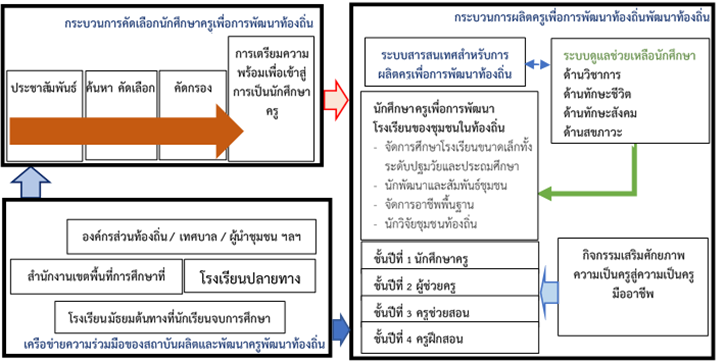
The research found that: 1) The development of a teacher production model should emphasize the collaboration network, the selection process, teacher student identity and enhancement activities, short-term special education courses, community-based research skills, student support systems, and information systems. 2) The developed teacher production model for local community school development is divided into three sectors: the selection process for teacher students, the teacher production process, and the cooperation network of teacher production and development institutes. 3) Opinions on the teacher production model showed the highest level of agreement on the search, screening, selection, preparation processes for becoming teacher students, and the importance of cooperation networks. The findings highlight the significance of visiting the area and obtaining cooperation from local people to develop a curriculum that meets local needs.
Article Details

This work is licensed under a Creative Commons Attribution-NonCommercial-NoDerivatives 4.0 International License.
References
ชนิตา รักษ์พลเมือง และคณะ. (2560). การศึกษาสภาพและปัญหาการผลิต การใช้ และการพัฒนาครูการศึกษาขั้นพื้นฐาน ที่สอดคล้องกับความต้องการในอนาคต. วารสารครุศาสตร์, 45(3).
ทุนครูรัก(ษ์)ถิ่น. (2563). โครงการสร้างโอกาศทางการศึกษาสำหรับนักเรียนในพื้นที่ห่างใกลเป็นครูรุ่นใหม่เพื่อพัฒนาคุณภาพโรงเรียนของชุมชน. กรุงเทพฯ: กองทุนเพื่อความเสมอภาคทางการศึกษา. ค้นเมื่อ 10 พฤศจิกายน 2564, จากhttps://www.eef.or.th/fund/teachereef/
รัตนะ บัวสนธ์. (2556). วิจัยเชิงคุณภาพการศึกษา. พิมพครั้งที่ 4. กรุงเทพฯ: สำนักพิมพ์แห่งจุฬาลงกรณ์มหาวิทยาลัย.
วรลักษณ์ คำหว่าง และนงลักษณ์ ใจฉลาด. (2560). แนวทางพัฒนาทักษะครูในศตวรรษที่ 21 สังกัดสำนักงานเขตพื้นที่การศึกษา มัธยมศึกษาในจังหวัดพิษณุโลก. วารสารมหาวิทยาลัยราชภัฏลำปาง, 6(1), 129-138.
ล้วน สายยศ และอังคณา สายยศ. (2540). สถิติวิทยาการวิจัย. พิมพ์ครั้งที่ 3. กรุงเทพฯ: สุวิริยาสาสน์.
ล้วน สายยศ และอังคณา สายยศ. (2538). เทคนิคการวิจัยทางการศึกษา. พิมพ์ครั้งที่ 4. กรุงเทพฯ: สุวีริยาสาส์น.
ศักดิ์ชาย เพชรช่วย และคณะ. (2560). แนวปฏิบัติที่ดีของโครงการผลิตครูในสถาบันอุดมศึกษาไทย. วารสารวิทยาลัยดุสิตธานี, 11(1).
ศุภณัฏฐ์ ศศิวุฒิวัฒน์. (2559). รายงานชุดการปฏิรูประบบบุคลากรครู: ข้อเสนอการสร้างและคัดเลือกครูสอนดีรุ่นใหม่สู่การยกระดับคุณภาพการศึกษา. กรุงเทพฯ: สถาบันวิจัยเพื่อการพัฒนาประเทศ.
สมศักดิ์ ดลประสิทธิ์. (2564). แนวทางการจัดการศึกษาเพื่อพัฒนากำลังคนในศตวรรษที่ 21. วารสารคุรุสภาวิทยาจารย์. Journal of Teacher Professional Development, 2(1).
สำนักงานคณะกรรมการข้าราชการครูและบุคลากรทางการศึกษา. (2564). กรอบแนวคิดสำคัญในการปฏิรูปวิชาชีพครู. ค้นเมื่อ 10 พฤศจิกายน 2564, จาก https://otepc.go.th/th/content_page/item/3378-pa-3.html
อภิภา ปรัชญพฤทธิ์. (2561). การพัฒนารูปแบบการผลิตครูเพื่อรองรับการศึกษายุค 4.0. กรุงเทพฯ: จุฬาลงกรณ์มหาวิทยาลัย.
Chaowarit. P., Noppadol. T., Warsittee. S., & Panupong R. (2023). The Process Development of Public Relation, Search, Screening, Selecttion, and Preparation For Admission To Scholarship Student In The Kru-Rak-Tin Project. The International Conference on Education and Social Science (ICESS): Education and Social Science. P.32-37 Feb 9-10, 2023, Kyoto, Japan.
Krittagan, D., Noppadol. T. (2022). Development of Shot-term Special Education Course for Early Childhood Teacher and Primary School Teacher Central Area under the Kru-Rak-Tin Project. Specialusis Ugdymas / Special Education 2022, 1(43), 7055-7062.
Lais, O. L., Sari, H. N., & Erkko, S. (2022). How environmental and individual factors dynamically influence student teacher professional agency during teacher education, Scandinavian Journal of Educational Research, DOI: 10.1080/00313831.2022.2127879
Miles, M. B., & Huberman, A. M. (1994). Qualitative data analysis: An expanded sourcebook. 2nd ed. Sage Publications, Inc.
Noppadol. T., Kriangwut. N., Choat I. (2023). Implementation of Kru-Rak-Tin Project by Muban Chom Bueng Rajabhat University: Lessons Learned from a Field Case Study. International Journal of Management and Applied Science (IJMAS), 9(3), 34-40.
Savickiene, I. (2010). Conception of Learning Outcomes in the Bloom's Taxonomy Affective Domain. Quality of Higher Education, 7, 37-59. https://files.eric.ed.gov/fulltext/EJ900258.pdf
Stoichici (Iavorschi), E., & Ioniță (Cristea), A. E. (2022). Dynamics of relationships between mentors and beginning teachers. Technium Social Sciences Journal, 38(1), 103–113. DOI: https://doi.org/10.47577/tssj.v38i1.7759
Tonsai. K., Tanakit. S., & Jintana. N. (2022). Development of Psychological and Life Skills Short-Term Training Courses for Full-Ride Scholarship Student: A Case Study of Muban Chombueng Rajabhat University's KRURAKTIN Scholarship. 10th International Conference on Teaching, Education & Learning (ICTEL). P.109. July 11–12, 2022. Budapest, Hungary.
