ทักษะแห่งอนาคตสำหรับคนรุ่นใหม่: การทบทวนวรรณกรรมแบบกำหนดขอบเขต
Article Sidebar
Main Article Content
บทคัดย่อ
หลายฝ่ายมีความเห็นตรงกันว่า การศึกษาต้องมีเป้าหมายใหม่ที่สอดคล้องกับความต้องการของอนาคต ซึ่งเป้าหมายเหล่านี้มักถูกเรียกว่า ทักษะแห่งอนาคตหรือทักษะแห่งศตวรรษที่ 21 ที่ช่วยเตรียมผู้เรียนให้พร้อมสำหรับอนาคตที่มาพร้อมกับความ
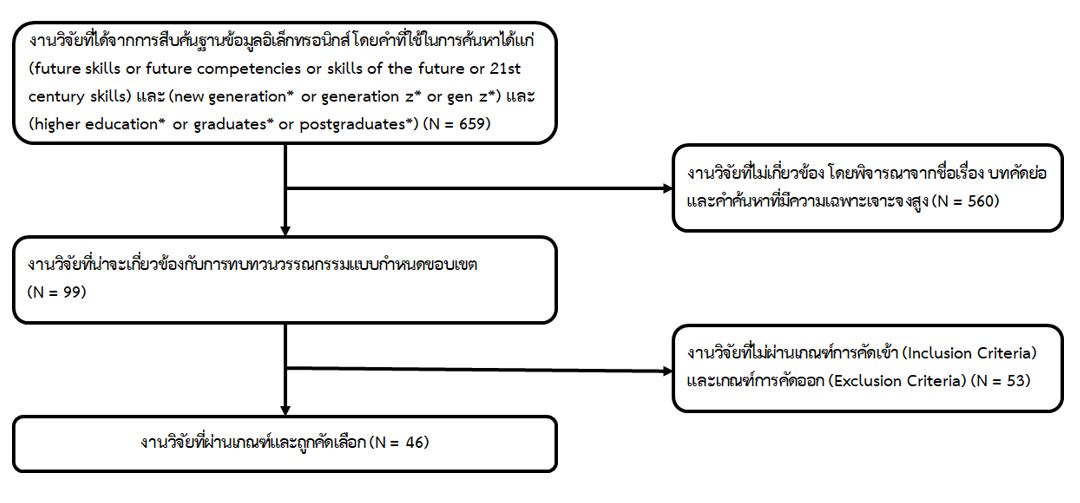
ท้าทายใหม่ ๆ แม้ว่าการศึกษาวิจัยเรื่องทักษะแห่งอนาคตที่ผ่านมาจะพยายามเชื่อมโยงและบูรณาการผลการศึกษาวิจัยเกี่ยวกับทักษะแห่งอนาคตที่มีอยู่มากมาย แต่ผลงานการทบทวนวรรณกรรมเหล่านี้จะระบุทักษะแห่งอนาคตในลักษณะเป็นการทั่วไป โดยไม่ได้ระบุทักษะแห่งอนาคตที่มีความสำคัญเป็นการเฉพาะต่อคนรุ่นใหม่ ซึ่งเป็นกลุ่มประชากรที่มีความจำเป็นเร่งด่วนที่สุดที่จะต้องได้รับการเตรียมพร้อมสำหรับการทำงานแห่งอนาคต การศึกษานี้จึงบูรณาการองค์ความรู้เกี่ยวกับทักษะแห่งอนาคตที่มีความสำคัญต่อคนรุ่นใหม่ที่มีอยู่อย่างมากมายในปัจจุบัน และสังเคราะห์เป็นกรอบแนวคิดเชิงทฤษฎีเกี่ยวกับทักษะแห่งอนาคตที่มีความสำคัญต่อคนรุ่นใหม่ที่ชัดเจนและเข้าใจได้ง่ายขึ้น การวิจัยนี้เป็นการวิจัยขั้นทุติยภูมิ โดยใช้การทบทวนวรรณกรรมแบบกําหนดขอบเขตเพื่อศึกษางานวิจัยเกี่ยวกับทักษะแห่งอนาคตที่มีความสำคัญเป็นการเฉพาะต่อคนรุ่นใหม่จำนวน 46 งานวิจัย ซึ่งมีการเสนอแนะทักษะแห่งอนาคตสำหรับผู้เรียนที่เป็นคนรุ่นใหม่หรือผู้เรียนในระดับอุดมศึกษารวมทั้งสิ้น 530 ทักษะ และใช้กระบวนการวิเคราะห์แก่นสาระพัฒนากรอบแนวคิดเชิงทฤษฎีเกี่ยวกับทักษะแห่งอนาคตที่มีความสำคัญต่อคนรุ่นใหม่ ซึ่งประกอบด้วยชุดทักษะจำนวน 7 ชุดทักษะ ผู้กำหนดนโยบายและผู้ปฏิบัติงานในภาคการศึกษาสามารถใช้กรอบแนวคิดเชิงทฤษฎีนี้ประกอบการเรียนการสอน เพื่อเตรียมคนรุ่นใหม่ให้พร้อมสำหรับอนาคตที่ท้าทาย
Article Details

อนุญาตภายใต้เงื่อนไข Creative Commons Attribution-NonCommercial-NoDerivatives 4.0 International License.
เอกสารอ้างอิง
ACT. (2015). Beyond Academics: A holistic framework for enhancing education and workplace success. https://www.act.org/content/dam/act/unsecured/documents/ACT_RR2015-4.pdf
Akyazi, T., Goti, A., Oyarbide, A., Alberdi, E., & Bayon, F. (2020). A guide for the food industry to meet the future skills requirements emerging with industry 4.0. Foods, 9(4), 492. https://doi.org/10.3390/foods9040492
Al Kandari, A. M., & Al Qattan, M. M. (2020). E-task-based learning approach to enhancing 21st-century learning outcomes. International Journal of Instruction, 13(1), 551-566.
Ananiadou, K., & Claro, M. (2009). 21st century skills and competences for new millennium learners in OECD countries. https://tuv.oer4pacific.org/id/eprint/4/1/OECD-Work.pdf
Arksey, H., & O'Malley, L. (2005). Scoping studies: towards a methodological framework. International journal of social research methodology, 8(1), 19-32.
Bakhshi, H., Downing, J. M., Osborne, M. A., & Schneider, P. (2017). The future of skills: Employment in 2030. Pearson. https://ora.ox.ac.uk/objects/uuid:86577437-1353-4743-8520-401c1f99ad1b/download_file?file_format=pdf&safe_filename=Future%2Bof%2Bskills%2BVoR.pdf&type_of_work=Report
Balistreri, S., Di Giacomo, F. T., Noisette, I., & Ptak, T. (2012). Global Education: Connections, concepts, and careers. https://files.eric.ed.gov/fulltext/ED562681.pdf
Barrett, M. (2016). Competences for democratic culture: Living together as equals in culturally diverse democratic societies. https://rm.coe.int/16806ccc07
Binkley, M., Erstad, O., Herman, J., Raizen, S., Ripley, M., Miller-Ricci, M., & Rumble, M. (2012). Defining twenty-first century skills. In P. Griffin & E. Care (Eds.), Assessment and teaching of 21st century skills: Methods and approach (pp. 17-66). Springer.
Brewer, M. L., Van Kessel, G., Sanderson, B., Naumann, F., Lane, M., Reubenson, A., & Carter, A. (2019). Resilience in higher education students: A scoping review. Higher Education Research & Development, 38(6), 1105-1120. https://doi.org/10.1080/07294360.2019.1626810
Brynjolfsson, E., & McAfee, A. (2014). The second machine age: Work, progress, and prosperity in a time of brilliant technologies. WW Norton & Company.
Burrus, J., Jackson, T., Xi, N., & Steinberg, J. (2013). Identifying the most important 21st century workforce competencies: An analysis of the Occupational Information Network (O* NET). Educational Testing Service. https://onlinelibrary.wiley.com/doi/pdf/10.1002/j.2333-8504.2013.tb02328.x
CASEL. (2019). CASEL’s framework for systemic social and emotional learning. https://measuringsel.casel.org/wp-content/uploads/2019/08/AWG-Framework-Series-B.2.pdf
Chen, D. (2019). Toward an understanding for assessing 21st-century skills: Based on literature and national assessment practice. https://files.eric.ed.gov/fulltext/ED606274.pdf
Cicek, K., Akyuz, E., & Celik, M. (2019). Future skills requirements analysis in maritime industry. Procedia Computer Science, 158, 270-274.
Connecticut State Department of Education. (2018). Components of social, emotional, and intellectual habits: Kindergarten through grade 3. https://portal.ct.gov/-/media/SDE/Board/BoardMaterials010318/The_Components_of_Social_Emotional_and_Intellectual_Habits_Kindergarten_through_Grade_3.pdf
Dondi, M., Klier, J., Panier, F., & Schubert, J. (2021). Defining the skills citizens will need in the future world of work. McKinsey Global Institute. https://comskills.co.uk/wp-content/uploads/2021/11/defining-the-skills-citizens-will-need-in-the-future-world-of-work.pdf
Dragon, T., Mavrikis, M., McLaren, B. M., Harrer, A., Kynigos, C., Wegerif, R., & Yang, Y. (2013). Metafora: A web-based platform for learning to learn together in science and mathematics. IEEE Transactions on Learning Technologies, 6(3), 197-207.
Economist Intelligence Unit (2015) Driving the skills agenda: Preparing students for the future. https://static.googleusercontent.com/media/edu.google.com/en//pdfs/skills-of-the-future-report.pdf
Ehlers, U. D. (2020). Future Skills: Future Learning, Future Higher Education. Books on Demand.
European Commission Joint Research Centre. (2016). EntreComp: The entrepreneurship competence framework. https://publications.jrc.ec.europa.eu/repository/bitstream/JRC101581/lfna27939enn.pdf
Francis, T., & Hoefel, F. (2018). True Gen’: Generation Z and its implications for companies. McKinsey & Company. http://www.drthomaswu.com/uicmpaccsmac/Gen%20Z.pdf
Frey, C. B., & Osborne, M. A. (2017). The future of employment: How susceptible are jobs to computerisation?. Technological forecasting and social change, 114, 254-280. https://doi.org/10.1016/j.techfore.2016.08.019
Gates, S., Lippman, L., Shadowen, N., Burke, H., Diener, O., & Malkin, M. (2016). Key soft skills for cross-sectoral youth outcomes. https://www.fhi360.org/sites/default/files/media/documents/resource-soft-skills-report.pdf
Grbich, C. (2007). An introduction: Qualitative data analysis. SAGE.
Guerra, N., Modecki, K., & Cunningham, W. (2014). Developing social-emotional skills for the labor market: The PRACTICE model. https://papers.ssrn.com/sol3/Delivery.cfm/7123.pdf?abstractid=2530772&mirid=1
Hariharasudan, A., & Kot, S. (2018). A scoping review on Digital English and Education 4.0 for Industry 4.0. Social sciences, 7(11), 227. https://doi.org/10.3390/socsci7110227
Heckman, J. J., & Kautz, T. (2012). Hard evidence on soft skills. Labour economics, 19(4), 451-464. https://doi.org/10.1016/j.labeco.2012.05.014
International Association for the Evaluation of Educational Achievement. (2013). International computer and information literacy study: Assessment framework. https://www.iea.nl/sites/default/files/2019-04/ICILS_2013_Framework.pdf
Jackson, D. (2014). Testing a model of undergraduate competence in employability skills and its implications for stakeholders. Journal of education and work, 27(2), 220-242.
Kenya Institute of Curriculum Development. (2017). Basic education curriculum framework. https://kicd.ac.ke/wp-content/uploads/2017/10/CURRICULUMFRAMEWORK.pdf
Kirchherr, J. W., Klier, J., Lehmann-Brauns, C., & Winde, M. (2018). Future skills: Which skills are lacking in Germany. https://www.stifterverband.org/download/file/fid/7116
Lippman, L. H., Ryberg, R., Carney, R., & Moore, K. A. (2015). Key “soft skills” that foster youth workforce success: Toward a consensus across fields. https://www.childtrends.org/wp-content/uploads/2015/06/2015-24WFCSoftSkills1.pdf
Media Smarts. (2018). Classroom guide: Integrating digital literacy into your classroom practice. https://mediasmarts.ca/sites/default/files/guides/classroom_guide_digital_literacy.pdf
Ministry of Education Singapore. (2020). 21st century competencies. https://www.moe.gov.sg/education-in-sg/21st-century-competencies
Nagaoka, J., Farrington, C. A., Ehrlich, S. B., Johnson, D. W., Dickson, S., Heath, R., & Mayo, A. (2014).
A framework for developing young adult success in the 21st century. https://consortium.uchicago.edu/sites/default/files/2019-01/Wallace-Framework-White-Paper.pdf
NESET. (2018). Strengthening social and emotional education as a core curricular area across the EU: A review of the international evidence. https://nesetweb.eu/wp-content/uploads/AR3_Full-Report.pdf
Nesta (2017) Skills, attitudes, and behaviors that fuel public innovation. https://media.nesta.org.uk/documents/Nesta_CompetencyFramework_Guide_July2019.pdf
Niemi, H., Harju, V., Vivitsou, M., Viitanen, K., Multisilta, J., & Kuokkanen, A. (2014). Digital storytelling for 21st-century skills in virtual learning environments. Creative Education 5(9), 657-671. https://doi.org/10.4236/ce.2014.59078
OECD. (2016). Preliminary reflections and research on knowledge, skills, attitudes, and values necessary for 2030. https://www.oecd.org/education/2030-project/about/documents/PRELIMINARY-REFLECTIONS-AND-RESEARCH-ON-KNOWLEDGE-SKILLS-ATTITUDES-AND-VALUES-NECESSARY-FOR-2030.pdf
OECD. (2018) The future of education and skills: Education 2030. https://www.oecd.org/education/2030/E2030%20Position%20Paper%20(05.04.2018).pdf
Parker, K., & Igielnik, R. (2020). On the cusp of adulthood and facing an uncertain future: What we know about Gen Z so far. Pew Research Center. https://www.pewresearch.org/social-trends/2020/05/14/on-the-cusp-of-adulthood-and-facing-an-uncertain-future-what-we-know-about-gen-z-so-far-2/
Partnership for 21st Century Learning. (2019). Framework for 21st century learning. https://www.teacherrambo.com/file.php/1/21st_century_skills.pdf
Pratham. (2018). Importance of life skills: Pratham’s approach. https://kashmirreader.com/2021/03/13/importance-of-life-skills-prathams-approach/
Ravitz, J. (2014). A survey for measuring 21st century teaching and learning: West Virginia 21st century teaching and learning survey. Office of Research, West Virginia Department of Education.
Romero, M., Lambropoulos, N., & Birwatkar, V. (2015). Introducing preservice primary education teachers to the 21st century skills: Changing schools as learning organizations by utilizing digital games. In Szucs, A., & Mázár, I. (Eds.), Transforming schools into innovative learning organisations (pp. 176-182). European Distance and E-Learning Network.
Room to Read. (2016). Advancing the agency of adolescent girls. https://www.roomtoread.org/media/gkni2y0u/gep-evaluation-2016-18-rajasthan-final-report.pdf
Saavedra, A. R., & Opfer, V. D. (2012). Teaching and learning 21st century skills: Lessons from the learning sciences. A Global Cities Education Network Report. https://www.opsba.org/wp-content/uploads/2021/02/RANDPaper.pdf
Schoon, I., Nasim, B., Sehmi, R., & Cook, R. (2015). The impact of early life skills on later outcomes. https://discovery.ucl.ac.uk/id/eprint/10051902/1/Schoon_2015%20The%20Impact%20of%20Early%20Life%20Skills%20on%20Later%20Outcomes_%20Sept%20fin2015.pdf
Schroth, H. (2019). Are you ready for Gen Z in the workplace?. California Management Review, 61(3), 5-18. https://doi.org/10.1177/0008125619841006
Smith, C., McGovern, G., Larson, R. W., Hillaker, B., & Peck, S. C. (2016). Preparing youth to thrive: Promising practices in social & emotional learning. https://measuringsel.casel.org/wp-content/uploads/2019/08/AWG-Framework-Series-B.5.pdf
Soland, J., Hamilton, L. S., & Stecher, B. M. (2013). Measuring 21st century competencies: Guidance for educators. https://asiasociety.org/files/gcen-measuring21cskills.pdf
The Open University. (2012). Digital and information literacy framework. https://www.open.edu/openlearn/pluginfile.php/801340/mod_resource/content/3/Session%205%20Open%20University%20Digital%20and%20Information%20Literacy%20Framework.pdf
Tran, T. T. (2015). Is graduate employability the ‘whole-of-higher-education-issue’?. Journal of Education and Work, 28(3), 207-227. https://doi.org/10.1080/13639080.2014.900167
Transforming Education in partnership with the CORE Districts. (2016). Measuring MESH: Student and teacher surveys curated for the CORE districts. https://transformingeducation.org/wp-content/uploads/2017/04/160406_MeasuringMESH_ForRelease2.pdf
Turnaround for Children. (2016). Building blocks for learning: A framework for comprehensive student development. https://turnaroundusa.org/wp-content/uploads/2016/03/Turnaround-for-Children-Building-Blocks-for-Learningx-2.pdf
UNESCO. (2013). Toward universal learning: recommendations from the Learning Metrics Task Force. https://unesdoc.unesco.org/ark:/48223/pf0000223116
UNESCO. (2019). Futures literacy: An essential competency for the 21st century. https://en.unesco.org/futuresliteracy/about
UNICEF. (2019). Comprehensive life skills framework: Rights based and life cycle approach to building skills for empowerment. https://www.unicef.org/india/media/2571/file/Comprehensive-lifeskills-framework.pdf
U.S. Department of Education. (2018). Technology and engineering literacy framework for the 2018 national assessment of educational progress. https://files.eric.ed.gov/fulltext/ED594359.pdf
Van Laar, E., Van Deursen, A. J., Van Dijk, J. A., & De Haan, J. (2017). The relation between 21st-century skills and digital skills: A systematic literature review. Computers in human behavior, 72, 577-588. https://doi.org/10.1016/j.chb.2017.03.010
Voogt, J., & Pelgrum, H. (2005). ICT and curriculum change. Human Technology, 1(2), 157-175.
Wang, Y., Lavonen, J., & Tirri, K. (2018). Aims for learning 21st century competencies in national primary science curricula in China and Finland. Eurasia journal of mathematics science and technology education. 14(6), 2081-2095. https://doi.org/10.29333/ejmste/86363
White, L. A., Saleem, S., Dhuey, E., & Perlman, M. (2022). A critical analysis of international organizations’ and global management consulting firms’ consensus around twenty-first century skills. Review of International Political Economy, 1-26. https://doi.org/10.1080/09692290.2022.2097289
Williams, A. (2015). Move over, millennials, here comes Generation Z. The New York Times. https://www.nytimes.com/2015/09/20/fashion/move-over-millennials-here-comes-generation-z.html
Wood, S. (2013). Generation Z as consumers: trends and innovation. North Carolina State University, Institute for Emerging Issues. https://archive.iei.ncsu.edu/wp-content/uploads/2013/01/GenZConsumers.pdf
World Economic Forum. (2020). The future of jobs report 2020. https://www.weforum.org/reports/the-future-of-jobs-report-2020/
