สภาพปัจจุบันในการจัดการเรียนรู้โดยใช้ประเด็นทางสังคมที่เกี่ยวเนื่องกับวิทยาศาสตร์เป็นฐาน โรงเรียนมัธยมศึกษาแห่งหนึ่งในจังหวัดอุดรธานี
Article Sidebar
Main Article Content
บทคัดย่อ
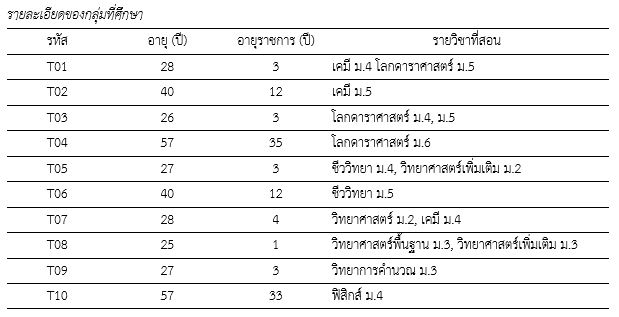
การวิจัยครั้งเป็นการวิจัยเชิงคุณภาพมีวัตถุประสงค์เพื่อศึกษาสภาพปัจจุบันในการจัดการเรียนรู้โดยใช้ประเด็นทางสังคมที่เกี่ยวเนื่องกับวิทยาศาสตร์เป็นฐานและลักษณะของการพัฒนาครูเพื่อส่งเสริมการจัดการเรียนรู้โดยใช้ประเด็นทางสังคมที่เกี่ยวเนื่องกับวิทยาศาสตร์เป็นฐานโดยกลุ่มที่ศึกษาเป็นครูวิทยาศาสตร์ระดับมัธยมศึกษา โรงเรียนมัธยมศึกษาขนาดใหญ่แห่งหนึ่งในจังหวัดอุดรธานี จำนวน 10 คน ได้มาจากการเลือกแบบเจาะจง เก็บข้อมูลโดยใช้แบบสัมภาษณ์กึ่งโครงสร้างและวิเคราะห์ข้อมูลเชิงคุณภาพแบบอุปนัยผลการศึกษาเกี่ยวกับสภาพปัจจุบันในการจัดการเรียนรู้โดยใช้ประเด็นทางสังคมที่เกี่ยวเนื่องกับวิทยาศาสตร์เป็นฐาน พบว่ากลุ่มที่ศึกษาทุกคนมีประสบการณ์ในการใช้ประเด็นทางสังคมทั่วไปในการจัดการเรียนรู้วิทยาศาสตร์และครึ่งหนึ่งของจำนวนดังกล่าวใช้ประเด็นที่มีลักษณะตามนิยามของประเด็นทางสังคมที่เกี่ยวเนื่องกับวิทยาศาสตร์ส่วนมากใช้ประเด็นเพื่อการนำเข้าสู่บทเรียนหรือการขยายความรู้เท่านั้น (4/5) ไม่ได้ใช้เพื่อขับเคลื่อนกิจกรรมการเรียนรู้มีเป้าหมายในการจัดการเรียนรู้วิทยาศาสตร์ให้นักเรียนเกิดการเชื่อมโยงสิ่งที่เรียนรู้ด้วยเหตุและผล (4/10) นักเรียนมีบทบาทในการอภิปรายในชั้นเรียน (8/10) ส่วนมากใช้สื่อวิดีโอเพื่อให้นักเรียนเข้าใจในประเด็นที่นำเข้าสู่บทเรียนได้ดีขึ้น (7/10) มีการวัดและประเมินทั้งระหว่างเรียนและเพื่อสรุปบทเรียน (10/10) ผลการศึกษาเกี่ยวกับลักษณะของรูปแบบการพัฒนาครูส่วนมากเสนอว่าควรเป็นกิจกรรมเชิงปฏิบัติการ (7/10) ให้ครูได้ลงมือทำจริง มีความต่อเนื่องมีการสะท้อนผลและติดตามผลได้ลองเป็นนักเรียนสิ่งดังกล่าวเป็นประโยชน์ต่อการสร้างกิจกรรมพัฒนาครูเพื่อส่งเสริมการจัดการเรียนรู้โดยใช้ประเด็นทางสังคมที่เกี่ยวเนื่องกับวิทยาศาสตร์เป็นฐานอย่างเหมาะสมตามบริบทของสถานศึกษา
Article Details

อนุญาตภายใต้เงื่อนไข Creative Commons Attribution-NonCommercial-NoDerivatives 4.0 International License.
เอกสารอ้างอิง
กระทรวงศึกษาธิการ. (2560). ตัวชี้วัดและสาระการเรียนรู้แกนกลาง กลุ่มสาระการเรียนรู้วิทยาศาสตร์ (ฉบับปรังปรุง 2560)
ตามหลักสูตรแกนกลางการศึกษาขั้นพื้นฐาน พุทธศักราช 2551. กรุงเทพฯ: โรงพิมพ์สหกรณ์ชุมนุมการเกษตรแห่งประเทศไทย.
นนทวัฒน์ เกตุไชโย และ ดวงกมล ไตรวิจิตรคุณ. (2561). การนำเสนอแนวทางในการพัฒนาครูของโรงเรียนนภสร จังหวัด
ปทุมธานี. An Online Journal of Education, 13(3), 504-515.
พิรุณ ไพสนิท และ ดวงกมล ไตรวิจิตรคุณ. (2557). การวิจัยและพัฒนากลยุทธ์การวิจัยเพื่อยกระดับการรู้วิทยาศาสตร์.
An Online Journal of Education, 9(2), 739-752.
ภูษณิศา สุวรรณศิลป์ และ ชนินันท์ พฤกษ์ประมูล. (2020). การศึกษาทักษะการโต้แย้งทางวิทยาศาสตร์ของนักศึกษา
ครูวิทยาศาสตร์ โดยใช้ประเด็นทางสังคมที่เกี่ยวเนื่องกับวิทยาศาสตร์เรื่อง บั้งไฟพญานาค. ARU Research Journal Humanities and Social Sciences, 7(1), 49-56.
สถาบันส่งเสริมการสอนวิทยาศาสตร์และเทคโนโลยี (สสวท.). (2561). ผลการประเมิน PISA 2015 วิทยาศาสตร์
การอ่าน และคณิตศาสตร์ฉบับสมบูรณ์. กรุงเทพฯ: สถาบันส่งเสริมการสอนวิทยาศาสตร์และเทคโนโลยี (สสวท.).
สถาบันส่งเสริมการสอนวิทยาศาสตร์และเทคโนโลยี (สสวท.). (2564). ผลการประเมิน PISA 2018 การอ่าน คณิตศาสตร์และวิทยาศาสตร์. กรุงเทพฯ: สถาบันส่งเสริมการสอนวิทยาศาสตร์และเทคโนโลยี (สสวท.).
สำนักงานคณะกรรมการการศึกษาแห่งชาติ. (2545). พระราชบัญญัติการศึกษาแห่งชาติ พ.ศ. 2542 และที่แก้ไขเพิ่มเติม
(ฉบับที่ 2) พ.ศ. 2545. กรุงเทพฯ: พริกหวานกราฟฟิก.
ศศิเทพ ปิติพรเทพิน. (2558). การจัดการเรียนรู้วิทยาศาสตร์กับสังคมแห่งศตวรรษที่ 21. กรุงเทพฯ: บอสส์การพิมพ์.
Foong, C. C., & Daniel, E. G. (2013). Students’ argumentation skills across two socio-scientific issues in
a Confucian classroom: Is transfer possible? International Journal of Science Education, 35(14), 2331-2355.
Genc, M. (2015). The effect of scientific studies on students, scientific literacy and attitude. Ondokuz Mayis University Journal of Faculty of Education, 34(1), 41-152. doi: 10.782/omuefd.34.1.8.
Herman, B. C., Zeidler, D. L., & Newton, M. (2018). Students’ emotive reasoning through place-based
environmental socioscientific issues. Research in Science Education. 1-29.
Kay, K. (2010). 21st century skills: Why they matter, what they are, and how we get there. 21st century
skills: Rethinking how students learn.
Ketsing, J., Inoue, N., & Buczynski, S. (2020). Enhancing Pre-service Teachers’ Reflective Quality on Inquiry-based Teaching Through a Community of Practice. Science Education International, 31(4), 367-378.
Lee, H., Yoo, J., Choi, K., Kim, S. W., Krajcik, J., Herman, B. C., & Zeidler, D. L. (2013). Socioscientific issues as a vehicle for promoting character and values for global citizens. International Journal of Science Education, 35, 2079–2113.
Louis, K. S., & Marks, H. M. (1998). Does professional community affect the classroom? Teachers’ work and student experiences in restructuring schools. American Journal of Education, 106, 532–574.
Owens, D. C., Sadler, T. D., & Friedrichsen, P. (2019). Teaching practices for enactment of socio-scientific issues instruction: An instrumental case study of an experienced biology teacher. Research in Science Education, 1-24.
Pitpiorntapin, S., & Topcu, M. S. (2016). Teaching based on socioscientific issues in science classrooms:
A review study. KKU International Journal of Humanities and Social Sciences, 6(1), 119-136.
Pope, C. & Mays, N. (2002). Qualitative methods in research on healthcare quality. Qual Saf Health Care. 11(2), 148–152.
Presley, M. L., Sickel, A. J., Muslu, N., Merle-Johnson, D., Witzig, S. B., Izci, K., & Sadler, T. D. (2013).
A framework for socio-scientific issues-based education. Science Educator, 22(1), 26-32.
Reckwitz, A. (2002). Toward a theory of social practices: A Development in Culturalist Theorizing.
European Journal of Social Theory, 5(2), 243–263.
Sadler, T. D. (2004). Informal reasoning regarding socio-scientific issues: A critical review of research.
Journal of Research in Science Teaching, 41, 513–536.
Sadler, T. D. (2011). Socio-scientific Issues in the classroom, teaching, learning and research.
Contemporary Trends and Issues in Science Education Volume 39, New York: Springer, 4-5.
Sadler, T. D., Barab, S. A., & Scott, B. (2007). What do students gain by engaging in socioscientific
inquiry? Research in Science Education. 37(4), 371-391.
Sadler, T. D., Chambers, F. W., & Zeidler, D. L. (2004). Student conceptualizations of the nature of science in response to a socioscientific issue. International Journal of Science Education, 26(4), 387-409.
Solbes, J., Torres, N., & Traver, M. (2018, June). Use of socio-scientific issues in order to improve critical
thinking competences. In Asia-Pacific Forum on Science Learning and Teaching (Vol. 19, No. 1,
p. 1). The Education University of Hong Kong, Department of Science and Environmental Studies.
Spillane, J. P. (2012). Data in practice: Conceptualizing the data-based decision-making phenomena.
American Journal of Education, 118(2), 113–141.
Stein, S. (2021). Reimagining global citizenship education for a volatile, uncertain, complex, and ambiguous (VUCA) world. Globalisation, Societies and Education, 1-14.
Topçu, M. S., Foulk, J. A., Sadler, T. D., Pitiporntapin, S., & Atabey, N. (2018). The classroom observation
protocol for socioscientific issue-based instruction: development and implementation of a new research tool. Research in Science & Technological Education, 36(3), 302-323.
Windschitl, M., Thompson, J., Braaten, M., & Stroupe, D. (2012). Proposing a core set of instructional
practices and tools for teachers of science. Science Education, 96, 878–903.
