
Antecedents and Consequence of Career Adaptability among Applied Thai Traditional Medicine Students
Article Sidebar
Main Article Content
Abstract
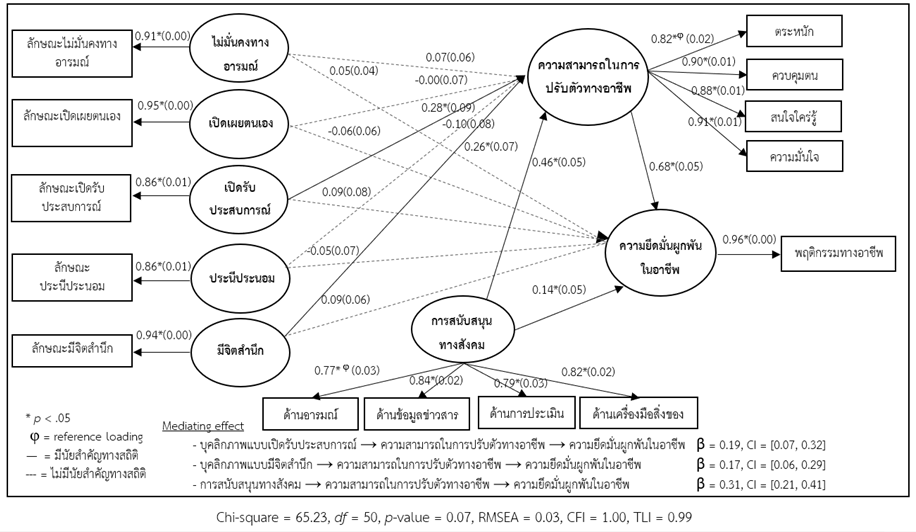
This research aims to study the following: (1) to analyze the level of career adaptability, the Five-Factor Model of personality, social support, and career engagement was applied to Thai traditional medicine students; and (2) to test the effects of the Five-Factor Model of Personality and social support on career engagement with the mediating effect of career adaptability. The data were collected by a proportional stratified random sampling from 373 applied Thai traditional medicine students, who were in third and fourth year. A questionnaire was used as a tool in this study. The descriptive statistics and structural equation modeling (SEM) analyzed the data with the following results: (1) the students had an agreeable and conscientious personality at a high level. The students also had career adaptability, social support, and career engagement at a high level; (2) the fit statistics for this analysis, Chi-square = 65.23, df = 50,
p = 0.07, RMSEA = 0.03, CFI = 1.00, TLI = 0.99, demonstrated a good fit to the data, and this model explained 66% of the career engagement variance; and (3) the factor of career adaptability fully mediated the relationship between the personality dimension, openness to experience and conscientiousness, and career engagement, while partially mediated the relationship between social support and career engagement. Therefore, career adaptability and social support should be promoted equally in all dimensions.
Article Details

This work is licensed under a Creative Commons Attribution-NonCommercial-NoDerivatives 4.0 International License.
References
กัณฐิกา บรรลือ. (2553). บุคลิกภาพแบบหลงตนเองและบุคลิกภาพห้าองค์ประกอบ ในฐานะตัวทำนายการเกิดผู้นำในกลุ่มที่ไม่คุ้นเคยกัน. วิทยานิพนธ์ปริญญามหาบัณฑิต จุฬาลงกรณ์มหาวิทยาลัย กรุงเทพฯ. ค้นเมื่อ 8 ตุลาคม 2563, จาก http://cuir.car.chula.ac.th/handle/123456789/20548
ขวัญชนก เทพปัน นวรัตน์ สุวรรณผ่อง นพพร โหวธีระกุล และ มธุรส ทิพยมงคลกุล. (2560). การตัดสินใจเลือกใช้บริการแพทย์แผนไทยของประชาชนผู้มาใช้บริการที่โรงพยาบาลทั่วไป จังหวัดราชบุรี. วารสารวิทยาลัยพยาบาลพระปกเกล้า จันทบุรี, 28(2), 80-92. ค้นเมื่อ 30 สิงหาคม 2563 , จาก https://he01.tci-thaijo.org/index.php/pnc/article/view/118075/90602
สุรวิทย์ อัสสพันธุ์, และ เสมอกาญจน์ โสภณหิรัญรักษ์. (2561). การวิเคราะห์ความเที่ยงตรงเชิงโครงสร้างและเกณฑ์ปกติของแบบวัดความสามารถในการปรับตัวทางอาชีพ (Career Adapt-Abilities Scale) ฉบับภาษาไทยของนักศึกษาปริญญาตรี ในเขตกรุงเทพมหานครและปริมณฑล. วารสารวิชาการศึกษาศาสตร์, 19(2), 167-181. ค้นเมื่อ 2 กันยายน 2563 , จาก http://ejournals.swu.ac.th/index.php/jedu/article/view/11713/9717
Ataç, L. O., Dirik, D., & Tetik, H. T. (2018). Predicting career adaptability through self-esteem and social support: A research on young adults. International Journal for Educational and Vocational Guidance, 18(1), 45-61. Retrieved September 1, 2020, from https://doi.org/10.1007/s10775-017-9346-1
Avram, E., Burtaverde, V., & Zanfirescu, A. (2019). The incremental validity of career adaptability in predicting academic performance. Social Psychology of Education, 22(4), 867-882. Retrieved August 30, 2020, from https://doi.org/10.1007/s11218-019-09505-6
Barrett, P. (2007). Structural equation modelling: Adjudging model fit. Personality and Individual Differences, 42(5), 815-824.
Benet-Martínez, V., & John, O. P. (1998). Los Cinco Grandes across cultures and ethnic groups: Multitrait-multimethod analyses of the Big Five in Spanish and English. Journal of Personality and Social Psychology, 75(3), 729-750. Retrieved September 1, 2020, from https://doi.org/10.1037/0022-3514.75.3.729
Costa, P. T., Jr., & McCrae, R. R. (1992). Revised NEO Personality Inventory (NEO-PI-R) and NEO Five-Factor Inventory (NEO-FFI) professional manual. Odessa, FL: Psychological Assessment Resources.
Dumulescu, D., Filip, C., & Opre, A. (2015). Career Calling: Correlates in a Romanian Student Sample. Cognition, Brain, Behavior. An Interdisciplinary Journal, 19(3), 271-284.
Eryılmaz, A., & Kara, A. (2017). Comparison of Teachers and Pre-Service Teachers with Respect to Personality Traits and Career Adaptability. International Journal of Instruction, 10, 85-100. Retrieved September 1, 2020, from http://www.e-iji.net/dosyalar/iji_2017_1_6.pdf
Fang, W., Zhang, Y., Mei, J., Chai, X., & Fan, X. (2018). Relationships between optimism, educational environment, career adaptability and career motivation in nursing undergraduates: A cross-sectional study. Nurse Education Today, 68, 33-39. Retrieved August 31, 2020, from http://www.sciencedirect.com/science/article/pii/S026069171830217X
Fawehinmi, O. O., & Yahya, K. K. (2018). Investigating the Linkage Between Proactive Personality and Social Support on Career Adaptability Amidst Undergraduate Students. Journal of Business and Social Review in Emerging Economies, 4(1), 81-92. Retrieved August 31, 2020, from https://doi.org/10.26710/jbsee.v4i1.370
Haase, C. M., Heckhausen, J., & Silbereisen, R. K. (2012). The Interplay of Occupational Motivation and Well-Being During the Transition From University to Work. Developmental Psychology, 48(6), 1739-1751. Retrieved September 2, 2020, from https://doi.org/10.1037/a0026641
Hartung, P. J. (2013). The Life-Span, Life-Space Theory of Careers. In S. D. Brown & R. W. Lent (Eds.), Career Development and Counseling: Putting Theory and Research to Work (2nd ed., pp. 83-113). Hoboken, NJ: Wiley.
Hirschi, A., & Freund, P. A. (2014). Career Engagement: Investigating Intraindividual Predictors of Weekly Fluctuations in Proactive Career Behaviors. The Career Development Quarterly, 62(1), 5-20. Retrieved August 31, 2020, from https://doi.org/10.1002/j.2161-0045.2014.00066.x
Hirschi, A., Freund, P. A., & Herrmann, A. (2014). The Career Engagement Scale: Development and Validation of a Measure of Proactive Career Behaviors. Journal of Career Assessment, 22(4), 575-594. Retrieved October 20, 2020, from https://doi.org/10.1177/1069072713514813
Hirschi, A., Herrmann, A., & Keller, A. C. (2015). Career adaptivity, adaptability, and adapting: A conceptual and empirical investigation. Journal of Vocational Behavior, 87, 1-10. Retrieved August 31, 2020, from http://www.sciencedirect.com/science/article/pii/S0001879114001456
Hirschi, A., Niles, S. G., & Akos, P. (2011). Engagement in adolescent career preparation: Social support, personality and the development of choice decidedness and congruence. Journal of Adolescence, 34(1), 173-182. Retrieved September 2, 2020, from http://www.sciencedirect.com/science/article/pii/S014019710900164X
Hlad’o, P., Lazarová, B., & Hloušková, L. (2019). Career Adaptability of Vocational Education and Training Graduates in the Period of Prospective School-to-Work Transition. Paedagogica Studios, 24(2), 59-83. Retrieved August 30, 2020, from http://dx.doi.org/10.5817/SP2019-2-3
House, J. S. (1981). Work stress and social support. Reading, MA: Addison-Wesley.
Hu, L. t., & Bentler, P. M. (1999). Cutoff criteria for fit indexes in covariance structure analysis: Conventional criteria versus new alternatives. Structural Equation Modeling: A Multidisciplinary Journal, 6(1), 1-55.
Hui, T., Yuen, M., & Chen, G. (2018). Career Adaptability, Self-Esteem, and Social Support Among Hong Kong University Students. The Career Development Quarterly, 66(2), 94-106. Retrieved August 31, 2020, from https://doi.org/10.1002/cdq.12118
Ispir, Ö., Elibol, E., & Sönmez, B. (2019). The relationship of personality traits and entrepreneurship tendencies with career adaptability of nursing students. Nurse Education Today, 79, 41-47. Retrieved October 16, 2020, from http://www.sciencedirect.com/science/article/pii/S0260691719307063
Jia, Y., Hou, Z.-J., Zhang, H., & Xiao, Y. (2020). Future Time Perspective, Career Adaptability, Anxiety, and Career Decision-Making Difficulty: Exploring Mediations and Moderations. Journal of Career Development, 0894845320941922. Retrieved May 17, 2021, from https://doi.org/10.1177/0894845320941922
Kim, J. H., & Shin, H. S. (2020). Effects of self-reflection-focused career course on career search efficacy, career maturity, and career adaptability in nursing students: A mixed methods study. Journal of Professional Nursing, 36(5), 395-403. Retrieved June 11, 2021, from https://www.sciencedirect.com/science/article/pii/S8755722320300703
Kim, N.-R., Kim, H. J., & Lee, K.-H. (2018). Social Support and Occupational Engagement Among Korean Undergraduates: The Moderating and Mediating Effect of Work Volition. Journal of Career Development, 45(3), 285-298. Retrieved September 2, 2020, from https://doi.org/10.1177/0894845316682319
Li, Y., Guan, Y., Wang, F., Zhou, X., Guo, K., Jiang, P., . . . Fang, Z. (2015). Big-five personality and BIS/BAS traits as predictors of career exploration: The mediation role of career adaptability. Journal of Vocational Behavior, 89, 39-45. Retrieved August 30, 2020, from http://www.sciencedirect.com/science/article/pii/S000187911500041X
Mathias III, G. R. (2019). Differences in Career Engagement Scores among Mid-Atlantic High School Seniors within Career Readiness Programs of Study. (Doctoral dissertation, Liberty University, VA). Retrieved September 2, 2020, from https://digitalcommons.liberty.edu/doctoral/2138
McCrae, R. R., & John, O. P. (1992). An Introduction to the Five-Factor Model and Its Applications. Journal of Personality, 60(2), 175-215. Retrieved September 1, 2020, from https://doi.org/10.1111/j.1467-6494.1992.tb00970.x
Murphy, K. A., Blustein, D. L., Bohlig, A. J., & Platt, M. G. (2010). The College-to-Career Transition: An Exploration of Emerging Adulthood. Journal of Counseling & Development, 88(2), 174-181. Retrieved July 13, 2021, from https://doi.org/10.1002/j.1556-6678.2010.tb00006.x
Nilforooshan, P., & Salimi, S. (2016). Career adaptability as a mediator between personality and career engagement. Journal of Vocational Behavior, 94, 1-10. Retrieved August 30, 2020, from https://doi.org/10.1016/j.jvb.2016.02.010
Öztemel, K., & Yıldız-Akyol, E. (2019). The Predictive Role of Happiness, Social Support, and Future Time Orientation in Career Adaptability. Journal of Career Development, 0894845319840437. Retrieved August 30, 2020, from https://doi.org/10.1177/0894845319840437
Park, S., & Park, S. Y. (2020). Career adaptability of South Korean engineering students. European Journal of Training and Development, 44(4/5), 469-488. Retrieved July 13, 2021, from https://doi.org/10.1108/EJTD-10-2019-0181
Preacher, K. J., & Hayes, A. F. (2004). SPSS and SAS procedures for estimating indirect effects in simple mediation models. Behavior Research Methods, Instruments, & Computers, 36(4), 717-731. Retrieved September 2, 2020, from https://doi.org/10.3758/BF03206553
Qi, Y., Liu, T., & Chen, Y. (2017). Relationships among personality, calling, career engagement, and self-defeating job search behavior in Chinese undergraduate students: The mediating effects of career adaptability. 2017 IEEE International Conference on Industrial Engineering and Engineering Management (IEEM), 2215-2220. Retrieved August 30, 2020, from https://doi.org/10.1109/IEEM.2017.8290285
Rudolph, C. W., Lavigne, K. N., & Zacher, H. (2017). Career adaptability: A meta-analysis of relationships with measures of adaptivity, adapting responses, and adaptation results. Journal of Vocational Behavior, 98, 17-34. Retrieved October 16, 2020, from http://www.sciencedirect.com/science/article/pii/S0001879116300604
Rudolph, C. W., Zacher, H., & Hirschi, A. (2019). Empirical developments in career construction theory. Journal of Vocational Behavior, 111, 1-6. Retrieved August 30, 2020, from http://www.sciencedirect.com/science/article/pii/S0001879118301556
Savickas, M. L. (2005). The theory and practice of career construction. In S. D. Brown & R. W. Lent (Eds.), Career development and counselling: Putting theory and research to work (pp. 42 –70). Hoboken, NJ: Wiley.
Savickas, M. L. (2013). Career Construction Theory and Practice. In S. D. Brown & R. W. Lent (Eds.), Career Development and Counseling: Putting Theory and Research to Work (2nd ed., pp. 147-183). Hoboken, NJ: Wiley.
Savickas, M. L., Nota, L., Rossier, J., Dauwalder, J.-P., Duarte, M. E., Guichard, J., . . . van Vianen, A. E. M. (2009). Life designing: A paradigm for career construction in the 21st century. Journal of Vocational Behavior, 75(3), 239-250. Retrieved August 31, 2020, from http://www.sciencedirect.com/science/article/pii/S000187910900058X
Savickas, M. L., & Porfeli, E. J. (2012). Career Adapt-Abilities Scale: Construction, reliability, and measurement equivalence across 13 countries. Journal of Vocational Behavior, 80(3), 661-673. Retrieved October 16, 2020, from http://www.sciencedirect.com/science/article/pii/S0001879112000139
Soper, D. S. (2021). A-priori Sample Size Calculator for Structural Equation Models [Software]. Retrieved July 7, 2021, from https://www.danielsoper.com/statcalc
Storme, M., Celik, P., & Myszkowski, N. (2020). A forgotten antecedent of career adaptability: A study on the predictive role of within-person variability in personality. Personality and Individual Differences, 160, 109936. Retrieved August 30, 2020, from http://www.sciencedirect.com/science/article/pii/S0191886920301252
Tolentino, L. R., Garcia, P. R. J. M., Lu, V. N., Restubog, S. L. D., Bordia, P., & Plewa, C. (2014). Career adaptation: The relation of adaptability to goal orientation, proactive personality, and career optimism. Journal of Vocational Behavior, 84(1), 39-48. Retrieved July 26, 2021, from https://www.sciencedirect.com/science/article/pii/S000187911300170X
Upadyaya, K., & Salmela-Aro, K. (2015). Development of early vocational behavior: Parallel associations between career engagement and satisfaction. Journal of Vocational Behavior, 90, 66-74. Retrieved August 30, 2020, from https://doi.org/10.1016/j.jvb.2015.07.008
Wang, Z., & Fu, Y. (2015). Social Support, Social Comparison, and Career Adaptability: A Moderated Mediation Model. Social Behavior and Personality: an international journal, 43(4), 649-659. Retrieved September 2, 2020, from https://doi.org/10.2224/sbp.2015.43.4.649
Zimet, G. D., Dahlem, N. W., Zimet, S. G., & Farley, G. K. (1988). The Multidimensional Scale of Perceived Social Support. Journal of Personality Assessment, 52(1), 30-41. Retrieved September 2, 2020, from https://doi.org/10.1207/s15327752jpa5201_2
