
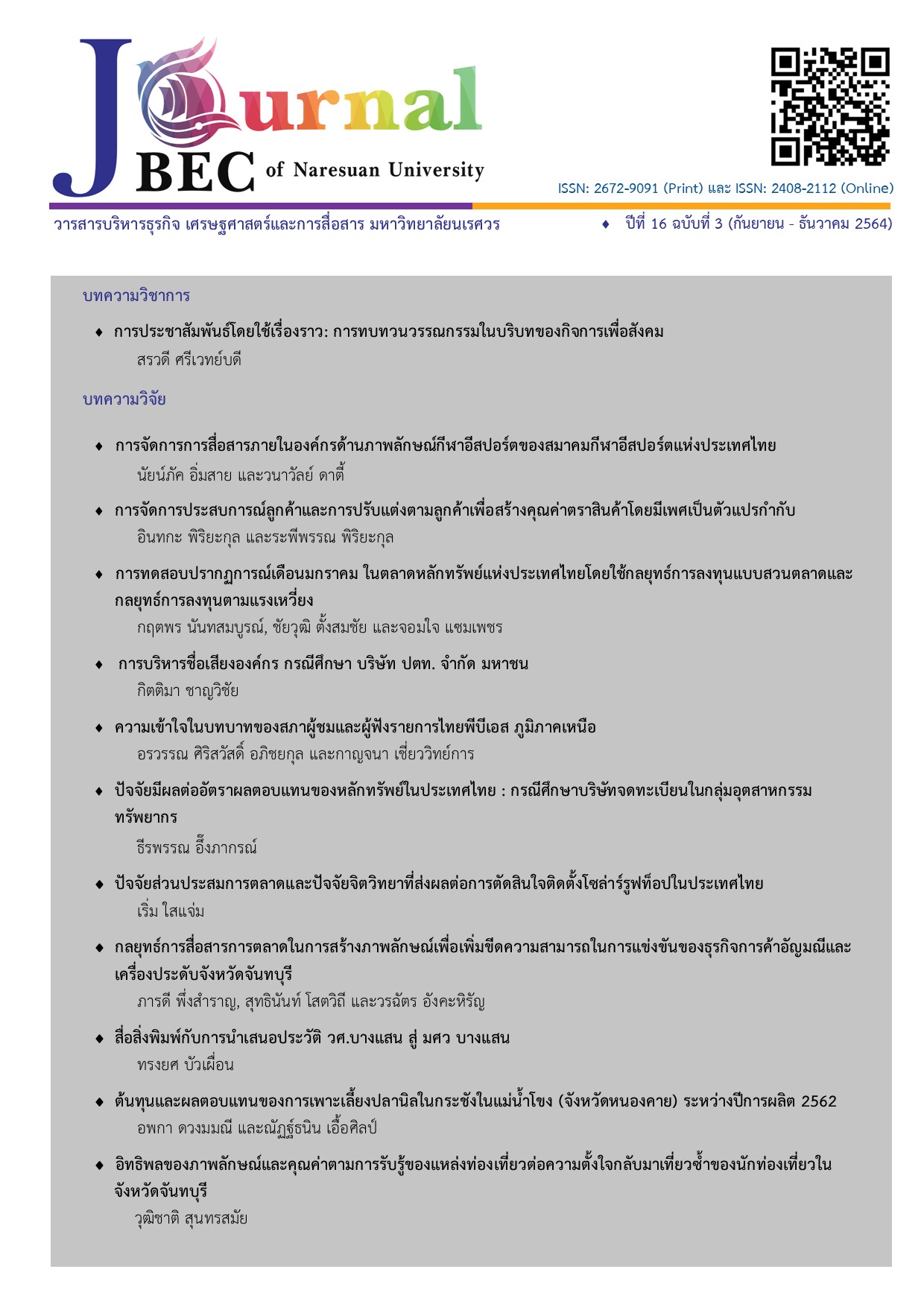
Marketing Communications Strategies for Creating Brand Image to Increase the Competitiveness of Gems and Jewelry Trade in Chanthaburi.
Article Sidebar
Main Article Content
Abstract
The objectives of this research were to study marketing communication strategy as well as problems and obstacles in marketing communication strategy for corporate image building to increase the competitiveness of the gem and jewelry trade in Chanthaburi. This research was qualitative research and data were collected by documentary investigation, in-depth interview, focus group and observation participation. The results revealed that communication strategy consisted of 3 forms: sender strategy, message strategy, and media strategy are integrated marketing communication. Integrated marketing communication tools combined with personal media, point-of-sales sellers, marketing activities, public relations, social media advertising, various promotions, and story telling through the experiences between senders and receivers by building the identity of store names and operators. Honest trading behavior affected image recognition that ultimately affected reputation. Increasing competitiveness was based on a 6-area assessment of environmental factors. Relevant and supportive industry issues were still considered to be inferior to the competitor. Problems and obstacles were lacking knowledge, understanding, building acceptance, common interpretation, internal communication and budget for media production. It also found problems and obstacles in the economic dimension.
Article Details

This work is licensed under a Creative Commons Attribution-NonCommercial-NoDerivatives 4.0 International License.
References
Agarwal, S. and Teas, R.K. (2001) Perceived Value: Mediating Role of Perceived Risk. Journal of Marketing Theory and Practice, 9, 1-14.
Benjarongkij, Y. (2011). Planning and evaluation of strategic communication. Bangkok: Faculty of Communication Arts, Chulalongkorn University.
Brown, T. J., Dacin, P. A., Pratt, M. G., & Whetten, D. A. (2006). Identity, Intended Image, Construed Image, and Reputation: An Interdisciplinary Framework and Suggested Terminology. Journal of the Academy of Marketing Science, 34(2), 99–106.
Craig, J. B., Dibrell, C., and Davis, P. S. (2008). Leveraging Family-Based Brand Identity to Enhance Firm Competitiveness and Performance in Family Business. Journal of Small Business Management, 46(3), p. 351-371.
Deephouse, D. L., and Jaskiewicz., P. (2013). Do family firms have better reputations than non-family firms? An integration of socioemotional wealth and social identity theories. Journal of Management Studies, 50(3), 337-360.
Department of International Trade Promotion. (2017). Situation information on exporting gems and jewelry products 2017. Fact Sheet. Retrieved September 1, 2019, from https://ditp.go.th/ditp_web61/article_sub_view.php?filename=contents_attach/542727/542727.pdf&title=542727&cate=791&d=0
Ducan. T.R. (2005). Principles of Advertising & IMC (2nd ed.) Boston, Mass.: McGraw- Hill/Irwin.
Duncan, T. R., and Everett, S.R. (1993). Client Perceptions of Integrated Marketing Communications. Journal of Advertising Research, 33(3), 30-39.
Kemp, E., & Bui, M. (2011). Healthy brands: Establishing brand credibility, commitment and connection among consumers. Journal of Consumer Marketing, 28(6), 429–437.
Fombrun, C. (1996). Reputation: Realizing Value from the Corporate Image. Boston, MA: Harvard Business School Press.
Jaichansukkit, P. (2015). Good Brand & Grand Image. Bangkok: Maiochonbook.
Chiu, K.K., Lin, R., Hsu, M.K. and Huang, L. (2010). Power of branding on internet service providers, The Journal of Computer Information Systems, 50(3), 112-120.
Kahlert, C., Botero, I. C., and Prugl, R. (2017). Revealing the family: Effects of being perceived as a family firm in the recruiting market in Germany. Journal of Family Business Management, 7(1), 21-43.
Kim, W. G., and Kim, H. B. (2004). Measuring customer-based restaurant brand equity: Investigating the relationship between brand equity and firms’ performance. Cornell H. R. A. Quarterly, 45(2), 115–131.
Kotler, P. and Keller, K. (2006). Marketing Management (12th ed.). New Jersey : Prentice-Hall.
Kotler. P., and Keller, K. L. (2008). Principles of Marketing (12th ed.). New Jersey : Prentice-Hall.
Kotler, Philip and Keller, Kevin Lane (2009). Marketing Management (13th ed.) New Jersey : Prentice-Hall.
Lude, M., and Prugl, R. (2016). Effects of communication the family firm status on brand perception : Insights from an experimental study. Paper presented at the Annual European Academy of Management Conference, University Paris-Est Creteil Val de Marne, Paris, France.
Martineau, P. (1958). Sharper Focus for Corporate Image. Harvard Business Review, 36(6),
-58.
Mieres, C, G., Martin, A. M., & Gutierrez, J. A. T. (2006). Influence of percieived risk on store brand proneness. International Journal of Retail & Distribution Managemane, 34(10), 761-772..
MOTOC A. (2019). Family Business Image and Reputation. A Model of the Influencing Factors, Actions, and Effects. Management Dynamics in the Knowledge Economy. 7(4), 503-519.
Orth, U. R., and Green, M. T. (2009). Consumer loyalty to family versus non-family business : The roles of store image, trust, and satisfaction. Journal of Retailing and Consumer Services, 16(4), 248-259.
Porter, M. E. (1998). The Competitive Advantage of Nations. New York: Free Press.
Rungruangphon, W. (2011). A Study of Gems and Jewelry Buying Behavior of Foreign Buyers. Bangkok: Thammasat University Research and Consultancy Institute.
Schultz, D. E. (1999). Integrated Marketing Communications and How It relates to Traditional Media Advertising. In J.P. Jones (Ed.), The Advertising Business: Operation, Creativity, Media Planning, Integrated Communications, pp. 211- 215. Thousand Oaks, CA: Sage.
Shimp, T. A. (2000). Advertising promotion. Supplemental aspects of integrated marketing communications (5th ed). San Diego, CA: Harcourt College Publishers.
Siripant, S. (2007). A study of factors leading to becoming the world's gem and jewelry manufacturing and trading center. Bangkok. National Research Administration Organization Network.
Srisuko, P. (2015). Development of training program in design and technology of jewelry production for small and micro community enterprise (SMEs) case study : Chanthaburi Province. Bangkok: National Research Administration Organization Network.
Wongkiatkajorn, S. (2015). Gems and Jewelry to ASEAN. Retrieved. January 6, 2015, from http://www.itd.or.th/wp-content/uploads/2015/05/20150108-ar_gems-and-jewelry-thailand-asean.pdf
Yanchana Vanichchai, T. (2010). IMC (Integrated Marketing Communications). University of the Thai Chamber of Commerce Journal. 30(2). (99-115).
Zellweger, T. M., Kellermanns, F. W., Eddleston, K. A., and Memili, E. (2012). Building a family firm image: How family firms capitalize on their family ties. Journal of Family Business Strategy, 3(4), 239-250.
Zellweger, T. M. Nason, Rr. S., Nordqvist, M., & Brush, C.G. (2013). Why do family firs strive for nonfinancial goals? An organizational identity perspective. Entrepreneurship Theory and Practice, 37(2), 229-248.
