
Causal Relationship between Human Resources Management, Job Satisfaction and Organizational Loyalty of Thai Hotel Employees
Article Sidebar
Main Article Content
Abstract
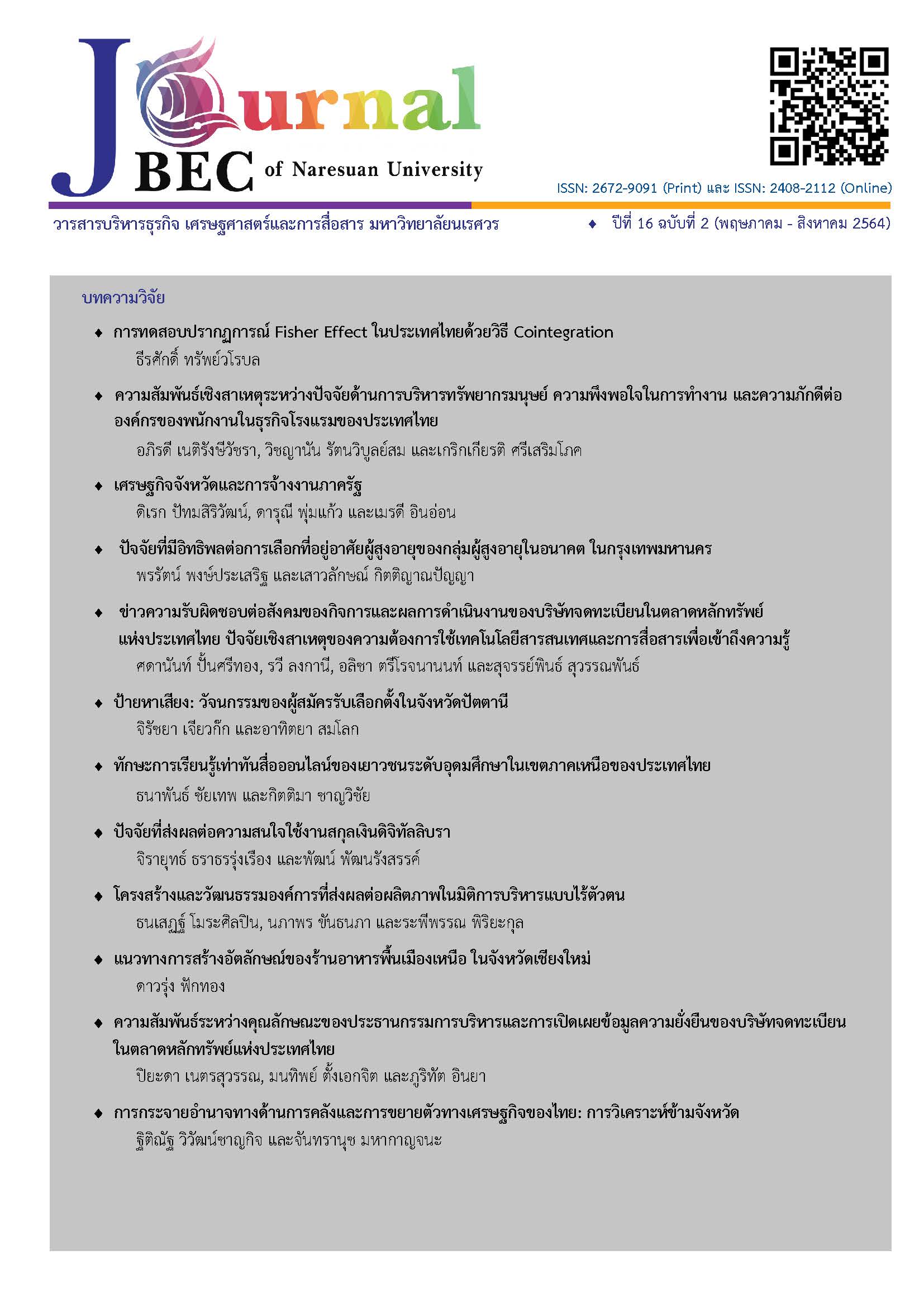
The objective of this research was to examine the causal relationship between factors of human resource management (HRM), which consists of empowerment, job autonomy, compensation management, training and development, facilities, relations, job satisfaction and organizational loyalty of 5-star hotel employees. The multi-stage sampling method was conducted by selecting the samples from hotel employees, which are located in different regions across the country. A total of 800 questionnaires were distributed, and 406 usable questionnaires were returned. Structural equation model (SEM) used to analyze the data. The results of this research had showed that 1) the developed model is valid and fitted to empirical data with c2/df = 2.539, RMR = 0.062, GFI = 0.871, CFI = 0.962, RMSEA = 0.062, moreover the variances of job satisfaction and organization loyalty were explained by the model as 84.1% and 86.2%, respectively. 2) some HRM practices have direct effect on job satisfaction, such as job autonomy, compensation management, training and development, while empowerment, compensation management, and human relations have effect on organization loyalty, directly. Additionally, job satisfaction has a direct effect on organization loyalty.
Article Details
References
Alwin, D.F. and Krosnick, J.A. (1991). The reliability of survey attitude measurement: The influence of question and respondent attributes. Sociological Methods & Research, 20 (1), 139 - 181.
Armstrong, M. (2006). A handbook of human resource management practice (10th ed.). Great Britain: Cambridge University Press.
Banchirdrit, S. (2017). New practices of human resource management for hotel industry in Western part of Thailand. VRU Research and Development Journal Humanities and Social Science, 12(2), 287 – 298.
Batarlienė, N., Čižiūnienė, K., Vaičiūtė, K., Šapalaitė, I. and Jarašūnienė, A. (2017). The impact of human resource management on the competitiveness of transport companies. Procedia Engineering, 187, 110-116.
Becker, T.E., Randall, D.M. and Riegel, C.D. (1995). The multidimensional view of commitment and theory of reasoned action: A comparative evaluation. Journal of Management, 21(4), 617 - 638.
Borzaga, C. and Tortia, E. (2006). Worker motivations, job satisfaction, and loyalty in public and nonprofit social services. Nonprofit and Voluntary Sector Quarterly, 35(2), 225–248.
Byars, L.L. and Rue, L.W. (2008). Human resource management (10th ed.). New York: McGraw-Hill.
Chen, C. (2006). Job satisfaction, organizational commitment, and flight attendants’ turnover intentions: A note. Journal of Air Transport Management, 12, 274-276.
Chiang, C.F., Back, K.J. and Canter, D. D. (2005). The impact of employee training on job satisfaction and intention to stay in the hotel industry. Journal of Human Resources in Hospitality & Tourism, 4(2), 99-118.
Choi, K. (2006). A structural relationship analysis of hotel employees’ turnover intention. Asia Pacific Journal of Tourism Research, 11(4), 321 - 337.
Chow, C.W., Haddad, K. and Singh, G. (2007). Human resource management, job satisfaction, morale, optimism, and turnover. International Journal of Hospitality and Tourism Administration, 8(2), 73 – 88.
Costen, W. M. and Salazar, J. (2011). The impact of training and development on employee job satisfaction, loyalty, and intent to stay in the lodging industry. Journal of Human Resources in Hospitality and Tourism, 10(3), 273-284.
Cruz, F.G. S., López-Guzmán, T. and Cañizares, S.M.S. (2014). Analysis of job satisfaction in the hotel industry: A study of hotels in Spain. Journal of Human Resources in Hospitality & Tourism, 13(1), 63 – 80.
Esmaeilpour, M. and Ranjbar, M. (2018). Investigating the impact of commitment, satisfaction, and loyalty of employees on providing high-quality service to customer. Studies in Business and Economics, 13(1), 41 – 57.
Gazzoli, G., Hancer, M. and Park, Y. (2010). The role and effect of job satisfaction and empowerment on customers’ perception of service quality: A study in the restaurant industry. Journal of Hospitality & Tourism Research, 34(1), 56-77.
Gounaris, S. (2008). The notion of internal market orientation and employee job satisfaction: Some preliminary evidence. Journal of Services Marketing, 22(1), 68 – 90.
GSB Research. (2020). Industrial economics. Retrieved May 23, 2020, from https://www.gsbresearch.or.th/gsb/category/economics/industrial-economics/industry-update/service/travel-and-hotels/
Gu, Z. and Siu, R. C. S. (2009). Drivers of job satisfaction as related to work performance in Macao casino hotels: An investigation based on employee survey. International Journal of Contemporary Hospitality Management, 21(5), 561-578.
Hair, J. F., Black, W. C., Babin, B. J. and Anderson, R. E. (2014). Multivariate data analysis (7th Ed.). Harlow: Pearson Education.
Heskett, J.L., Jones, T.O., Loveman, G.W., Sasser Jr., W.E. and Schlesinger, L.A. (1994). Putting the service-profit chain to work. Harvard Business Review, 72(2), 164–174.
Koç, M., Çavuş, M.F. and Saraçoglu, T. (2014). Human resource management practices, job satisfaction and organizational commitment. International Journal of Academic Research in Business and Social Sciences, 4(9), 178 – 190.
Lee,Y.K., Kim, S. and Kim, S.Y. (2013). The impact of internal branding on employee engagement and outcome variables in the hotel industry. Asia Pacific Journal of Tourism Research, 19(12), 1359 – 1380.
Lee, Y.K., Nam, J.H., Park, D.H. and Lee, K. A. (2006). What factors influence customer-oriented prosocial behavior of customer-contact employees. Journal of Services Marketing, 20(4), 251–264.
Limyothin, P. and Trichun, C. (2012). The structural equation model of factors influencing the hotel staff in Thailand’s intention to quit. International Journal of Human Resource Studies, 2(3), 22 – 35.
Marco-Lajara, B. and Úbeda-García, M. (2013). Human resource management approaches in Spanish hotels: An introductory analysis. International Journal of Hospitality Management, 35, 339 – 347.
Martensen, A. and Grønholdt, L. (2006). Internal marketing: A study of organization loyalty, its determinants and consequences. Innovative Marketing, 2(4), 92-116.
Mokaya, S.O., Musau, J. L., Wagoki, J. and Karanja, K. (2013). Effects of organizational work conditions on employee job satisfaction in the hotel industry in Kenya. International Journal of Arts and Commerce, 2(2), 79 – 90.
Ozturk, A. B., Hancer, M. and Im, J.Y. (2014). Job characteristics, job satisfaction, and organizational commitment for hotel workers in Turkey, Journal of Hospitality Marketing & Management, 23(3), 294-313.
Prayoonsak, P. (2016). Guidelines for human resources development of hotel businessesin the ASEAN economic community (AEC). SDU Research Journal Humanities and Social Science, 12(2), 143 – 157.
Pelit, E., Öztürk, Y. and Arslantürk, Y. (2011). The effects of employee empowerment on employee job satisfaction: A study on hotels in Turkey. International Journal of Contemporary Hospitality Management, 23(6), 784 – 802.
Petrescu, A.L. and Simmons, R. (2008). Human resource management practices and workers’ job satisfaction. International Journal of Manpower, 29(7), 651 – 667.
Sirca, N.T., Katarina Babnik, K. and Breznik, K. (lecturer). (June 20-22, 2012). The relationship between human resource development system and job satisfaction. In Management, Knowledge and Learning International Conference (pp. 977 – 987). Celje: International School for Social and Business Studies.
Sirithai, P. and Chaimadan, C. (2016). The relationship between motivation and work efficieny of personnel working, Sa Kaeo community college. Journal of Public Administration and Politics, 5(1), 157 – 197.
Spinelli, M.A. and Canavos, G.C. (2000). Investigating the relationship between employee satisfaction and guest satisfaction. Cornell Hotel and Restaurant Administration Quarterly, 41(6), 29-33.
TAT Intelligence Center. (2020a). International tourism situation. Retrieved May 23, 2020,from https://intelligencecenter.tat.or.th/articles/11857
TAT Intelligence Center. (2020b). Business information. Retrieved May 23, 2020, from https://intelligencecenter.tat.or.th/articles/11846
Thai Hotel Association. (2016). Name list for hotel & resorts 2014. Retrieved February 20, 2016, from http://thaihotels.org/name-list-for-hotel-resort-2014
Turkyilmaz, A., Akman, G., Ozkan, C. and Pastuszak, Z. (2011). Empirical study of public sector organization loyalty and satisfaction. Industrial Management & Data Systems, 111(5), 675 – 696.
Yang, J.T. (2010). Antecedents and consequences of job satisfaction in the hotel industry. International Journal of Hospitality Management, 29, 609–619.
Yee, R.W.Y., Yeung, A.C.L. and Cheng, T.C.E. (2008). The impact of employee satisfaction on quality and profitability in high-contact service industries. Journal of Operations Management, 26(5), 651–668.
Yoyyim, S. and Jadesadalug, V. (2017). Factors influencing job satisfaction, job performance and intention to leave of guide. Journal of Business, Economics and Communications, 12(2), 133 – 144.
