
News Regarding Corporate Social Responsibility and Performances of Listed Companies in the Stock Exchange of Thailand
Article Sidebar
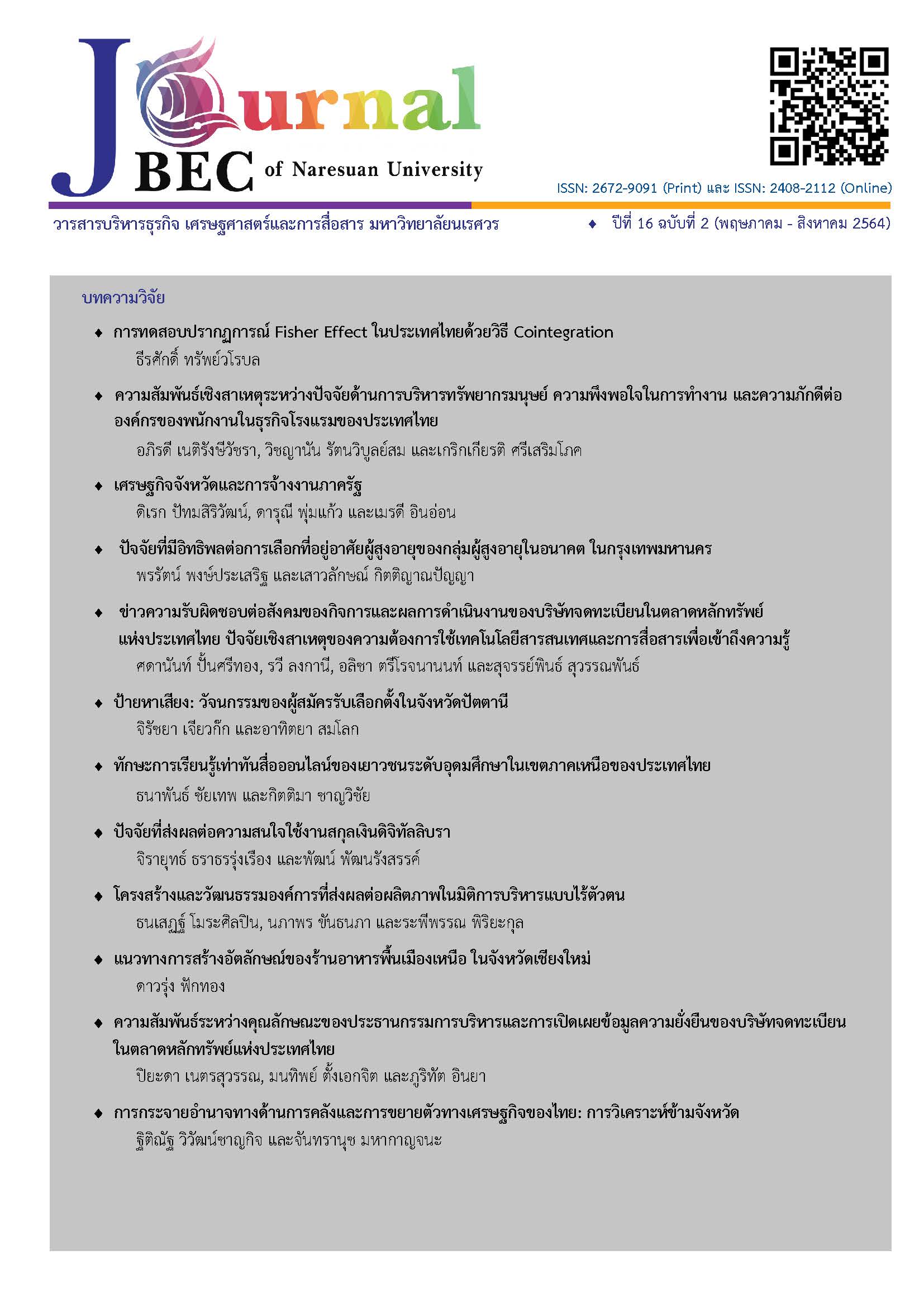
Main Article Content
Abstract
News on Corporate Social Responsibility (CSR) published in newspapers is an important message related to Corporate Social Responsibility: CSR activities and reflect the type of CSR activities by firms. This research aims to study the effects of CSR activities on firm’s performances of listed companies. The objective of the study is to evaluate the effects of CSR related news on the firm’s performances. Additionally, this study also analyzes whether the types of CSR news, the frequency of CSR news, and the coverage of CSR news influences the firm’s performances. Results found that CSR type influence firm’s performances especially the CSR on environmental activities which has a positive impact on the return on total asset and earning per share. This demonstrates that companies participated in environmental responsibility have positive performance outcome in terms of the returns on asset and the earning per shares. This study supports the theory of stakeholders which not just shareholders are of interested by management.
Article Details
References
Borghesi, R., Houston, J.F., & Naranjo, A. (2014). Corporate Social Responsibility Investment: CEO altruism, reputation, and shareholders interest. Journal of Corporate Finance, 26, 164- 181.
Chinprateep, A. (2015). Corporate Social Responsibility and the Return on Assets. Local Administration Journal, 9(1), 118-132.
Da, Z., Gao, P., & Engelberg, J. (2011). In search of attention. Journal of Finance, 66(5), 1461–1499.
DeAngelo, H., DeAngelo, L., & Stulz, R. (2006). Dividend policy and the earned/ contributedCapital mix: a test of the life-cycle theory. Journal of Financial Economics, 81, 227-254.
Dhurakij Pundit University Research Center. (2005). Survey on Consumer’s Behavior and Attitude toward Corporate Social Responsibility of the Business organization in Thailand. Retrieved October 13, 2017, from https://www.dpu.ac.th/dpurdi/upload/ public/raeczmrtt1wo4wg4oc.pdf.
Elkington, J. (1997). Cannibals with forks –Triple bottom line of 21st century business. Stoney Creek. CT: New Society Publishers.
Flammer, C. (2012). Corporate Social Responsibility and Stock Prices: The Environment Awareness of Shareholders, MIT Sloan School of Management.
Freeman, R. E. (2001). A stakeholder theory of the modern corporation. Perspectives in Business Ethics Sie, 3(144). 38-48.
Jaggi, B., & Freeman, M. (1992). An examination of the impact of pollution performance on economic and market performance: Pulp and paper firms. Journal of Business Finance and Accounting, 19(5). 697-713.
Jensen, M. & Meckling, W. (1976). Theory of the firm: Managerial behavior, agency costs and ownership structure. Journal of Financial Economics, 3(4), 305-360.
Kanter, R.M. (1999). From spare change to real change: the social factor as beta site for business innovation. Harvard Business Review, 77(3), 122-132.
Khunpolkaew, C. (2007). Value Building thru CSR Process (CSR in Process, in Thai). Productivity World, 12(71), 82- 85.
Knox, S., & Maklan, S. (2004). Corporate social responsibility: moving beyond investment towards measured outcomes. European Management Journal, 22 (5), 508-515.
Kornthongtawelarp, T. (2010). The relationship corporate social responsibility and financial performance indicated by return on asset (ROA) and return on equity (ROE) case study : Companies Listed in the Stock Exchange of Thailand (Doctoral dissertation, Thammasat University,Bangkok). Retrieved October 13, 2017, from http://digi.library.tu.ac.th/thesis/ac/0584/01title- illustration.pdf.
Kotler, P., & Lee, N. (2005). Corporate Social Responsibility: Doing the most good for your company and your cause. Hoboken: NJ. Wiley.
Laosirihongthong, T., Tungkaprasert, P., Sakolbancherd, W. & Sangwongrassame, P. (2009). Corporate Social Responsibility and Supply Chain Management Part 2. TPA News, 2009(143), 64-66.
Laszlo, C. (2003). The sustainable company: How to create lasting value through social and environmental performance. Washington, DC: Island Press.
Low, C., & Cowton, C. (2004). Beyond stakeholder engagement: the challenges of stakeholder participation in corporate governance. International journal of business governance and ethics, 1(1), 45-55.
Margolis, J.D., and Walsh, J.P. (2003). Misery loves companies: rethinking social initiatives by business. Administrative Sciences Quarterly, 48(2), 268-305.
McCombs, M. E., & Shaw, D. L. (1972). The Agenda-Setting Function of Mass Media. The public Opinion Quarterly, 36(2). 176-187.
Pipitsombut, S. (2007). Content analysis of news coverage for public relations purposes in Thai daily newspapers. Master thesis, M.A., Chulalongkorn University, Bangkok.
Pipitsombut, S. & Benjarongkij, Y. (2008). Content analysis of news coverage for public relations purposes in Thai daily newspapers. Journal of Public Relations and Advertising, 1(2), 18-31.
Porter, M.E., & Kramer, M.R. (2002). The competitive advantage of corporate philanthropy. Harvard Business Review, 80(12), 56–68.
Porter, M., & Vanderlinde, C. (1995). Toward a new conception of the environment competitiveness relationship. Journal of Economic Perspectives. 9(4), 97- 118. Retrieved April 9, 2017, from www.jstor.org/stable/2138392
Rukphanichmanee, S., Duangchaiyusuk, S. & Thammasiri, W. (lecturer). (2018). Corporate Social Responsibility Information Disclosures and Organizational Performance of Listed Companies in the Stock Exchange of Thailand. In The Second UTCC Academic Day 2018 (pp.602-615). Bangkok: The University of the Thai Chamber of Commerce.
Sereerat, S. (1996). Marketing Research. Bangkok: Dharmasarn Printing Company Limited.
Stäbler, S. (2016). Impact of Corporate Social Responsibility News on Customer Brand Perception and Stock Return performance (Research report). University of Cologne, Germany.
Sthapitanonda, P. & Nueangjamnong, P. (2016). Corporate Social Responsibility Communication: From concept to action and future research challenges. Journal of Public Relations and Advertising, 9(1), 73-92.
Sustainable Business Development Institute. (n.d.). CSR for Corporate Sustainability. RetrievedNovember 17, 2017, from http:://www.set.or.th/yfs/main/download/YFS2018_ExamReading01.pdf
Tetlock, P.C. (2007). Giving content to investor sentiment: The role of media in the stock market. Journal of Finance, 62(3), 1139- 1168.
The Saylor Foundation. (n.d.). Stakeholders and Corporate Social Responsibility. Retrieved January 30, 2017, from https://www.saylor.org/site/wpcontent/uploads/2013/09/Saylor. orgs-Stakeholders- and-CSR.pdf.
Tongkachok, T. (2013). The Causal Model of Transformational Leadership, Corporate Governance, Stakeholder Engagement and Corporate Social Responsibility in the Listed Companies: A Review. Executive Journal, 33(2), 80-88.
Wigley, S. (2008). Gauging consumers’ responses to CSR activities: Does increased awareness make cents?. Public Relations Review, 34(2008), 306-308.
