
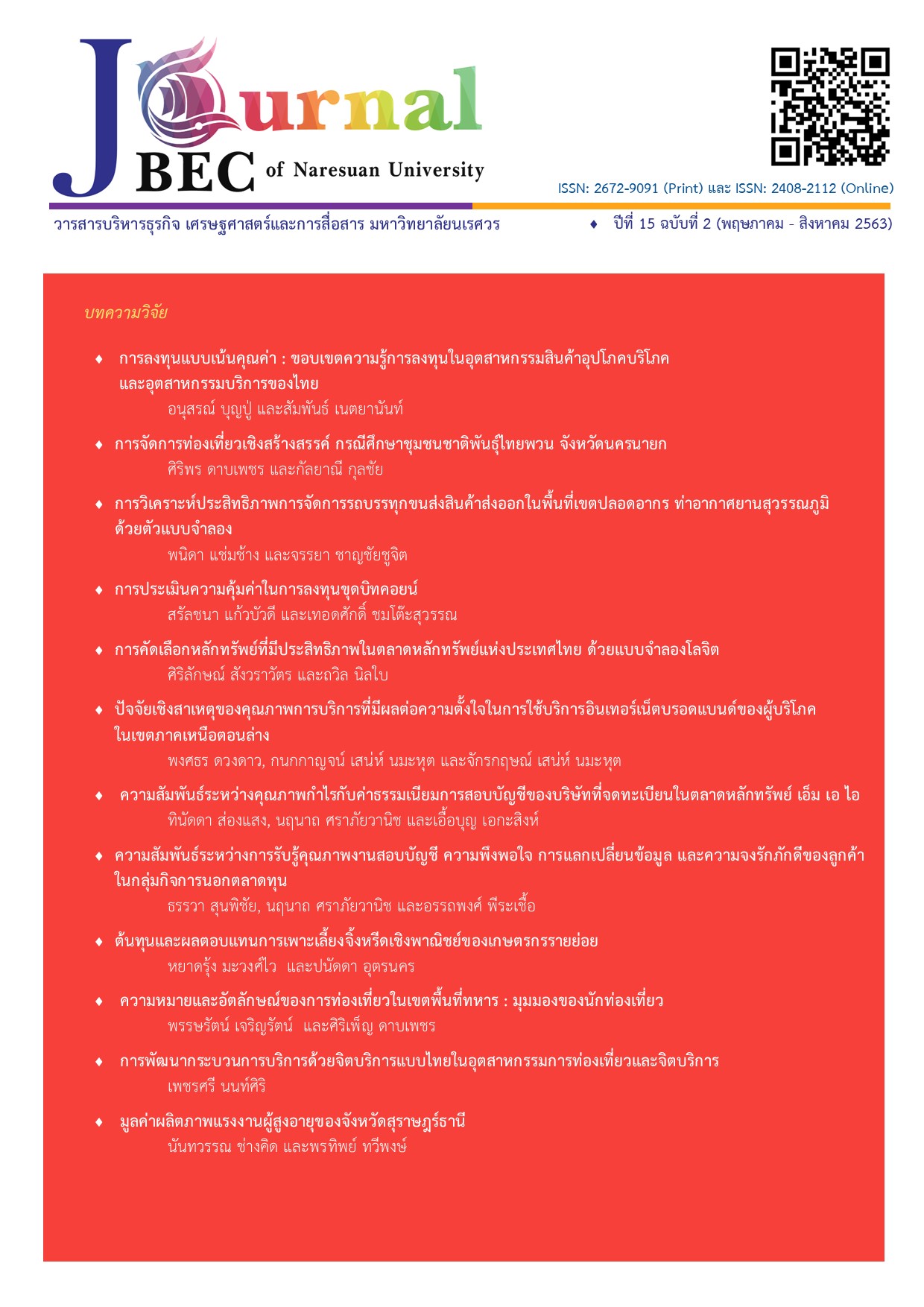
The Development of Service Process with Thai Hospitality in The Tourism and Hospitality Industry
Article Sidebar
Main Article Content
Abstract
The research aims to investigate Hospitality Context applied to the development of Thai’s service process, the so-called Thai Hospitality, within hospitality businesses such as Hotels, Food and Beverage Services, Health and Wellness Centers and Tour Operators. The main objectives of this research were: 1) To explore the pattern of service delivery with Thai Hospitality; and 2) To suggest the development of service process with Thai Hospitality. The research applies qualitative method. 185 executives were interviewed and discussed while 72 hospitality businesses were observed directly. Data analysis was done by content analysis. The findings explored 3 patterns of service delivery which delivered Thai Hospitality from providers to customers such as 1) service personnel; 2) servicescape, and 3) product and service procedure. The results suggest the development of service process which were: 1) to enhance thai hospitality of the service staffs by inside-out and outside-in approaches; 2) to create customer experiences with 3 C’s strategies composed of 1) Customization 2) Co-Creation and 3) Corporate Social Responsibility (CSR).
Keywords: 1) Service Delivery 2) Thai Hospitality 3) Tourism and Hospitality Industry 4) Servicescape
Article Details
References
Bell, D. (2008). Tourism and Hospitality. The Sage Handbook of Tourism Studies. pp.19-33.
Bitner, M.J. (1992). Servicescapes: The impact of physical surrounding on customers and employees. Journal of Marketing (56)2, 57-71.
Bowie, D., Buttle, F., Brookes, M., Mariussen, A. (2017). Hospitality Marketing. London: Routledge, https://doi.org/10.4324/9781315682549
Brotherton, B. (1999). Towards a definitive view of the nature of hospitality management. International Journal of Contemporary Hospitality Management 11(1), 165-173.
Brymer, R. (1995). Hospitality Management: An Introduction to the Industry. Dubuque, IA: Kendall/Hunt Publishing.
Buddhabhumbhitak, K. (2019). The Development of Thai Hospitality Competency for Personnel Development in Tourism and Hospitality Industry, Final Report. Thailand Research Fund. Bangkok, Thailand.
Burgess, J. (1982). Perspective on gift exchange and hospitable behavior. International Journal of Hospitality Management, 1(1), 49-57.
Cassee, E. H. a. R., R. . (1983). Hospitality in Hospitals in The Management of Hospitality. Oxford: Pergamon.
Chang-Hua, Y., Hsiu-Yu, T., Ko-Yu, C., & Nien-Chi, H. (2019). Restaurant Innovativeness, Customer Engagement And Value Co-Creation Behaviors. Proceedings of the Multidisciplinary Academic Conference, pp. 206-210.
Cole, G. (2017), Increasing customer loyalty: the impact of corporate social responsibility and corporate image. Annals in Social Responsibility, 3(1), 59-61.
Cuesta-Valino, P., Rodriguez, P. G., Nunez-Barriopedro, E. (2019). The impact of corporate social responsibility on customer loyalty in hypermarkets: A new socially responsible strategy. Corporate Social Responsibility and Environmental Management, [s. l.], (4), 761.
Dabphet, S. (2020). The Search for Thai Hospitality Dimensions in Hospitality and Tourism Industry. Journal of Community Development (Humanities and Social Sciences) 13(2).
Daengbuppha, J.(2010). Thai Hospitality Development to enhance competitiveness in T and H industry, Final Report. Thailand Research Fund. Bangkok, Thailand.
David Bowie, F. B., Maureen Brookes, Anastasia Mariussen. (2017). Hospitality Marketing (3rd ed.). New York: Routledge.
Field, J. M. (2012). Designing Service Processes to Unlock Value.
Geetz, C. (2000). The interpretation of cultures: Selected essays. New York, Basic Books.
Gillespie, C. H. (1994). Gastrophy and Nouvelle Cuisine: Entrepreneurial Fashion and Fiction. British Food Journal, 96(10), 19-23.
Goodenough, W. H. (1971). Culture, language and society. Reading, MA, Addison Wesley Modular Publications
Hemmington, N. (2007). From Service to Experience: Understanding and Defining the Hospitality Business. The Service Industries Journal, 27(6), 747-755. doi: 10.1080/02642060701453221
Jayawardena, C. (2000). International Hotel Manager. International Journal of Contemporary Hospitality Management, 12(1), 67-69.
King, C. A. (1995). What is hospitality? International Journal of Hospitality Management 14 (3), 219-234.
King O. (2009). What is Service Design? Touchpoint. The Journal of Service 1(1), 22-23.
Komin, S. (1990). The Psyvhology of the Thai People: Value and Behavioral Patterns. Ph.D. Thesis, Research Center of National Institute of Development Administrative (NIDA), Bangkok, Thailand.
Lashley, C., Morrison, A. (2000). Search of Hospitality; Theoretical Perspectives and Debateos. Oxfrd.
Kyongsill L., Kyung-won C., Ki-Young N., (2013). Orchestrating Designable Touchpoints for Service Businesses, Wiley-Blackwell DMI Fall, pp.13-21.
Mohr L.A., Bitner M.J. (1995). The role of Employee Effort in Satisfaction with Service Transactions.” Journal of Business Research 32(3), 239-252.
Nate-Tra Dhevabanchachai (2016). Service mind, Behavior and how to be Excellent. 13 may 2016 retrieved from https://mai-bs.com/blog/service-mind-behaviour-and-how-to-be-excellent/
Sampson, S.E., C.M. Froehle. (2006). Foundation and Implications of a Proposed Unified Services Theory. Production and Operation Management, 15 (2), 329-343
Sampson, S. (2010). A Unified Service Theory pp. 31-47.
Senchad, W., Nonsiri, P.(2019). A study of Servicescape Design with Local Culture in Hotel Business, Chiang Mai Province. E-Proceedings of the 1st International Conference, Tourism and Humanities: Tourism in a transformatives Era, 19-20 December 2019. Chaing Mai University, Thailand: pp.540-559.
Shostack, G. L. (1984). Designing services that deliver. Harvard Business Review, 62(1), 133-139.
Slattery, P. (2002). Finding the Hospitality Industry. Journal of Hospitality, Leisure, Sport and Tourism Education, 1(1), 19-28.
Tax SS, Stuart I. (1997). Designing and Implementing New services: The Challenges of Integrating Service System. Journal of Retailing 73(1), 105-134.
Thompson, D. F. (1996). The Oxford quick reference dictionary. Oxford, England: Oxford University Press.
Wattanacharoensil, W., Kobkitpanichpol, B.(2014). Asian hospitality: how emotional intelligence and organisational service culture play a role: Development of Regional Tourism by collaboration between public sector and academics in the Asia Pacific region. Proceedings of 2014 APTA Conference, Hochiminh City, Vietnam, Asia Pacific Tourism Association (2012).
Winsted, K. (1997). The Service Experience in Two Cultures: a Behavioral Perspective. Journal of Retailing, (73), 337-360. doi: 10.1016/S0022-4359(97)90022-1.
