
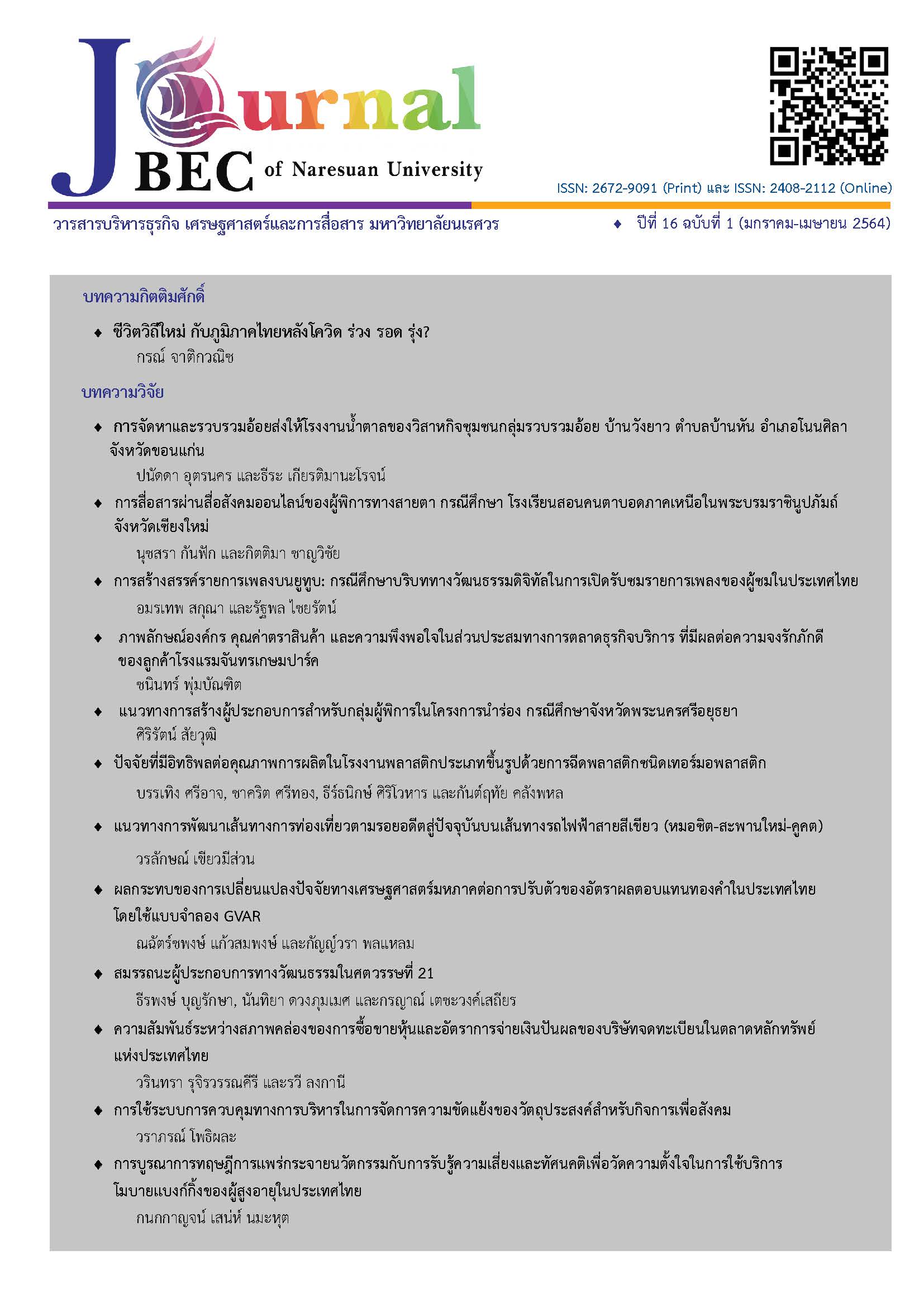
Supplying and Collecting Sugarcane Models for Shipping to Sugar Factory of Sugarcane Community Enterprise at Baan Wang Yao, Baan Han Sub-district, Non Sila District, Khon Kaen Province
Article Sidebar
Main Article Content
Abstract
This research aimed to examine the supplying sugarcane tecnique and collectd model, benefits of members, and to analyze the business environment of sugarcane community enterprise at Baan Wang Yao, Khon Kean Province. The results show that there are three supplying sugarcane models: 1) Collecting place by group head, 2) Collecting from relative by some members, and 3) Purchasing bill from sugarcan owner at sugar factory. The members had reciept a cash when they sold sugarcane; and get dividend and other benefits after finishing harvest season. The finding threats influence group performace were threat of nearby area of competitors, threat of new collecter entry, 2-3 days more for a waiting time to entry the sugar factory, planting cassava instead of sugarcane area, and highly adjusting interest rate of financial institutions. The possible guideliness for sustainable group performance are group must set up clearly and fairly benefits for the members; all members have to collaborate for providing and collecting sugarcane, then group can continuely shipping sugarcane to sugar factory; and the relevant organization should support loan with a low interest rate annualy.
Article Details
References
NorthEastern/DocLib_Research/03_Paper_SugarcaneIndust.pdf
Bank of Thailand (Northeastern Regional Office). (2017). Step into the new context of Thai sugarcane and sugar industry. Retrieved February 12, 2018, from https://www.bot.or.th/Thai/MonetaryPolicy/NorthEastern/DocLib_Research/03_Paper_SugarcaneIndust.pdf
Boon-it, S. (2015). Supply chain management for excellence. Edit 1st. Thammasat BusinessSchool, Thammasat University: Bangkok.
Charoenying, K. and Kidsom, A. (2013). The 5 forces model and competitive advantages analysis for expanding into Republic of India: A study of Container Liner Company, Limited. MUT Journal of Business Administration, 10(1), 1-21.
Chokwarakul, K. (2018). The efficient development and productivity to raise the value added of the manufacturing industry, agriculture, “cane” in the Northeast. NRRU Community Research Journal,12(1), 181-190.
Erbkamol, N. (2007). A case study on labour replacement with a sugarcane harvester.
King Mongkut’s University of Technology North Bangkok. Nonthaburi.
Inwang, K., Inwang, S. and Wanpira, A. (2011). Community enterprise management. Phisanulok University: Phisanulok.
Kaavijan, U. (2017). Guidelines for success of community-based tourism management. SAU Journal of Social Sciences & Humanilities, 1(2), 70-79.
Kaewlor, N. and Pakseti, M. (2018). Study on cost of sugar cane production and sugarcane transportation to the factory case study: Tambon Thalung Lek, Amphoe Mueang, Buriram Province, Production Year 2017/2018. Program in Agriculture, faculty of Agricultural Technology, Buriram Rajabhat University.
Kotas, M. (2015). Key success factors for social services organization in Poland. Management. 19(2): 122-135.
Kumdum, J. and Kiatmanaroch, T. (2017). Business management of sugarcane farmer group in Banwangyoa Tambon Banhun Amphoe Nonsila Changwat Khon Kaen. Khon Kaen Agriculture Journal (Suppl.), 45 (1), 1449-1453.
Kusoncum, C. and Sethanan, K. (2012). A study of costs and returns of sugarcane production sent to the sugar mill for small-scale growers in Buakhao, Kuchinarai District, Kalasin Province. pp. 2134-2140. The Industrial Engineering Network Conference 2012 on October 17-19, 2012 at Cha-am, Phetchaburi Province.
Lalitaporn, P. (2016). Inventory management in supply chains: Analysis Design and Management. Edit 1st. Chulalongkorn University Printery: Bangkok.
Meepanya, C. and Chanthakun, J. (2014). Study on economy of sugarcane for factory, Amphoe Wichian Buri, Phetchabun Province. Thesis of Science Degree (Geography), Naresuan University.
Ministry of Agriculture and Cooperatives. (2005). Community Enterprise Promotion Act, B.E. 2548. pp. 319-327. Retrieved September 24, 2019, from https://www2.moac.go.th/ download/laws28.pdf.
Mokkhamakkul, T. (2008). Performance of measurement in logistics and supply chain. Chulalongkorn Business Review. 30(117-118): 157-165.
Office of Cane and Sugar Board. (2017). Statistics of exporting sugar to overseas, classifying by importers, reported from January-December 2016. Retrieved July 1, 2018, from http://www.ocsb.go.th/upload/cuntry/fileupload/7876-7251.pdf.
Opanukul, W., Nakwattananukul, S., Jongsukwai, K., Toonhaw, M., Tongdang, B., Santoonpitak, D., et al. (2012). Study of sugarcane harvester used in Thailand. pp. 106-115. The 13rd Thai Society of Agricultural Engineering Conference on April 4-5, 2012 at Chiang Mai Province.
Pongwanich-anan, U. (2009). Study of cost and benefit for sugar cane production, Tambon Don Chedi, Amphur Phanomthuan, Karnchanaburi Province, Crop Year 2007/2008. Master Degree of Economics in Managerial Economics, Srinakharinwirot University.
Pookhang, B., Kao-ian, S. and Potchanasin, C. (2012). Analysis of a sugarcane procurement business system in Suphan Buri Province. Kasetsart Journal (Social Sciences), 33, 253-263.
Pornbuncheidkul, S. (2018). Why the big growth business using logistics system for mainlydriving business? Edit 1st. SevenDee Book Co., Ltd.: Bangkok.
Porter, M.E. (2008). The five competitive forces that shape strategy. Harvard Business Review.86(1): 78-93.
Promchai, A. and Suwannachod, S. (2011). The success of Huaykan Community Enterprise. Local Administration Journal. 4(2): 16-29.
Promchat, P. and Jadesadalug, V. (2017). Environment analysis and strategy to create a competitive advantage in fuel briquettes from coconut shell charcoal and timber charcoal from Domnerncarbon Co., Ltd in Ratchaburi Province. Veridian E-Journal: Humanities, Social Sciences, and Arts. 10(2): 709-734.
Rooplor, R., Promtat, D. and Wongwiwitgul, W. (2013). The approach for sustainable development and growth community enterprise. RMUTP Research Journal Special Issue, The 5th Rajamangala University of Technology National Conference. 158-170.
Rungtrakulchai, R., Sukjareon, W., Avirutha, A. and Chotchaicharin, W. (2019). The study of market analysis and market development planning in Bio-Base industry: The case of Thailand. TNI Journal of Business Administration and Languages. 7(1): 75-82.
School of Management at King Mongkut’s University of Technology Thonburi. (2016). Logistics and supply chain management. Edit 3rd. A-Print And Pack Co., Ltd.: Bangkok.
Tasedam, T. (2016). Analysis of cost and benefit for sugarcane planting of agriculturists in Ban Huai Luk, Tambon Don Mon, Amphur Satuek, Buriram Province. Accountancy, Faculty of Management Science, Buriram Rajabhat University.
Wongsuwan, C. (2012). The study of capital structure of sugar cane production and logistic to the factory case study: Boasuphan Sub-District, Songpinong District, Suphanburi Province/Cultivate Year 2011/2012. Independent Study of Master Degree of Economics. University of the Thai Chamber of Commerce.
Zuzuki, P. (2009). Microfinace and financial society. The 4th of Seminar of Thammasat’s Economic. Open Book: Bangkok.
