
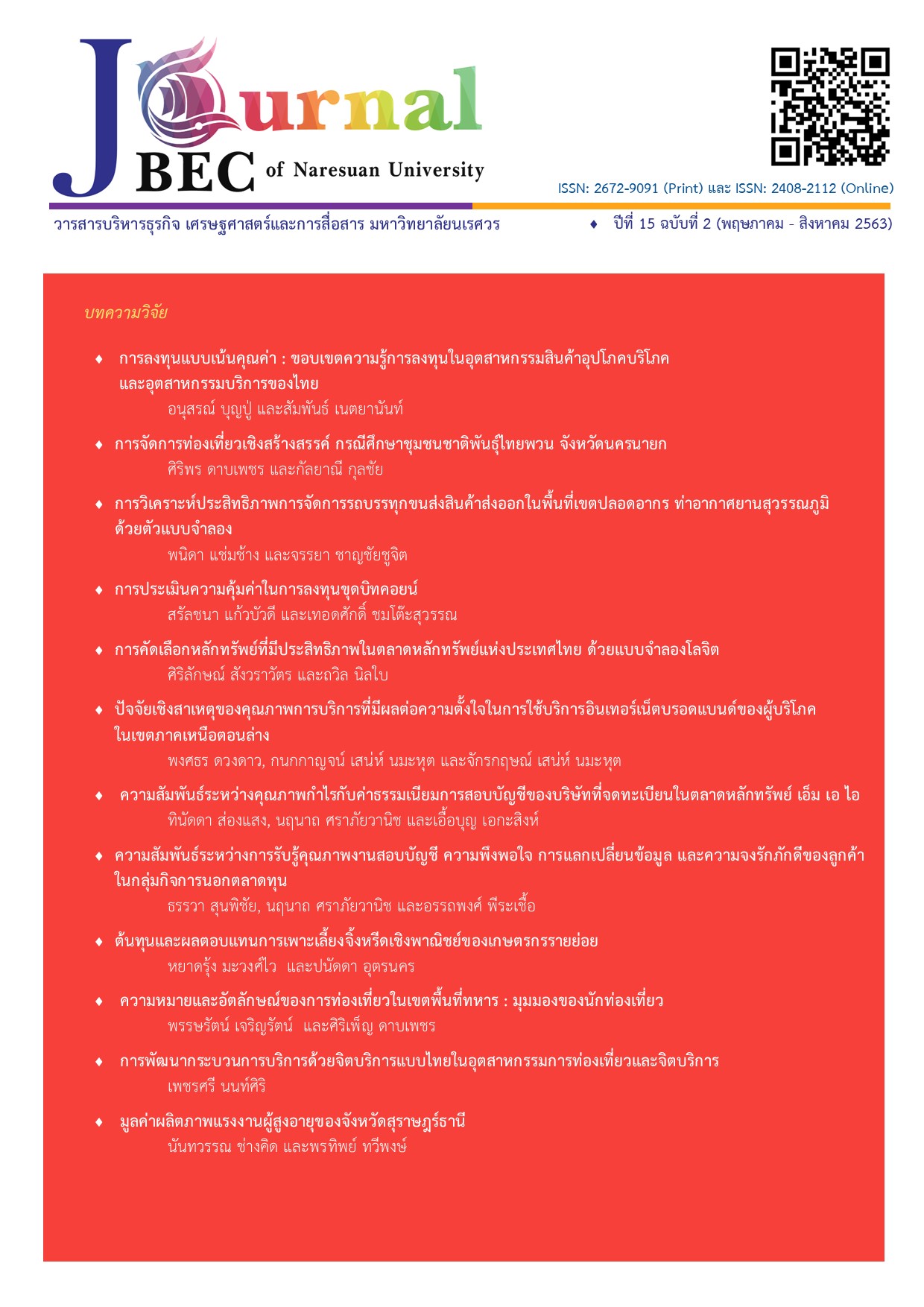
Creative Tourism Management in Thai Puan Ethnic Group, Nakhonnayok Province
Article Sidebar
Main Article Content
Abstract
This research aimed to provide creative tourism activities that were developed from local cultural capital of Thai Phuan people, Nakhonnayok province. The qualitative research approaches were used through a study of document and in-depth interviews with 10 key informants, including community leaders, members of the local weaving group, cooking club, and the Thai Phuan community's cultural tourism as well as tourists. The findings have shown that Thai Phuan people has a unique set of culture and has been promoted cultural tourism, but the number of tourists relies on special occasions. This study has thus proposed that Thai Phuan’s cultural capital can be promoted as creative tourism in three perspectives: folk games, weaving and culinary activities. The area-based cultural capital can be developed as guideline for creative tourism activities, particularly for exclusive small-sized tourist groups and participatory creative tourism activities.
Keywords: 1) Thai Phuan, Nakhonnayok 2) Cultural Capital 3) Creative Tourism
Article Details
References
Bhakdechakriwut, Y., Piemkaroon, P. and Tancharoenwong, A.S. (2016). The Phuan people and
the integrated cultural tourism promotion strategy. Journal of Social Communication Innovation. 4, 1(7) January-June, 18-32.
Bourdieu, P. (1989). Distinction: A social critique of the judgment of taste. London:
Routledge.
Bourdieu, P. (1997). ‘The Forms of Capital’ in Halsey, A.H., H. Lauder, P. Brown and A.S. Wells
(eds). Education: Culture, economy, society. Oxford: Oxford University Press.
Chinachot, P. and Chantuk. T. (2016). Model of creative tourism management in Suan Phueng. Veridian E-Journal, Silpakorn University 9(1), 250-268.
Florida, R. (2002). The rise of the creative class: and how it is transforming work, leisure, community, and everyday life. New York: Basic Books.
Florida, R. (2005). Cities and the creative class. New York: Routledge.
Griswold, W. (2004). Cultures and societies in a changing world. Thousand Oaks: Pine Forge
Press.
Jelincic, D. A. (2013). Facing the challenge? creative tourism in Croatia. Journal of Tourism Consumption and Practice, 5(1), 78-90.
Junprasert, T. (2014). The role of community leaders in the conservation of local culture and processes to strengthen the culture of the community : A case study of Thai Phuan, Koh Wai, Nakhonayok. Behavioral Science Research Institute, Srinakharinwirote University
Raymond, C. (2007). Creative tourism New Zealand: The practical challenges of developing
creative tourism. In G. Richards & J. Wilson (Eds.), Tourism, creativity and development (pp. 145-157). New York: Routledge.
Richards, G. (2009). Creative tourism and local development. In R. Wurzburger, A. Pattakos & S. Pratt (Eds.), Creative tourism: A global conversation (pp. 78-90). Santa Fe: Sunstone Press.
Richards, G. (2010). Creative tourism and cultural events. Paper presented at the 2nd Forum on UNESCO Creative Cities Network Icheon, Republic of Korea, 21 October 2010: 4-13.
Richards, G. (2011). Cultural tourism: global and local perspectives. New York: Routledge
Richards, G. and Raymond, C. (2000). Creative tourism. ATLAS news. 23: 16-20.
Richards, G. and Wilson, J. (2007). Tourism, creativity and development. London: Routledge.
Sangrung, K. (1989). Ethnic identity consciousness of Lao Phueun. Master thesis, M.A.,
Chulalongkorn University.
UNESCO Creative Cities Network. (2006). Towards sustainable strategies for creative tourism. Paper presented at the Planning meeting for 2008 international conference on creative tourism Santa Fe, New Mexico, U.S.A.
Udomsilp. P. (1996). Tai Phuan's literature: Its relation to society. Master thesis, M.A.,
Chulalongkorn University.
Wisudthiluck. S. (2015). Knowledge of creative tourism: handbook and guideline. Bangkok:
Designated Areas for Sustainable Tourism Administration (Public Organization).
Yanyongkasemsuk. R. (2016). Concepts of class and capital of Pierre Bourdieu. Journal of
Political Economy. 2 (1), 29-46.
