
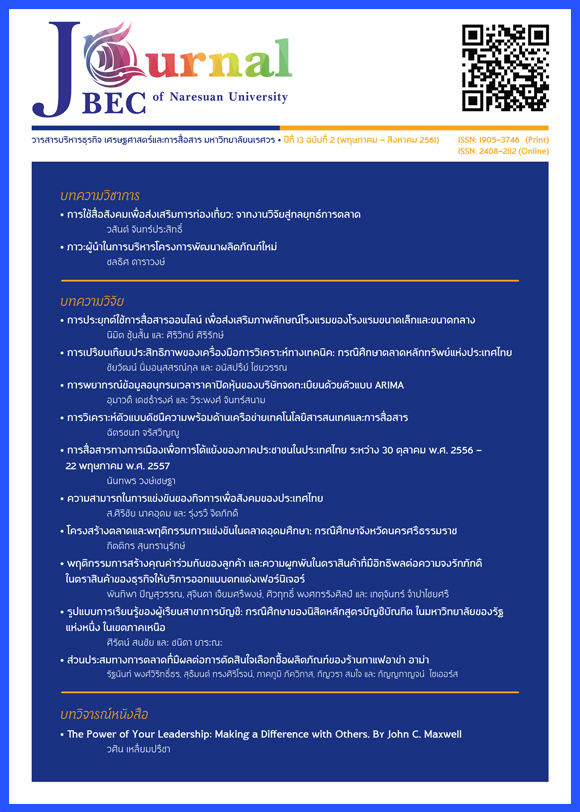
การใช้สื่อสังคมเพื่อส่งเสริมการท่องเที่ยว: จากงานวิจัยสู่กลยุทธ์การตลาด [Using Social Media for Promoting Tourism: From Research Perspectives to Applications of Marketing Strategies]
Article Sidebar
Main Article Content
Abstract
The first two parts of this article state the general knowledge regarding social media, namely the definition, characteristics and classification of social media as well as the roles and importance of social media in the tourism context. These contents will be implemented as fundamental knowledge leading to understanding the usage of social media for marketing strategies in the tourism context. This article demonstrates how to use social media for the purpose of promoting tourism in three perspectives: (1) strategic social marketing: a holistic framework, (2) lessons from selected best practices of social media campaigns and key elements of successful social media strategy by means of building or maintaining competitive advantages of tourism destinations, and (3) strategies to convince tourists to use social media in travel information search. The contents presented in this paper will be guidelines for identifying marketing strategies, marketing communication strategies of business units in tourism industry as well as destination marketing organizations.
Article Details
References
Ashley, C., & Tuten, T. (2015). Creative strategies in social media marketing: An exploratory study of branded social content and consumer engagement. Psychology & Marketing, 32(1), 15 – 27.
Baym, N. K. (2010). Personal connections in the digital age. Cambridge: Polity Press.
Bianchi, C., & Andrews, L. (2015). Investigating marketing managers' perspectives on social media in Chile. Journal of Business Research, 68(12), 2552 – 2559.
Cabiddu, F., Carlo, M. D., & Piccoli, G. (2014). Social media affordances: Enabling customer engagement. Annals of Tourism Research, 48, 175 - 192.
Chau, M., & Xu, J. (2012). Business intelligence in Blogs: Understanding consumer interactions and communities. MIS Quarterly, 36(4), 1189 - 1216.
Chu, S. C., & Kim, Y. (2011). Determinants of consumer engagement in electronic word-of-mouth (eWOM) in social networking sites. International journal of Advertising. 30(1), 47 – 75.
Chung, N., & Han, H. (2016). The relationship among tourists' persuasion, attachment and behavioral changes in social media. Technological Forecasting & Social Change. Retrieved from http://www.sciencedirect.com/science/article/pii/S004016251630275X
Chung, N. & Koo, C. (2015). Telematics and Informatics. The use of social media in travel information search, 32(2015) 215 – 229.
Cohen, H. (2011). 30 social media definitions. Retrieved from http://heidicohen.com/social-media-definition
Compete Incorporated. (2007). Consumer generated content: Learning from the innovators. Retrieved from http://www.competeinc.com/research/newsletters/traveltsrends_
conumer_generated_travel_content/
Damchoo, P., Fuckthong, D., Sornsawarn, B., Sornwang, P., & Jidaree, O. (2017). Motivations for sharing experiences through social media of flashpacker in hostels in Thailand. Journal of Business, Economics and Communications, 12(1), 89 – 106.
Deutsch, M., & Gerard, H. B. (1955). A study of normative and informational social influences upon individual judgment. The Journal of Abnormal and Social Psychology, 51(3), 629 – 636.
Dijkmans, C., Kerkhof, P., & Beukeboom, C. J. (2015). A stage to engage: Social media use and corporate reputation. Tourism Management, 47, 58-67.
eMarketer (2013). Asia-Pacific, social media inspires travelers. Retrieved from www.emarketer.com/Article/Asia-Pacific-Social-Media-Inspires-Travelers/1009605
Felix, R., Rauschnabel, A. P., & Hinsch, C. (2017). Elements of strategic social media marketing: A holistic framework. Journal of Business Research, 70, 118 – 126.
Filieri, R. (2014). Why do travelers trust TripAdvisor ? Antecedents of trust towards consumer-generated media and its influence on recommendation adoption and word of mouth. Tourism Management, 51, 174 - 185.
Forbes. (2015). TripAdvisor's growth plans for 2015 and beyond. Retrieved from http://www. forbes.com/ sites/greatspeculations/2015/03/06/tripadvisorsgrowth- plans-for-2015-and-beyond
Fotis, J., Buhalis, D., & Rossides, N. (2012). Social media use and impact during the holiday travel planning process. In M. Fuchs, F. Ricci, & L. Cantoni (Eds.), Information and communication technologies in tourism (pp. 13 – 24). Vienna, Austria: Springer.
Gretzel, U., & Yoo, K. H. (2008). Use and impact of online travel reviews. In P. O’Connor, W. Hopken, & U. Gretzel (Eds.), Information and communication technologies in tourism (pp. 35 – 46). Vienna, Austria: Springer.
Hamilton Island (2012). Hamilton Island´s ultimate instameet. Retrieved from http://www.
hamiltonisland.com.au/ultimate-instameet
Hollebeek, L. D., Glynn, M. S., & Brodie, R. J. (2014). Consumer brand engagement in social media: Conceptualization, scale development and validation. Journal of Interactive Marketing, 28(2), 149 -165.
Jacobsen, J. K. S., & Munar, A. M. (2012). Tourist information search and destination choice in a digital age. Tourism Management Perspectives, 1(1), 39 - 47.
Kaplan, A. M., & Haenlein, M. (2010). Users of the world, unite! The challenges and opportunities of social media. Business Horizons, 53(1), 61.
Kim, D. Y., Lehto, X. Y., & Morrison, A. M. (2007). Gender differences in online travel information search: Implications for marketing communications on the internet. Tourism Management, 28(2), 423 – 433.
Királová, A. & Pavlíćeka, A. (2015). Development of social media strategies in tourism destination. Procedia - Social and Behavioral Sciences, 175, 358 – 366.
Lai, K. H., & Cheng, T. E. (2005). Effects of quality management and marketing on organizational performance. Journal of Business Research, 58(4), 446 – 456.
Lee, H., Law, R., & Murphy, J. (2011). Helpful reviewers in TripAdvisor, an online travel community. Journal of Travel & Tourism Marketing, 28 (7), 675 – 688.
Lee, J. N., & Choi, B. (2014). Strategic role of IT and its impact on organizations. Information & Management, 51, 881 - 882.
Leung, X. Y., Bai, B., & Stahura, K. A. (2015). The marketing effectiveness of social media in the hotel industry a comparison of Facebook and Twitter. Journal of Hospitality & Tourism Research, 39(2), 147 - 169.
Li, C. Y. (2013). Persuasive messages on information system acceptance: A theoretical extension of elaboration likelihood model and social influence theory. Computers in Human Behavior. 29 (1), 264 – 275.
Lin, K. Y., & Lu, H. P. (2011). Why people use social networking sites: An empirical study integrating network externalities and motivation theory. Computers in Human Behavior. 27(3), 1152 – 1161.
Mediabistro. (2012). Social media’s influence on the travel industry. Retrieved from http://www.mediabistro. com/alltwitter/online-travel-industry_b25865
Munar, A. M. (2010). Digital exhibitionism: The age of exposure. Culture Unbound: Journal of Current Cultural Research, 2, 401 - 422.
Munar, A. M., & Jacobsen, J. K. S. (2013). Trust and involvement in tourism social media and web-based travel information sources. Scandinavian Journal of Hospitality and Tourism, 13(1), 1 - 19.
Munar, A. M., & Jacobsen, J. K. S. (2014). Motivations for sharing tourism experiences through social media. Tourism Management, 43, 46 - 54.
Prentice, D. A., Miller, D. T., & Lightdale, J. R. (1994). Asymmetries in attachments to groups and to their members: Distinguishing between common-identity and common-bond groups. Personality and Social Psychology Bulletin, 20(5), 484 – 493.
Ren, Y., Kraut, R. E., & Kiesler, S. (2007). Applying common identity and bond theory to design of online communities. Organization Studies, 28(2), 377 – 408.
Rokka, J., Karlsson, K., & Tienari, J. (2014). Balancing acts: Managing employees and reputation in social media. Journal of Marketing Management, 30(7/8), 802 – 827.
Schultz, D. E., & Peltier, J. (2013). Social media's slippery slope: Challenges, opportunities and future research directions. Journal of Research in Interactive Marketing, 7(2), 86 – 99.
Schweidel, D. A., & Moe, W. W. (2014). Listening in on social media: A joint model of sentiment and venue format choice. Journal of Marketing Research, 51(4), 387–402.
Shimp, A. T. (2010). Integrated marketing communications in advertising and promotion (2 ed.). US: Cengage Learning.
Tam, K. Y., & Ho, S. Y. (2005). Web personalization as a persuasion strategy: An elaboration likelihood model perspective. Information Systems Research. 16 (3), 271 – 291.
Tan, W. K., & Chen, T. H., (2012). The usage of online tourist information sources in tourist information search: An exploratory study. The Service Industries Journal, 32(3), 451 – 476.
Tripadvisor. (2014). TripBarometer April 2014: Global edition. Retrieved from http://www.tripadvisor.com/TripAdvisorInsights/n2200/tripbarometer-april-2014-global- edition
Werthner, H., & Klein, S., (1999). Information technology and tourism: A challenging relationship. International Journal of Tourism Research, 2(6), 447 - 448.
Wikipedia (2013). Social media. Retrieved from http://en.wikipedia.org/wiki/Social _media
World Travel Market. (2013). World travel market 2013 industry report. Retrieved from https://www.hospitalitynet.org/file/152005207.pdf
World Travel Market. (2016). World travel market 2016 industry report. Retrieved from http://london.wtm.com/RXUK/RXUK_WTMLondon/2016/PDFs/WTM_INDUSTRY_REPORT_2016_FINAL%20PRIN_OPTIMISED.pdf?v=636141145766223392
Zeng, B. & Gerritsen, R. (2014). What do we know about social media in tourism?. Tourism Management Perspective: A review, 10, 27-36.
