
ปัจจัยที่ส่งผลต่อความสนใจใช้งานสกุลเงินดิจิทัลลิบรา
Article Sidebar
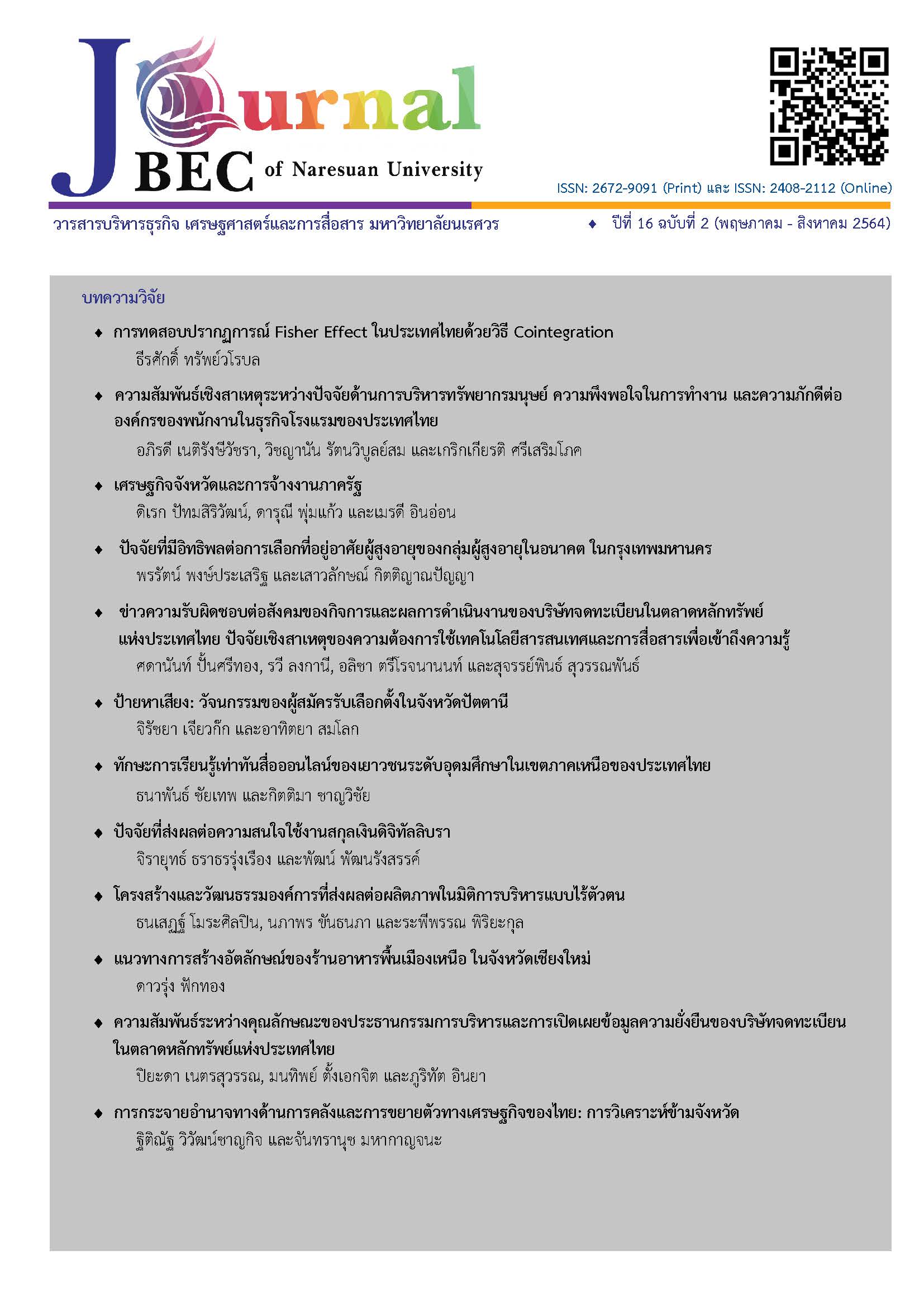
Main Article Content
บทคัดย่อ
การศึกษาครั้งนี้มีวัตถุประสงค์ เพื่อศึกษาปัจจัยที่ส่งผลต่อความสนใจใช้งานสกุลเงินดิจิทัลลิบรา (Libra) ผ่านการเก็บแบบสอบถามออนไลน์ โดยกำหนดขนาดของกลุ่มตัวอย่างจำนวน 400 ตัวอย่าง จากบุคคลทั่วไปที่ใช้บริการทางการเงินผ่านสมาร์ทโฟน นำมาวิเคราะห์ด้วยแบบจำลองโลจิต ผลการศึกษาพบว่า ปัจจัยที่ส่งผลต่อความสนใจใช้งานสกุลเงินดิจิทัลลิบรา ที่นัยสำคัญทางสถิติ 0.10 ได้แก่ เพศ อายุ การศึกษา รายได้ต่อเดือน ความถี่ในการทำธุรกรรมผ่านแอปพลิเคชั่น และการเคยซื้อสินค้าผ่านเครือข่ายบริการของเฟซบุ๊ก ความไว้วางใจในด้านการมีองค์กรอิสระมากำกับดูแล อิทธิพลจากเครือข่ายผ่าน เพื่อนหรือคนรู้จัก การยอมรับนวัตกรรมและเทคโนโลยีในด้านการใช้ชำระสินค้าและบริการในอัตราที่ต่ำ ด้านความรวดเร็วและเสถียร และด้านการใช้ชำระได้โดยไม่ต้องแลกเปลี่ยนเป็นสกุลเงินท้องถิ่น รวมถึงปัจจัยด้านเงินเสมือน คือ ได้รับการยอมรับและมีการใช้งานที่แพร่หลายทั้งในและต่างประเทศ ทั้งนี้ผู้ให้บริการที่มีความสนใจในสกุลเงินดิจิทัล ทั้งภาครัฐบาลและเอกชนสามารถใช้ผลการศึกษาเป็นแนวทางในการพัฒนาสกุลเงินดิจิทัลของตนเองได้
Article Details
เอกสารอ้างอิง
Bank of Thailand. (2017). Libra and Future of Global Currency ?. Retrieved September 23, 2019, from www.bot.or.th/Thai/PressandSpeeches/Press /News2560/n0260t.pdf
Bank of Thailand. (2019). Libra and Future of Global Currency ?. Retrieved March 13, 2020, from www.bot.or.th/broadcast/BOTMagazine/2562/BOT4_62/mobile/index.html
Bartz, T. (2019). Facebook verzichtet bei Libra auf chinesische Währung. Der Spiegel. Retrieved September 23, 2019, from https://www.spiegel.de/wirtschaft/facebook-will-kryptowaehrung-libra-nicht-an-yuan-koppeln-a-1287853.html
Chan-okul, S. (2015). Influences of eWORD of Mouth in E-commerce on Consumers’ Purchase Intentions. Master Thesis, M S., Thammasat University, Bangkok.
Cochran, W. G. (1977). Sampling Techniques. (3rd ed.). New York: John Wiley & Sons,Inc.Cronbach, L. J. (1947). Test reliability: Its meaning and determination. Psychometrika, 12(1), 1-6.
Digital Economy Promotion Agency. (2020). Getting to Know Cryptocurrency. Retrieved March 13, 2020, from www.depa.or.th/th/article-view/getting-know-cryptocurrency
Electronic Transactions Commission. (2018). Situation of Cryptocurrency in Thailand. Retrieved October 26, 2019, from www.etcommission.go.th/article-Techno-Cryptocurrency.html
Fongthiwong, S., Chancharoenchai, K (2019). Financial Innovation and Technology in Cryptocurrency at Bangkok Metropolitan Precinct. Journal of Economics and Management Strategy, 5(1), 1-17.
Gaitán, J. A., B. P. Peral, and M. A. R. Jerónimo. (2015). Elderly and Internet Banking: an Application of UTAUT2. Retrieved March 29, 2020, from www.researchgate.net/publication /277924056
Hsu, S. H. (2008). Developing an index for online customer satisfaction: Adaptationof American Customer Satisfaction Index. Expert Systems with Application, 34(1), 3033-3042.
Libra Association. (2019a). An Introduction to Libra. Retrieved July 17, 2019, from www.libra.org/en-US/white-paper.com
Libra Association. (2019b). The Libra Association. Retrieved July 17, 2019, from www.libra.org/en-US/association.com
Oliva, M. A., Borondo, J. P., and Clavero, G. M. (2019). Variables Influencing Cryptocurrency Use: A Technology Acceptance Model in Spain. Frontiers in Psychology, 10(1), 1-13.
Shehhi, A. A., Oudah, M and Aung, Z. (2014). Investigating Factors Behind Choosing a Cryptocurrency. Retrieved October 24, 2019, from www.researchgate.net /publication/290814876
Suwansirisilp, P. (2016). Factor Influencing The Adoption and Use of Promptpay Service. Independent Study, M.S., Thammasat University, Bangkok.
Teerasakdapong, A. (2016). An Analysis of Factors Affecting The Intention to Use Bitcoin. Independent Study, M.S, Thammasat University, Bangkok.
Tiantammachat, K. (2018). The study of The Influence of Decision Making by Using Cryptocurrency (Bitcoin) of The Millennials in Bangkok Metropolis. lndependent Study, M.S, Thammasat University, Bangkok
Venkatesh, V., M. G. Morris, G. B. Davis, and F. D. Davis. (2003). User Acceptance of Information Technology: Toward a Unified View. MIS Quarterly, 27(3), 425–478.
We Are Social. (2020). Digital 2020 Thailand. Retrieved April 4,2020, from www.slideshare.net/DataReportal/digital-2020-thailand-january-2020-v0
