
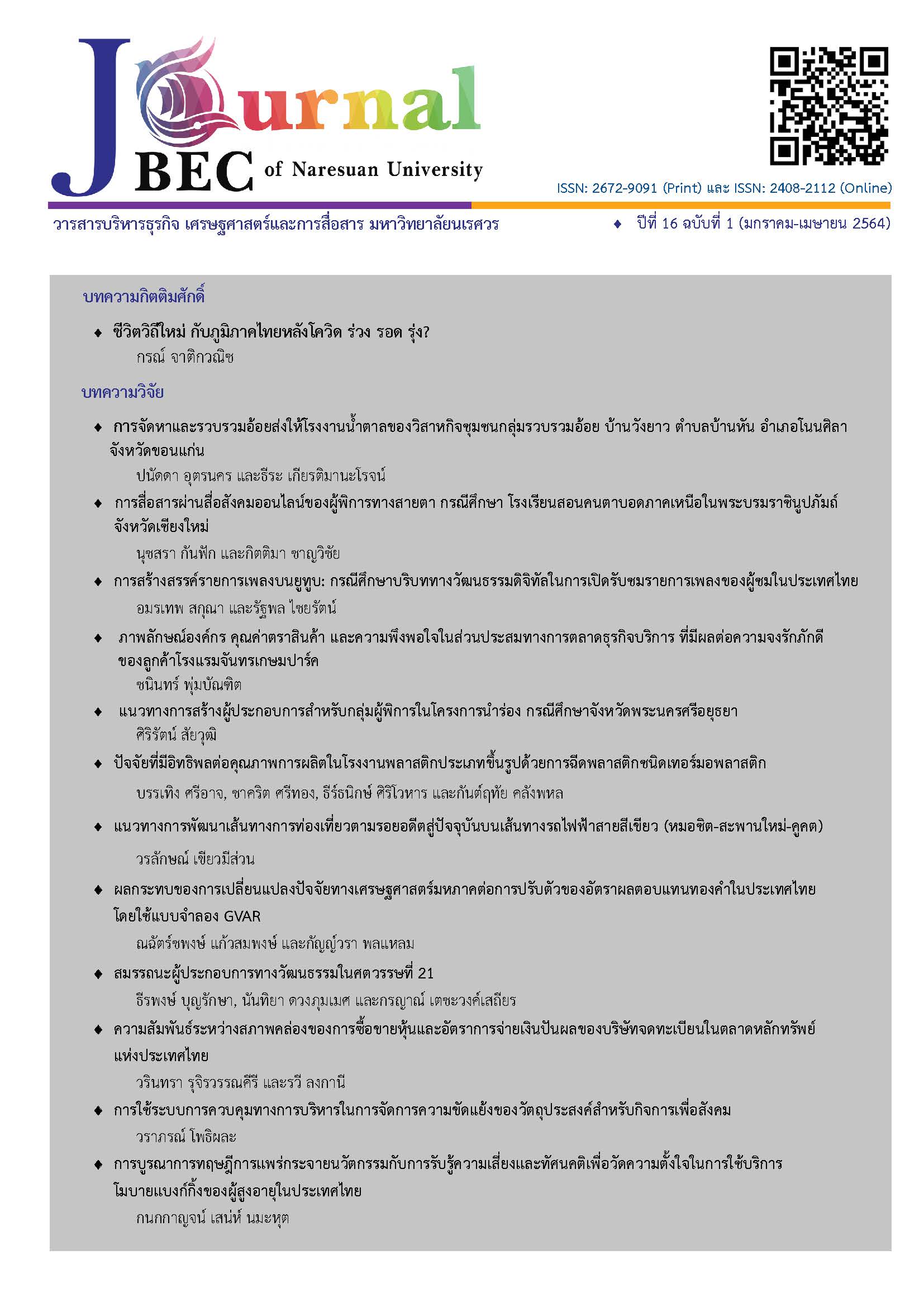
ปัจจัยที่มีอิทธิพลต่อคุณภาพการผลิตในโรงงานพลาสติกประเภทขึ้นรูปด้วยการฉีดพลาสติก ชนิดเทอร์มอพลาสติก
Article Sidebar
Main Article Content
บทคัดย่อ
งานวิจัยนี้วัตถุประสงค์เพื่อหาปัจจัยที่มีอิทธิพลต่อคุณภาพการผลิตของโรงงานพลาสติกประเภทขึ้นรูปด้วยการฉีดพลาสติกชนิดเทอร์มอพลาสติก ผู้วิจัยใช้ระเบียบวิธีวิจัยเชิงคุณภาพและการศึกษาเฉพาะกรณี เครื่องมือที่ใช้ในการวิจัยได้แก่ แบบสัมภาษณ์แบบกึ่งโครงสร้าง โดยปรับปรุงจากกรอบแนวคิดและทฤษฎีที่ได้ศึกษา 3 ด้าน คือ 1. ด้านการผลิต 2. ด้านการลดความสูญเสีย 3. ด้านพฤติกรรมการใช้เครื่องจักร ผู้วิจัยใช้การสัมภาษณ์เชิงลึกโดยเก็บข้อมูลจากผู้ให้สัมภาษณ์ 8 ท่าน ผู้วิจัยใช้การตรวจสอบข้อมูลแบบสามเส้า โดยมาจากแหล่งข้อมูลได้แก่
1. การสืบค้นทบทวนวรรณกรรมที่เกี่ยวข้อง 2. ข้อมูลจากผู้เชี่ยวชาญ 3. ข้อมูลจากโรงงาน ผลการวิจัยพบว่า ปัจจัยที่สำคัญและส่งผลต่อการลดของเสียในการผลิตพลาสติกมี 5 ปัจจัย ได้แก่ 1. ปัจจัยด้านพนักงาน พบว่าการรับคำสั่งจากผู้บังคับบัญชาอย่างเคร่งครัด การคำนึงถึงความปลอดภัยในงาน และปฏิบัติงานตามขั้นตอนช่วยให้ประสิทธิภาพในการผลิตเพิ่มขึ้น 2. ปัจจัยด้านเครื่องจักร พบว่าการจัดแผนซ่อมบำรุงเครื่องจักร การทำตารางตรวจสอบการทำงานของเครื่องจักร การกำหนดขั้นตอนการทำงานให้ผู้ดูแลเครื่องจักรช่วยเพิ่มประสิทธิภาพในการผลิตได้เช่นกัน 3.ปัจจัยด้านแม่พิมพ์ พบว่าผู้ผลิตสามารถลดเวลาการทำงานโดยตรวจสอบความสมบูรณ์ของแม่พิมพ์อยู่อย่างสม่ำเสมอ มิเช่นนั้น หากแม่พิมพ์มีรอยยุบ ชิ้นงานที่ออกมาก็จะมีข้อบกพร่อง เช่น มีครีบยื่นออกมา ซึ่งต้องเสียเวลาตบแต่งให้สวยงาม 4.ปัจจัยด้านเม็ดพลาสติก พบว่าแม่พิมพ์แต่ละชนิดถูกสร้างมาให้ใช้กับเม็ดพลาสติกเฉพาะชนิดเท่านั้น การเลือกใช้เม็ดพลาสติกประเภทที่สอดคล้องกับแม่พิมพ์จึงลดปริมาณชิ้นงานที่มีข้อบกพร่องได้ 5. ปัจจัยด้านการปรับตั้งเครื่องจักร พบว่าการปรับตั้งค่าของเครืองฉีดขึ้นรูปช่วยลดข้อบกพร่องของชิ้นงานในลักษณะต่าง ๆ เช่น การฉีดไม่เต็มแม่พิมพ์ ชิ้นงานมีครีบ เป็นต้น ปัจจัยทั้งห้าด้านส่งผลให้ของเสียลดลง ซึ่งช่วยเพิ่มประสิทธิภาพในการผลิตของโรงงานพลาสติกประเภทขึ้นรูปด้วยการฉีดพลาสติกชนิดเทอร์มอพลาสติก
Article Details
เอกสารอ้างอิง
Amarin Wongsetti and Joompon Bamrungwong. (2018). The Overall Equipment Effectiveness Improvement for Plastic Injection Molding Process in Case of the Orchid Packaging. IE Network Conference 2018 (pp. 1092-1096).Ubonratchathani: Department of Industrial Engineering Ubon Ratchathani University.)
Banterng Sriard et al, (2020) Guidelines for Waste Management in the Plastics Industry in Thailand Journal BU Academic Review, pp 164-176.
Brett Jackson, (2013). Controlling Conformations of Conjugated Polymers and Small Molecules: The Role of Nonbonding Interactions Nicholas E. Jackson, Brett M. Savoie, Kevin L. Kohlstedt, Monica Olvera de la Cruz, George C. Schatz, Lin X. Chen, and Mark A. Ratner Journal of the American Chemical Society 2013. 135(28), 10475-10483
Baird, K., Jia Hu, K., Reeve, R., (2011). The relationships between organizational culture, total quality management practices and operational performance. Int. J. Oper. Prod.Manag. 31 (7), 789–814.
Benavides-Velasco, Quintana-Garcia and Marchante-Lara (2014). Total quality management, corporate social responsibility and performance in the hotel industry http://dx.doi.org/10.1016/j.ijhm.2014.05.003 0278-4319/©2014 ElsevierLtd.All rights reserved
L. D. Mahajan, and P. N. Ulhe (2018). “ANALYSIS OF INJECTION MOLDING PROCESS TO REDUCED DEFECTS (SHORT-SHOT).” International Journal of Engineering Technologies and Management Research, 5(6), 113-119. DOI: 10.5281/zenodo.1313112
Industrial statistics of the year 2019, Department of Industrial Works Retrieved 24 March 2019 from https://www.diw.go.th hawk/content.php?mode=spss62
Michael Kwamega, Dongmei Li, Evans Brako Ntiamoah (2015). Role of Total Quality Management (TQM) as a Tool for Performance Measurement in Small and Mediumsized Enterprise (SME’S) in Ghana British Journal of Economics, Management & Trade 10(3): 1-10, 2015, Article no.BJEMT.20806
McLean, J. (2011). Fayol - Standing the test of time. Manager: British Journal of Administrative Management, 74. pp. 32-33.
Nagahanumaiah,B.RaviArticle,(2009).inRapidPrototypingJournal May2009DOI:10.1108/13552540910960271) Vyacheslav Lyashenko , Rami Matarneh , Svitlana Sotnik
McLean, J. (2011). Fayol - Standing the test of time. Manager: British Journal of Administrative Management, 74. pp. 32-33.
Nantsupawat. (2016). The Relationship between Nurse Practice Environment and Nurse Staffing Levels and Selected Nursing-Sensitive Indicators. university Hospitals in Thailand International Journal of Evidence-Based Healthcare. 2016(4). p S19.
Silva, A. S., Medeiros, C. F., & Vieira, R. K. (2017). Cleaner Production and PDCA cycle: Practical application for reducing the Cans Loss Index in a beverage company. Journal of Cleaner Production, 150, 324-338.
S.R. Vijayakumar, S. Gajendran. (2016). Improving Productivity Based on Evaluation Score of Overall Equipment Effectiveness (OEE ) Using DMAIC Approach on Blistering Machine, IOSR Journal of Mechanical and Civil Engineering (IOSR-JMCE), e- ISSN: 2278-1684, p-ISSN : 2320–334X, PP 47-60
The characteristics of not quality in the production of plastic industry, Production report for 2015-2019
The Federation of Thai Industries, 2019, Retrieved 24 March 2019 from https://www.fti.or.th/project/-2562
Vyacheslav Lyashenko,Rami Matarneh,Svitlana Sotnik,(2018). Defects of Casting Plastic Products: Causes, Recurrence, Synthesis and Ways of Elimination.
Yuniawan Sulistyoadi et al, (2016) “TPM Implementation to Reduce Downtime in Injection Molding Company”, Journal of Scientific and Engineering Research, pp 398-404.
