
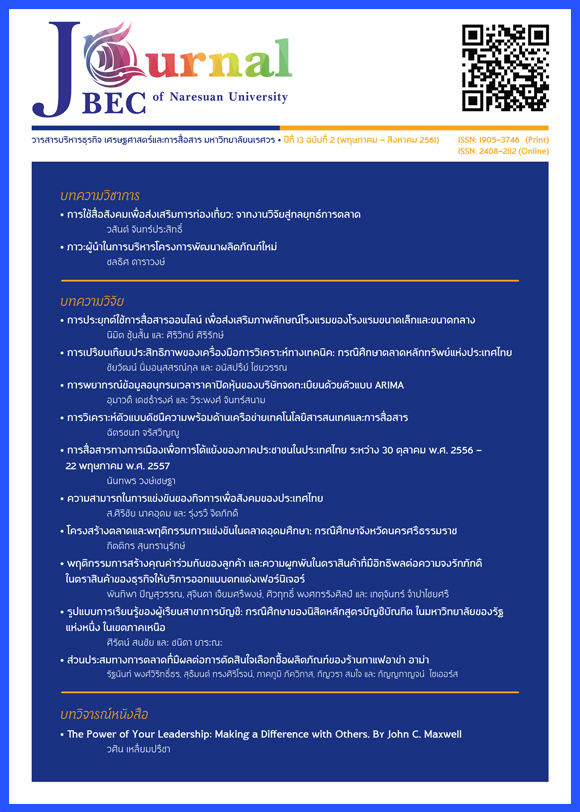
การสื่อสารทางการเมืองเพื่อการโต้แย้งของภาคประชาชนในประเทศไทย ระหว่าง 30 ตุลาคม พ.ศ. 2556 – 22 พฤษภาคม พ.ศ. 2557 [Civil Contentious Political Communication in Thailand During October 30, 2013 – May 22, 2014]
Article Sidebar
Main Article Content
บทคัดย่อ
บทความนี้เป็นส่วนหนึ่งของงานวิจัยเรื่องการสื่อสารทางการเมืองเพื่อการโต้แย้งของภาคประชาชนในประเทศไทย ระหว่าง 31 ตุลาคม พ.ศ. 2556 - 22 พฤษภาคม พ.ศ. 2557 มีวัตถุประสงค์เพื่อศึกษาการสื่อสารทางการเมืองที่มีสุเทพ เทือกสุบรรณ อดีตเลขาธิการและสมาชิกสภาผู้แทนราษฎรพรรคประชาธิปัตย์เป็นแกนนำในการโต้แย้งของภาคประชาชนกับรัฐบาลยิ่งลักษณ์ ชินวัตร และเพื่อสร้างตัวแบบการสื่อสารทางการเมืองเพื่อการโต้แย้งของภาคประชาชนจากกรณีดังกล่าว โดยใช้แนวคิดการโต้แย้งทางการเมืองของทิลลีและทาร์โรว์ร่วมกับแนวคิดพลังในการเคลื่อนไหวที่ผลักดันให้ข้อเรียกร้องไปสู่การกระทำของทาร์โรว์แต่เน้นเฉพาะพลังการสื่อสารเท่านั้น ผู้วิจัยใช้ระเบียบวิธีวิจัยเชิงคุณภาพ การเก็บข้อมูลจากหลักฐานต่าง ๆ ได้แก่ วิดิทัศน์การปราศรัยของสุเทพ เทือกสุบรรณที่เกิดขึ้นในช่วงเวลาของการโต้แย้ง สื่อสิ่งพิมพ์และสื่อใหม่ และสัมภาษณ์แบบเจาะลึกจากผู้ให้ข้อมูลระดับแกนนำการโต้แย้ง ใช้แนวทางการลดทอน การวิเคราะห์ข้อมูลโดยการถอดความต่อข้อมูลเพื่อจัดแยกประเภทและหมวดหมู่ในการหาข้อสรุปของงานวิจัย ผลการวิจัยพบว่าการสื่อสารทางการเมืองเพื่อการโต้แย้งของภาคประชาชนได้ยกระดับความเข้มข้นขึ้นเรื่อย ๆ ตามสถานการณ์เป็นระยะซึ่งสามารถแบ่งการสื่อสารออกเป็น 3 ระยะคือ การคัดค้าน ร่างพระราชบัญญัตินิรโทษกรรมฯ การขจัดระบอบทักษิณและการปฏิรูปการเมือง และสามารถสร้างแบบจำลองการสื่อสารทางการเมืองเพื่อการโต้แย้งของภาคประชาชนได้ 4 ขั้นตอน คือ การก่อชนวน การรวบรวมสรรพกำลัง การหยั่งกำลังและจัดตั้งองค์กร และการยกระดับสูงสุดคือการโต้แย้งทางการเมืองเต็มรูปแบบ
Article Details
เอกสารอ้างอิง
2. Blumler, J. G. and Gurevitch, M. (2000). Rethinking the study of political communication. In J. Curran and M. Gurevitch (Eds.), Mass media and society (3rd ed., pp. 155-174). London: Edward Arnold, Blumler.
3. Champakhao, W. (2011). The political communication of the people's alliance for democracy: A case study of the protests post-election December 23rd, 2007. Doctoral dissertation, Ph.D. (Political Communication), Krirk University, Bangkok.
4. Coleman, S. (2002). Election call 2001: How politicians and the public interacted. Parliamentary Affairs, 55(4), 731-42.
5. Coleman, S. (2004). Blogs as listening posts rather than soapboxes. Retrieved September 7, 2004, from http://www.hansardsociety.org.uk
6. Curran, J. and Gurevitch, M. (eds.). Mass Media and Society (3rd ed.). London: Arnold.
7. Dalton, R. J. and Burklin, W. (2003). Wahler ALS wandervogel: Dealignment and the German voter. German Politics and Society, 21(1), 57-74.
8. Davis, R. and Curtis, J. (2000). Speaking for the public: Representation and audience participation during the 1997 British general election campaign. Harvard International Journal of Press/Politics, 5(1), 62-77.
9. Kanpunpong, K. (2011). The political legitimacy on political movement; People's Alliance for Democracy (25 May-2 December, 2008) and National United Front of Democracy against Dictatorship (12 March-20 May, 2010). Master thesis, M.A. (Pol. Science) Thammasat University, Bangkok.
10. Karavekphan, B. (n.d.). Suthep Thaugsuban. Retrieved April 25, 2016, from http://wiki.kpi.ac.th/index.php?title=สุเทพ_เทือกสุบรรณ
11. Keilbowicz, R. B. and Scherer, C. (1986). The Role of the Press in the Dynamics of Social Movements. In L. Kriesberg. Greenwich (Ed.), Research in Social Movements, Conflict and Change (pp. 71-96). CT: JAI.
12. Kitprakob, S. (2015). “Kamnan Suthep” a political communication campaigner as perceived by political reporters and communication arts and political science academicians. Master thesis, M.Com. Arts., Dhurakij Pundit University, Bangkok.
13. Krasaesunthorn, S. (n.d.). Thaksin Shinnawat. Retrieved April 25, 2016, from http://wiki.kpi.ac.th/index.php?title=ทักษิณ ชินวัตร
14. Mingmaninakin, W. (2014). Thaksin regime: The beginning and the end. Manager Online. Retrieved April 25, 2016, from http://www.manager.co.th/daily/ViewNews.aspx?NewsID=957000 0017575
15. Passy, F. and Monsch, G. (2014). Do social networks really matter in contentious politics?. Social Movement Studies, 13(1), 22-47.
16. Piven, F. F. and Cloward, R. (1977). Poor people’s movements: Why they succeed, how they fail. New York: Vintage.
17. Polanska, D. V. (2013). The role of alliances and brokerage for collective political struggle: The case of polish tenants' movement. Retrieved October 28, 2017, from http://www.rc21.org/conferences/berlin2013/RC21-Berlin-Papers-2/03-polanska.pdf
18. Prasertkul, S. (2010). Civic political in Thailand’s democracy. Bangkok: Vipasa Publishing.
19. Satayawatana, C. (2014). The phenomena of mass’s power. Patumtani: Ransit University Press.
20. Sawangdee, P. (2010). Communication strategy of people's alliance for democracy.
Master thesis, M. Com.Ad., Thammasat University, Bangkok.
21. Snow, D. A. and Robert D. B. (1992). Master frames and cycles of protest. In A. Morris and C. McCllurg Mueller (Eds.), Frontiers in Social Movement Theory (pp. 133-155). New Haven, CT: Yale University Press.
22. Somjai, K. (2008). Political communication of political crisis in Thailand: A case study of people's alliance for democracy. Doctoral dissertation, Ph.D. (Political Communication), Krirk University, Bangkok.
23. Stanyer, J. (2007). Modern political communication. United Kingdom: Polity Press.
24. Tarrow, S. (2011). Power in movement (3rd ed.). New York: Cambridge University Press.
25. Thaugsuban, S. (2014). The power of change Kamnan Suthep Thaugsuban. Bangkok: Lips Publishing.
26. Tilly, C. (2008). Contentious performance. Cambridge: Cambridge University Press.
27. Tilly, C. and Tarrow, S. (2015). Contentious politics (2nd ed.). New York: Oxford University Press.
28. Treesuwan, H. (2017, October 30). 4 year-whistle mob and 4 stories behind the scene of PDRC. BBC Thai. Retrieved April 25, 2016, from http://www.bbc.com/thai/thailand-41804763
29. Viriyothai, K. (2009). Political branding strategy of people's Alliance for democracy in 2008. Master thesis, M. Com.Ad., Thammasat University, Bangkok.
30. Zelinska, O. (2015). Who were the protestors and what did they want? Contentious politics of local maidan across Ukraine, 2013-2014. Demokratizatsiya: The Journal of Post-Soviet Democratization, 23(4), 379-400.
