ปัจจัยเชิงสาเหตุที่มีอิทธิพลต่อสมรรถนะองค์กรที่ส่งผลต่อผลการดำเนินงานของวิสาหกิจชุมชน ประเภทผลิตภัณฑ์ผ้าทอและเสื้อผ้าในภาคตะวันออกเฉียงเหนือตอนกลาง
คำสำคัญ:
สมรรถนะองค์กร, การมุ่งประกอบการ, การบริหารทรัพยากรมนุษย์, การจัดการเทคโนโลยีสารสนเทศ, ผลการดำเนินงานขององค์กรบทคัดย่อ
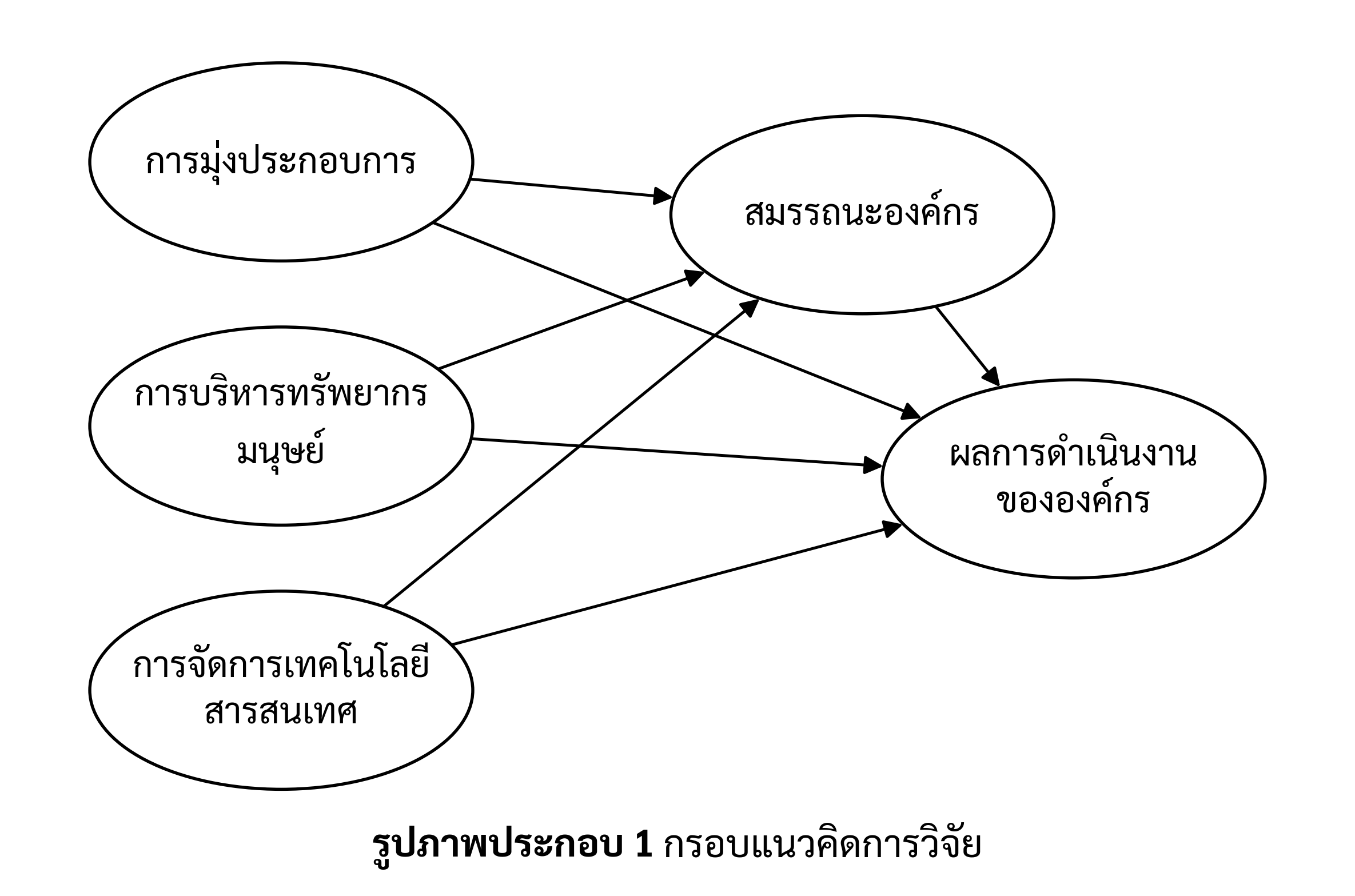
การยกระดับศักยภาพของวิสาหกิจชุมชนด้านผ้าทอและเครื่องนุ่งห่มเป็นความท้าทายสำคัญของเศรษฐกิจฐานราก เนื่องจาก กลุ่มผู้ประกอบการจำนวนมากยังขาดทักษะเชิงผู้ประกอบการ การบริหารจัดการที่เป็นระบบ และการใช้เทคโนโลยีดิจิทัล งานวิจัยนี้มุ่งศึกษากลไกเชิงสาเหตุที่กำหนดสมรรถนะองค์กรและผลการดำเนินงานของวิสาหกิจชุมชนด้านผ้าทอและเสื้อผ้าในภาคตะวันออกเฉียงเหนือตอนกลาง โดยใช้กรอบทฤษฎีระบบ (System Theory) ร่วมกับแนวคิดเชิงทรัพยากรและสมรรถนะองค์กร อธิบายความสัมพันธ์ระหว่างปัจจัยนำเข้า กระบวนการภายใน และผลลัพธ์องค์กร กลุ่มตัวอย่างจำนวน 420 แห่งได้รับการวิเคราะห์ด้วยโมเดลสมการโครงสร้าง (SEM)
ผลการวิจัยพบว่า โมเดลมีความสอดคล้องกับข้อมูลเชิงประจักษ์ โดยการมุ่งเน้นความเป็นผู้ประกอบการ การบริหารทรัพยากรมนุษย์ และการจัดการเทคโนโลยีสารสนเทศส่งผลเชิงบวกต่อสมรรถนะองค์กร ซึ่งทำหน้าที่ถ่ายทอดอิทธิพลไปสู่ผลการดำเนินงานขององค์กร โมเดลสามารถอธิบายความแปรปรวนของสมรรถนะองค์กรได้ร้อยละ 90 และของผลการดำเนินงานได้ร้อยละ 96 สะท้อนประสิทธิภาพในการทำนายผลลัพธ์เชิงองค์กรอย่างมีนัยสำคัญ ผลลัพธ์ยืนยันบทบาทของสมรรถนะองค์กรในฐานะกลไกกลางที่บูรณาการความรู้ ทักษะ และเทคโนโลยีเพื่อเสริมสร้างขีดความสามารถในการแข่งขันของวิสาหกิจชุมชนในภาคตะวันออกเฉียงเหนือที่พึ่งพาภูมิปัญญาท้องถิ่นและเครือข่ายความร่วมมืออย่างเข้มแข็ง
Downloads
เอกสารอ้างอิง
กลุ่มทะเบียนและสารสนเทศวิสาหกิจชุมชน กองส่งเสริมวิสาหกิจชุมชน. (2567). วิสาหกิจชุมชนและเครือข่ายวิสาหกิจชุมชนที่อนุมัติการจดทะเบียนแล้ว จำแนกตามเขตและจังหวัด และการประกอบกิจการ. สืบค้นเมื่อ 30 พฤษภาคม พ.ศ. 2567, จาก http://sceb.doae.go.th
ประพันธ์ แสงทองดี และวันทนา เนาว์วัน. (2566). แนวทางการพัฒนาการดำเนินงานของวิสาหกิจชุมชนอย่างยั่งยืนในเขตพื้นที่อำเภอบางปะอิน จังหวัดพระนครศรีอยุธยา. วารสารการบริหารจัดการและนวัตกรรมท้องถิ่น, 5(2), 14-22.
สถาบันพัฒนาอุตสาหกรรมสิ่งทอ. (2567). สถานการณ์อุตสาหกรรมสิ่งทอและเครื่องนุ่งห่มไทย เดือนธันวาคม 2567 และสรุปปีพ.ศ. 2567. สืบค้นเมื่อวันที่ 16 กันยายน 2568, จาก https://www.thaitextile.org/th/insign/detail.4427.1.0.html
Al-Edenat, M. (2023). Organizational competencies toward digital transformation at the events of disruptive changes: an operational process innovation perspective. Competitiveness Review: An International Business Journal, 33(4), 690-710. https://doi.org/10.1108/CR-05-2021-0081
Alkharafi, N., Alsaber, A., & Alnajem, M. (2024). Exploring entrepreneurial orientation in an emerging economy. Journal of Innovation & Knowledge, 9(4), 100553. https://doi.org/10.1016/j.jik.2024.100553
Appelbaum, E., Bailey, T., Berg, P., & Kalleberg, A. L. (2000). Manufacturing advantage: Why high-performance work systems pay off. Cornell University Press.
Arokiasamy, L., Fujikawa, T., Piaralal, S. K., & Arumugam, T. (2024). Role of HRM practices in organization performance: A survey approach. International Journal of Sociotechnology and Knowledge Development, 16(1), 1–32. https://doi.org/10.4018/IJSKD.334555
Barba-Sánchez, V., Meseguer-Martínez, Á., Gouveia-Rodrigues, R., & Raposo, M. L. (2024). Effects of digital transformation on firm performance: The role of IT capabilities and digital orientation. Heliyon, 10, e27725. https://doi.org/10.1016/j.heliyon.2024.e27725
Barney, J. (1991). Firm resources and sustained competitive advantage. Journal of Management, 17(1), 99-120. https://doi.org/10.1177/014920639101700108
Boulding, K. E. (1956). General systems theory the skeleton of science. Management Science, 2(3), 197-208.
Boyatzis, R. E. (2008). Competencies in the 21st century. Journal of Management Development, 27(1), 5-12.
Byrne, B. M. (2016). Structural Equation Modelling with AMOS: Basic Concepts, Applications, and Programming (3rd ed.). Routledge.
Escrig-Tena, A. B., & Bou‐Llusar, J. C. (2005). A model for evaluating organizational competencies: An application in the context of a quality management initiative. Decision Sciences, 36(2), 221-257. https://doi.org/10.1111/j.1540-5414.2005.00072.x
Fairoz, F. M., Hirobumi, T., & Tanaka, Y. (2010). Entrepreneurial orientation and business performance of small and medium scale enterprises of Hambantota District Sri Lanka. Asian Social Science, 6(3), 34-46.
Fornell, C., & Larcker, D. F. (1981). Evaluating structural equation models with unobservable variables and measurement error. Journal of Marketing Research, 18(1), 39–50.
Gulzar, M., Ali, A., Naqvi, B., & Smolander, K. (2024). Revealing the state of the art in managing IT infrastructure within enterprises: A systematic mapping study. IEEE Access, 12, 108533–108555. https://doi.org/10.1109/ACCESS.2024.3439093
Hair, J. F., Ringle, C. M., & Sarstedt, M. (2011). PLS-SEM: Indeed a silver bullet. Journal of Marketing Theory and Practice, 19(2), 139-152.
Hair, J. F., Babin, B. J., Anderson, R. E., & Black, W. C. (2019). Multivariate Data Analysis (8th ed.). Pearson Prentice.
Hair, J. F., Hult, G. T. M., Ringle, C. M., & Sarstedt, M. (2021). A Primer on Partial Least Squares Structural Equation Modeling (PLS-SEM) (3rd ed.). Sage.
Helfat, C. E., & Peteraf, M. A. (2009). Understanding dynamic capabilities: Progress along a developmental path. Strategic Organization, 7(1), 91–102. https://doi.org/10.1177/1476127008100133
Hernández-Linares, R., López-Fernández, M. C., García-Piqueres, G., Pina e Cunha, M., & Rego, A. (2024). How
knowledge-based dynamic capabilities relate to firm performance: The mediating role of entrepreneurial orientation. Review of Managerial Science, 18(10), 2781–2813.
Henseler, J., Ringle, C.M and Sarstedt, M. (2015). A New Criterion for Assessing Discriminant Validity in Variance-based Structural Equation Modeling. Journal of the Academy of Marketing Science, 43(1), 115-135. https://doi.org/10.1007/s11747-014-0403-8
Jirawuttinunt, S., Issarapaiboon, A., Mueangjum, C., & Pataraarechachai, V. (2024). The role of organizational innovation capability in the relationship between disruptive innovation and organizational performance of Thai listed firms. ABAC Journal, 44(3), 193–209. https://doi.org/10.59865/abacj.2024.27
Karabulut, A. T. (2015). Effects of innovation types on performance of manufacturing firms in Turkey. Procedia-Social and Behavioral Sciences, 195, 1355-1364. https://doi.org/10.1016/j.sbspro.2015.06.322
Kline, R. B. (2016). Principles and Practice of Structural Equation Modeling (4th ed.). Guilford Press.
Kusa, R., Suder, M., & Duda, J. (2024). Role of entrepreneurial orientation, information management, and knowledge management in improving firm performance. International Journal of Information Management, 78, 102802. https://doi.org/10.1016/j.ijinfomgt.2024.102802
Lumpkin, G. T., & Dess, G. G. (1996). Clarifying the entrepreneurial orientation construct and linking it to performance. Academy of Management Review, 21(1), 135-172.
McClelland, D. C. (1973). Testing for competence rather than for ‘intelligence’. American Psychologist, 28(1), 1-14.
Miller, D. (1983). The correlates of entrepreneurship in three types of firms. Management Science, 29(7), 770-791. https://doi.org/10.1287/mnsc.29.7.770
Mithas, S., Ramasubbu, N., & Sambamurthy, V. (2011). How information management capability influences firm performance. MIS Quarterly, 35(2), 237-256. https://doi.org/10.2307/23043496
Nunnally, J. C. (1978). Psychometric Theory (2nd ed.). McGraw-Hill.
Omar, A. O., Jailani, S. F. A. K., Ali, S. A. M., & Yunus, N. M. (2023). Impact of information technology towards organizational performance. Advances in Social Sciences Research Journal, 10(6.2), 128–137. https://doi.org/10.14738/assrj.106.2.15019
Osazevbaru, H. O., & Okeme, O. J. (2023). Impact of core competencies on organizational performance of industrial Goods firms in Nigeria. International Journal of Applied Research in Social Sciences, 5(10), 515–527.
Prahalad, C. K., & Hamel, G. (1990). The core competence of the corporation. Harvard Business Review, 68(3), 79-91.
Rovinelli, R. J., & Hambleton, R. K. (1977). On the use of content specialists in the assessment of criterion-referenced test item validity. Tijdschrift voor Onderwijsresearch, 2(2), 49-60.
Rodvinit, C., & Tangpinyoputtikhun, Y. (2024). Entrepreneurial orientation on business success through innovation
in accounting management of small and medium real estate businesses in the Northeastern region. Revista de Gestão Social e Ambiental, 18(5), 1–18. http://202.28.34.124/dspace/handle123456789/3008
Teece, D. J., Pisano, G., & Shuen, A. (1997). Dynamic capabilities and strategic management. Strategic Management Journal, 18(7), 509-533.
Teece, D. J. (2007). Explicating dynamic capabilities: the nature and microfoundations of (sustainable) enterprise performance. Strategic Management Journal, 28(13), 1319-1350. https://doi.org/10.1002/smj.640
Teece, D. J. (2014). The foundations of enterprise performance: Dynamic and ordinary capabilities in an (economic) theory of firms. Academy of Management Perspectives, 28(4), 328-352. https://doi.org/10.5465/amp.2013.0116
Tippins, M. J., & Sohi, R. S. (2003). IT competency and firm performance: Is organizational learning a missing link? Strategic Management Journal, 24(8), 745-761. https://doi.org/10.1002/smj.337
Torres Rivera, M. P., & Pedraza Melo, N. A. (2023). Management competencies and their relationship with organizational performance in small and medium-sized family businesses. European Journal of Family Business, 13(2), 220–233.
Ulrich, M. D., Way, S. A., & Wright, P. M. (2024). Building strategic human capabilities that drive performance. The International Journal of Human Resource Management, 35(20), 3341-3373. https://doi.org/10.1080/09585192.2024.2408026
Vermeeren, B. (2014). Variability in HRM implementation among line managers and its effect on performance: A 2-1-2 mediational multilevel approach. The International Journal of Human Resource Management, 25(22), 3039-3059. https://doi.org/10.1080/09585192.2014.934891
Von Bertalanffy, L. (1968). General system theory. New York: George Braziller.
Wang, Y., Zhu, L., & Jin, X. (2024). The effect of a high-performance work system on organizational innovation
performance: The mediating effect of employees’ intrinsic motivation and the moderating effect of person–organization fit. Systems, 12(7), 230. https://doi.org/10.3390/systems12070230
Wolf, E. J., Harrington, K. M., Clark, S. L., & Miller, M. W. (2013). Sample size requirements for structural equation models. Educational and Psychological Measurement, 73(6), 913–934.
ดาวน์โหลด
เผยแพร่แล้ว
รูปแบบการอ้างอิง
ฉบับ
ประเภทบทความ
สัญญาอนุญาต
ลิขสิทธิ์ (c) 2025 วารสารการบัญชีและการจัดการ

อนุญาตภายใต้เงื่อนไข Creative Commons Attribution-NonCommercial-NoDerivatives 4.0 International License.
บทความที่ได้รับการตีพิมพ์เป็นลิขสิทธิ์ของวารสารการบัญชีและการจัดการ
ข้อความที่ปรากฏในบทความแต่ละเรื่องในวารสารวิชาการเล่มนี้เป็นความคิดเห็นส่วนตัวของผู้เขียนแต่ละท่านไม่เกี่ยวข้องกับมหาวิทยาลัยมหาสารคาม และคณาจารย์ท่านอื่นๆในมหาวิทยาลัยฯ แต่อย่างใด ความรับผิดชอบองค์ประกอบทั้งหมดของบทความแต่ละเรื่องเป็นของผู้เขียนแต่ละท่าน หากมีความผิดพลาดใดๆ ผู้เขียนแต่ละท่านจะรับผิดชอบบทความของตนเองแต่ผู้เดียว