Causal Factors Influencing Organizational Competencies Affect Performance of Community Enterprises: Woven Fabrics and Clothing in the Northeastern Central Region
Keywords:
Organizational Competency, Entrepreneurial Orientation, Human Resource Management, Information Technology Management, Organizational PerformanceAbstract
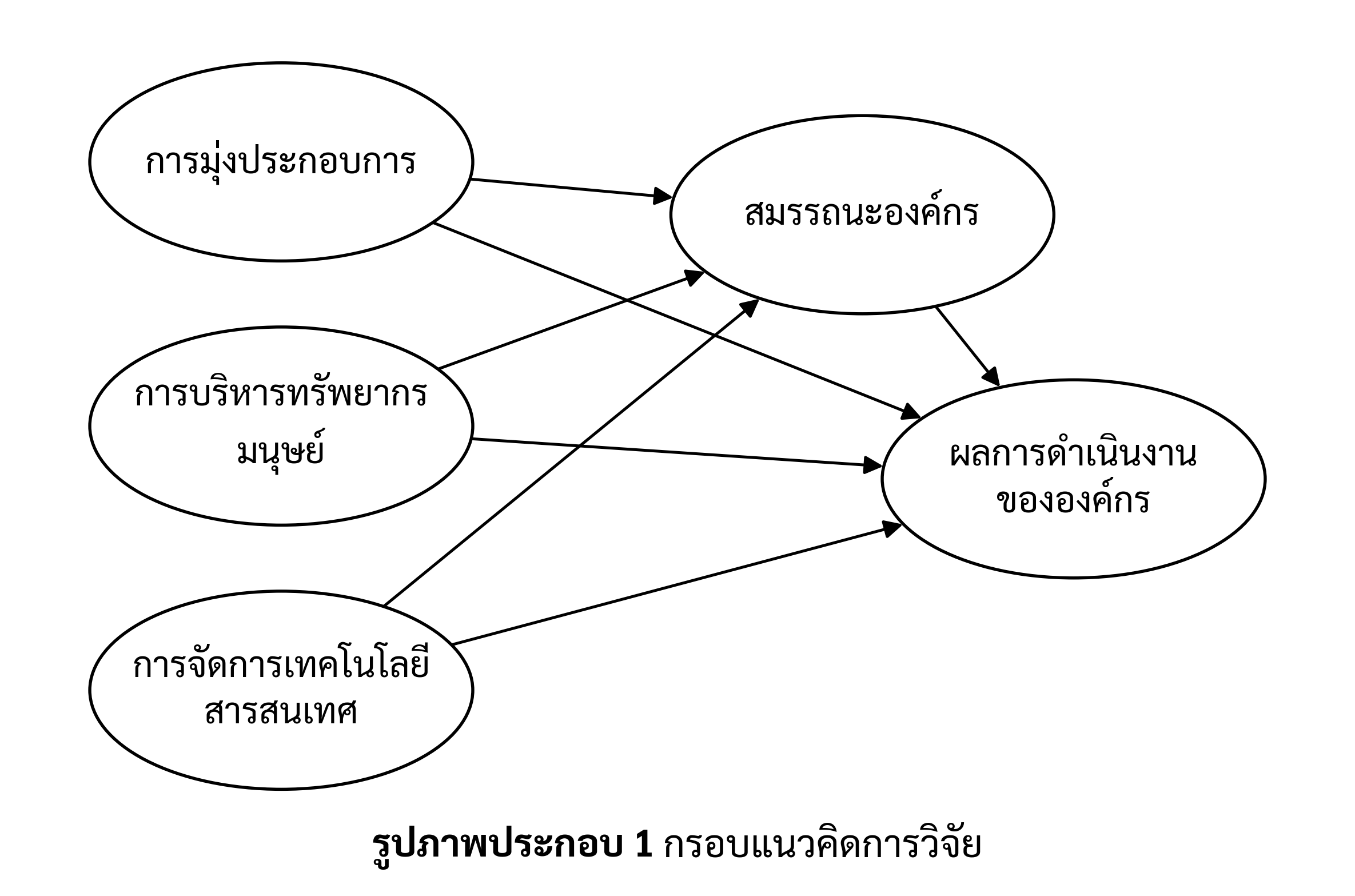
Enhancing the capabilities of community enterprises in the textile and garment sector remains a critical challenge for Thailand’s grassroots economy, as many producers continue to face limitations in entrepreneurial skills, systematic management practices, and the adoption of digital technologies. This study investigates the causal mechanisms that shape organizational competency and performance among community enterprises in the lower Northeastern region. The analysis is grounded in System Theory, complemented by resource-based and organizational competency perspectives, to explain the interplay among input factors, internal processes, and organizational outcomes. Data were collected from 420 community enterprises and analyzed using Structural Equation Modeling (SEM).
The research findings reveal that the model demonstrates strong empirical fit. Specifically, entrepreneurial orientation, human resource management, and information technology management exert positive effects on organizational competence, which serves as a mediating mechanism transmitting their influence to organizational performance. The model explains 90% of the variance in organizational competence and 96% of the variance in organizational performance, reflecting substantial predictive validity for organizational outcomes. These results confirm the pivotal role of organizational competence as an integrative mechanism that synthesizes knowledge, skills, and technology to enhance the competitive capabilities of community enterprises in the northeastern region, which rely heavily on local wisdom and robust collaborative networks.
Downloads
References
กลุ่มทะเบียนและสารสนเทศวิสาหกิจชุมชน กองส่งเสริมวิสาหกิจชุมชน. (2567). วิสาหกิจชุมชนและเครือข่ายวิสาหกิจชุมชนที่อนุมัติการจดทะเบียนแล้ว จำแนกตามเขตและจังหวัด และการประกอบกิจการ. สืบค้นเมื่อ 30 พฤษภาคม พ.ศ. 2567, จาก http://sceb.doae.go.th
ประพันธ์ แสงทองดี และวันทนา เนาว์วัน. (2566). แนวทางการพัฒนาการดำเนินงานของวิสาหกิจชุมชนอย่างยั่งยืนในเขตพื้นที่อำเภอบางปะอิน จังหวัดพระนครศรีอยุธยา. วารสารการบริหารจัดการและนวัตกรรมท้องถิ่น, 5(2), 14-22.
สถาบันพัฒนาอุตสาหกรรมสิ่งทอ. (2567). สถานการณ์อุตสาหกรรมสิ่งทอและเครื่องนุ่งห่มไทย เดือนธันวาคม 2567 และสรุปปีพ.ศ. 2567. สืบค้นเมื่อวันที่ 16 กันยายน 2568, จาก https://www.thaitextile.org/th/insign/detail.4427.1.0.html
Al-Edenat, M. (2023). Organizational competencies toward digital transformation at the events of disruptive changes: an operational process innovation perspective. Competitiveness Review: An International Business Journal, 33(4), 690-710. https://doi.org/10.1108/CR-05-2021-0081
Alkharafi, N., Alsaber, A., & Alnajem, M. (2024). Exploring entrepreneurial orientation in an emerging economy. Journal of Innovation & Knowledge, 9(4), 100553. https://doi.org/10.1016/j.jik.2024.100553
Appelbaum, E., Bailey, T., Berg, P., & Kalleberg, A. L. (2000). Manufacturing advantage: Why high-performance work systems pay off. Cornell University Press.
Arokiasamy, L., Fujikawa, T., Piaralal, S. K., & Arumugam, T. (2024). Role of HRM practices in organization performance: A survey approach. International Journal of Sociotechnology and Knowledge Development, 16(1), 1–32. https://doi.org/10.4018/IJSKD.334555
Barba-Sánchez, V., Meseguer-Martínez, Á., Gouveia-Rodrigues, R., & Raposo, M. L. (2024). Effects of digital transformation on firm performance: The role of IT capabilities and digital orientation. Heliyon, 10, e27725. https://doi.org/10.1016/j.heliyon.2024.e27725
Barney, J. (1991). Firm resources and sustained competitive advantage. Journal of Management, 17(1), 99-120. https://doi.org/10.1177/014920639101700108
Boulding, K. E. (1956). General systems theory the skeleton of science. Management Science, 2(3), 197-208.
Boyatzis, R. E. (2008). Competencies in the 21st century. Journal of Management Development, 27(1), 5-12.
Byrne, B. M. (2016). Structural Equation Modelling with AMOS: Basic Concepts, Applications, and Programming (3rd ed.). Routledge.
Escrig-Tena, A. B., & Bou‐Llusar, J. C. (2005). A model for evaluating organizational competencies: An application in the context of a quality management initiative. Decision Sciences, 36(2), 221-257. https://doi.org/10.1111/j.1540-5414.2005.00072.x
Fairoz, F. M., Hirobumi, T., & Tanaka, Y. (2010). Entrepreneurial orientation and business performance of small and medium scale enterprises of Hambantota District Sri Lanka. Asian Social Science, 6(3), 34-46.
Fornell, C., & Larcker, D. F. (1981). Evaluating structural equation models with unobservable variables and measurement error. Journal of Marketing Research, 18(1), 39–50.
Gulzar, M., Ali, A., Naqvi, B., & Smolander, K. (2024). Revealing the state of the art in managing IT infrastructure within enterprises: A systematic mapping study. IEEE Access, 12, 108533–108555. https://doi.org/10.1109/ACCESS.2024.3439093
Hair, J. F., Ringle, C. M., & Sarstedt, M. (2011). PLS-SEM: Indeed a silver bullet. Journal of Marketing Theory and Practice, 19(2), 139-152.
Hair, J. F., Babin, B. J., Anderson, R. E., & Black, W. C. (2019). Multivariate Data Analysis (8th ed.). Pearson Prentice.
Hair, J. F., Hult, G. T. M., Ringle, C. M., & Sarstedt, M. (2021). A Primer on Partial Least Squares Structural Equation Modeling (PLS-SEM) (3rd ed.). Sage.
Helfat, C. E., & Peteraf, M. A. (2009). Understanding dynamic capabilities: Progress along a developmental path. Strategic Organization, 7(1), 91–102. https://doi.org/10.1177/1476127008100133
Hernández-Linares, R., López-Fernández, M. C., García-Piqueres, G., Pina e Cunha, M., & Rego, A. (2024). How
knowledge-based dynamic capabilities relate to firm performance: The mediating role of entrepreneurial orientation. Review of Managerial Science, 18(10), 2781–2813.
Henseler, J., Ringle, C.M and Sarstedt, M. (2015). A New Criterion for Assessing Discriminant Validity in Variance-based Structural Equation Modeling. Journal of the Academy of Marketing Science, 43(1), 115-135. https://doi.org/10.1007/s11747-014-0403-8
Jirawuttinunt, S., Issarapaiboon, A., Mueangjum, C., & Pataraarechachai, V. (2024). The role of organizational innovation capability in the relationship between disruptive innovation and organizational performance of Thai listed firms. ABAC Journal, 44(3), 193–209. https://doi.org/10.59865/abacj.2024.27
Karabulut, A. T. (2015). Effects of innovation types on performance of manufacturing firms in Turkey. Procedia-Social and Behavioral Sciences, 195, 1355-1364. https://doi.org/10.1016/j.sbspro.2015.06.322
Kline, R. B. (2016). Principles and Practice of Structural Equation Modeling (4th ed.). Guilford Press.
Kusa, R., Suder, M., & Duda, J. (2024). Role of entrepreneurial orientation, information management, and knowledge management in improving firm performance. International Journal of Information Management, 78, 102802. https://doi.org/10.1016/j.ijinfomgt.2024.102802
Lumpkin, G. T., & Dess, G. G. (1996). Clarifying the entrepreneurial orientation construct and linking it to performance. Academy of Management Review, 21(1), 135-172.
McClelland, D. C. (1973). Testing for competence rather than for ‘intelligence’. American Psychologist, 28(1), 1-14.
Miller, D. (1983). The correlates of entrepreneurship in three types of firms. Management Science, 29(7), 770-791. https://doi.org/10.1287/mnsc.29.7.770
Mithas, S., Ramasubbu, N., & Sambamurthy, V. (2011). How information management capability influences firm performance. MIS Quarterly, 35(2), 237-256. https://doi.org/10.2307/23043496
Nunnally, J. C. (1978). Psychometric Theory (2nd ed.). McGraw-Hill.
Omar, A. O., Jailani, S. F. A. K., Ali, S. A. M., & Yunus, N. M. (2023). Impact of information technology towards organizational performance. Advances in Social Sciences Research Journal, 10(6.2), 128–137. https://doi.org/10.14738/assrj.106.2.15019
Osazevbaru, H. O., & Okeme, O. J. (2023). Impact of core competencies on organizational performance of industrial Goods firms in Nigeria. International Journal of Applied Research in Social Sciences, 5(10), 515–527.
Prahalad, C. K., & Hamel, G. (1990). The core competence of the corporation. Harvard Business Review, 68(3), 79-91.
Rovinelli, R. J., & Hambleton, R. K. (1977). On the use of content specialists in the assessment of criterion-referenced test item validity. Tijdschrift voor Onderwijsresearch, 2(2), 49-60.
Rodvinit, C., & Tangpinyoputtikhun, Y. (2024). Entrepreneurial orientation on business success through innovation
in accounting management of small and medium real estate businesses in the Northeastern region. Revista de Gestão Social e Ambiental, 18(5), 1–18. http://202.28.34.124/dspace/handle123456789/3008
Teece, D. J., Pisano, G., & Shuen, A. (1997). Dynamic capabilities and strategic management. Strategic Management Journal, 18(7), 509-533.
Teece, D. J. (2007). Explicating dynamic capabilities: the nature and microfoundations of (sustainable) enterprise performance. Strategic Management Journal, 28(13), 1319-1350. https://doi.org/10.1002/smj.640
Teece, D. J. (2014). The foundations of enterprise performance: Dynamic and ordinary capabilities in an (economic) theory of firms. Academy of Management Perspectives, 28(4), 328-352. https://doi.org/10.5465/amp.2013.0116
Tippins, M. J., & Sohi, R. S. (2003). IT competency and firm performance: Is organizational learning a missing link? Strategic Management Journal, 24(8), 745-761. https://doi.org/10.1002/smj.337
Torres Rivera, M. P., & Pedraza Melo, N. A. (2023). Management competencies and their relationship with organizational performance in small and medium-sized family businesses. European Journal of Family Business, 13(2), 220–233.
Ulrich, M. D., Way, S. A., & Wright, P. M. (2024). Building strategic human capabilities that drive performance. The International Journal of Human Resource Management, 35(20), 3341-3373. https://doi.org/10.1080/09585192.2024.2408026
Vermeeren, B. (2014). Variability in HRM implementation among line managers and its effect on performance: A 2-1-2 mediational multilevel approach. The International Journal of Human Resource Management, 25(22), 3039-3059. https://doi.org/10.1080/09585192.2014.934891
Von Bertalanffy, L. (1968). General system theory. New York: George Braziller.
Wang, Y., Zhu, L., & Jin, X. (2024). The effect of a high-performance work system on organizational innovation
performance: The mediating effect of employees’ intrinsic motivation and the moderating effect of person–organization fit. Systems, 12(7), 230. https://doi.org/10.3390/systems12070230
Wolf, E. J., Harrington, K. M., Clark, S. L., & Miller, M. W. (2013). Sample size requirements for structural equation models. Educational and Psychological Measurement, 73(6), 913–934.
Downloads
Published
How to Cite
Issue
Section
License
Copyright (c) 2025 Journal of Accountancy and Management

This work is licensed under a Creative Commons Attribution-NonCommercial-NoDerivatives 4.0 International License.
บทความที่ได้รับการตีพิมพ์เป็นลิขสิทธิ์ของวารสารการบัญชีและการจัดการ
ข้อความที่ปรากฏในบทความแต่ละเรื่องในวารสารวิชาการเล่มนี้เป็นความคิดเห็นส่วนตัวของผู้เขียนแต่ละท่านไม่เกี่ยวข้องกับมหาวิทยาลัยมหาสารคาม และคณาจารย์ท่านอื่นๆในมหาวิทยาลัยฯ แต่อย่างใด ความรับผิดชอบองค์ประกอบทั้งหมดของบทความแต่ละเรื่องเป็นของผู้เขียนแต่ละท่าน หากมีความผิดพลาดใดๆ ผู้เขียนแต่ละท่านจะรับผิดชอบบทความของตนเองแต่ผู้เดียว