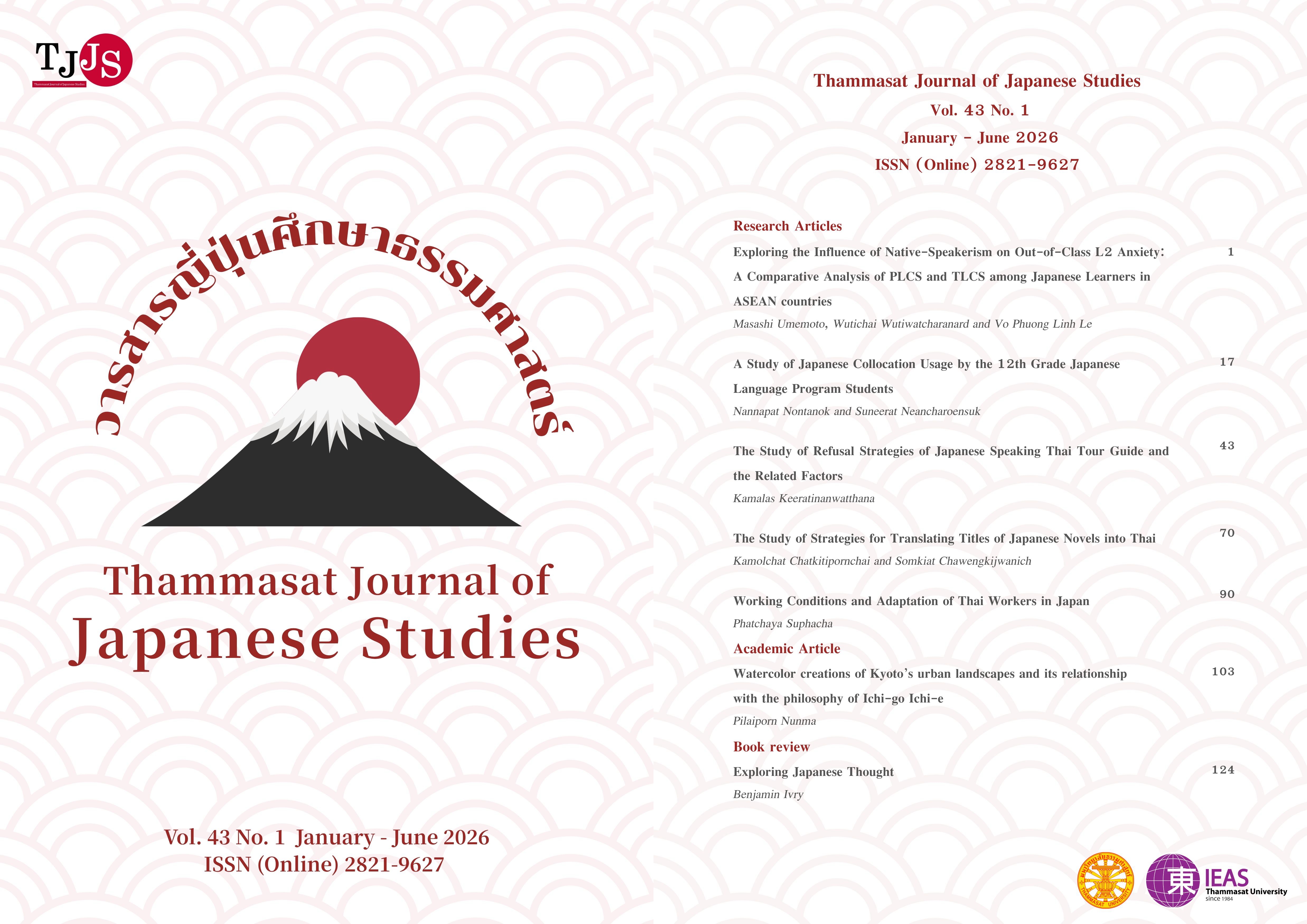
Working Conditions and Adaptation of Thai Workers in Japan
Keywords:
Thai workers in Japan, employment problems, work adaptationAbstract
This research aimed to study working conditions, problems encountered in the workplace and coping or adaptive strategies employed among Thai workers in Japan. The research was conducted based on a qualitative research design. Data were collected from conventical purposive sampling and in-depth interview with 10 Thai workers working in Japan. The study results indicated that most Thai workers were employed in two main occupational categories was service-related positions and company employees. The employment types were classified into three groups was permanent employment (80%), daily employment (10%), and freelance employment (10%). With regard to problems encountered in the workplace, consisting of 2 points: 1) an unclear compensation, welfare benefits, bonuses, and overtime pay, and 2) Income instability, particularly among freelancers and part-time workers. In terms of adaptation, Thai workers adopted diverse problem-solving methods and adaptive strategies. The analysis indicated that most Thai workers relied on individual-oriented coping strategies, reflecting their capacity for personal adjustment. Despite facing cultural and systemic differences in the Japanese working environment, Thai workers demonstrated flexibility, perseverance, and the ability to learn and adapt effectively to the Japanese work context.
Downloads
References
กรมการจัดหางาน กระทรวงแรงงาน. (2566). รายงานผลการปฏิบัติงาน กรมจัดหางาน ไตรมาสที่ 1 ประจำปีงบประมาณ 2566 (ตุลาคม- ธันวาคม 2565). กรมการจัดหางาน.
พรวิภา เหาตะวานิช และ อรัญญา ตุ้ยคำภีร์. (2558). การปรับตัวทางวัฒนธรรมของผู้ใช้แรงงานไทยย้ายถิ่น: การวิจัยเชิงคุณภาพ. วารสารวิจัย มข.(ฉบับบัณฑิตศึกษา) สาขามนุษยศาสตร์และสังคมศาสตร์, 1(1), 14-27.
เพ็ญวนา ปรานสุจริต, อ้อทิพย์ ราษฎร์นิยม และ ชมพูนุท โกสลากร เพิ่มพูนวิวัฒน์. (2556). การวิเคราะห์ทางเศรษฐศาสตร์ของแรงงานไทยที่เดินทางไปทำงานประเทศญี่ปุ่นและประเทศสาธารณรัฐเกาหลี. วารสารวิจัยราชภัฏพระนคร, 8(1), 183-197.
มนัญณัฏฐ์ โภชนจันทร์. (2562). การทำงานร่วมกับผู้จัดการชาวญี่ปุ่น : บนการบริหารความขัดแย้งและความแตกต่างทางวัฒนธรรมในประเทศไทย. วารสารเซนต์จอห์น, 22(31), 175-191.
เวณิกา สุปัญญเดชา, สุณีย์รัตน์ เนียรเจริญสุข และ วรินทร วูวงศ์. (2567). สภาพการจ้างงานและมุมมองต่อความคุ้มค่าในการไปทำงานที่ประเทศญี่ปุ่นของแรงงานไทย. วารสารศิลปศาสตร์ มหาวิทยาลัยธรรมศาสตร์, 24(3), 434–458.
Chonlaworn, P. (2021). Cheap and dispensable: Foreign labor in Japan via the technical Intern training program. Jsn Journal, 11(1), 33-49.
Lazarus, R. S., & Folkman, S. (1984). Stress, appraisal, and coping. Springer Publishing Company.
厚生労働省. (2024).「外国人雇用状況」の届出状況まとめ【本文】 (令和6年10月末時点).https://www.mhlw.go.jp/content/11655000/001389442.pdf (2025.7.27検索).
堀田 裕司﮲大塚 泰正. (2014). 「製造業における労働者の対人的援助とソーシャルサポート,職場ストレッサー,心理的ストレス反応,活気の関連」.『産業衛生学雑誌産衛誌 , 2014, 56(6) 』、 259–267.
Downloads
Published
Issue
Section
License
Copyright (c) 2026 Thammasat Journal of Japanese Studies

This work is licensed under a Creative Commons Attribution-NonCommercial-NoDerivatives 4.0 International License.



