
Digital media guidelines for sustainable tourism: A case study of historical tourism in Baan Khamkerm-Nong Saeng, Nakhon Phanom province, Thailand
Article Sidebar
Main Article Content
Abstract
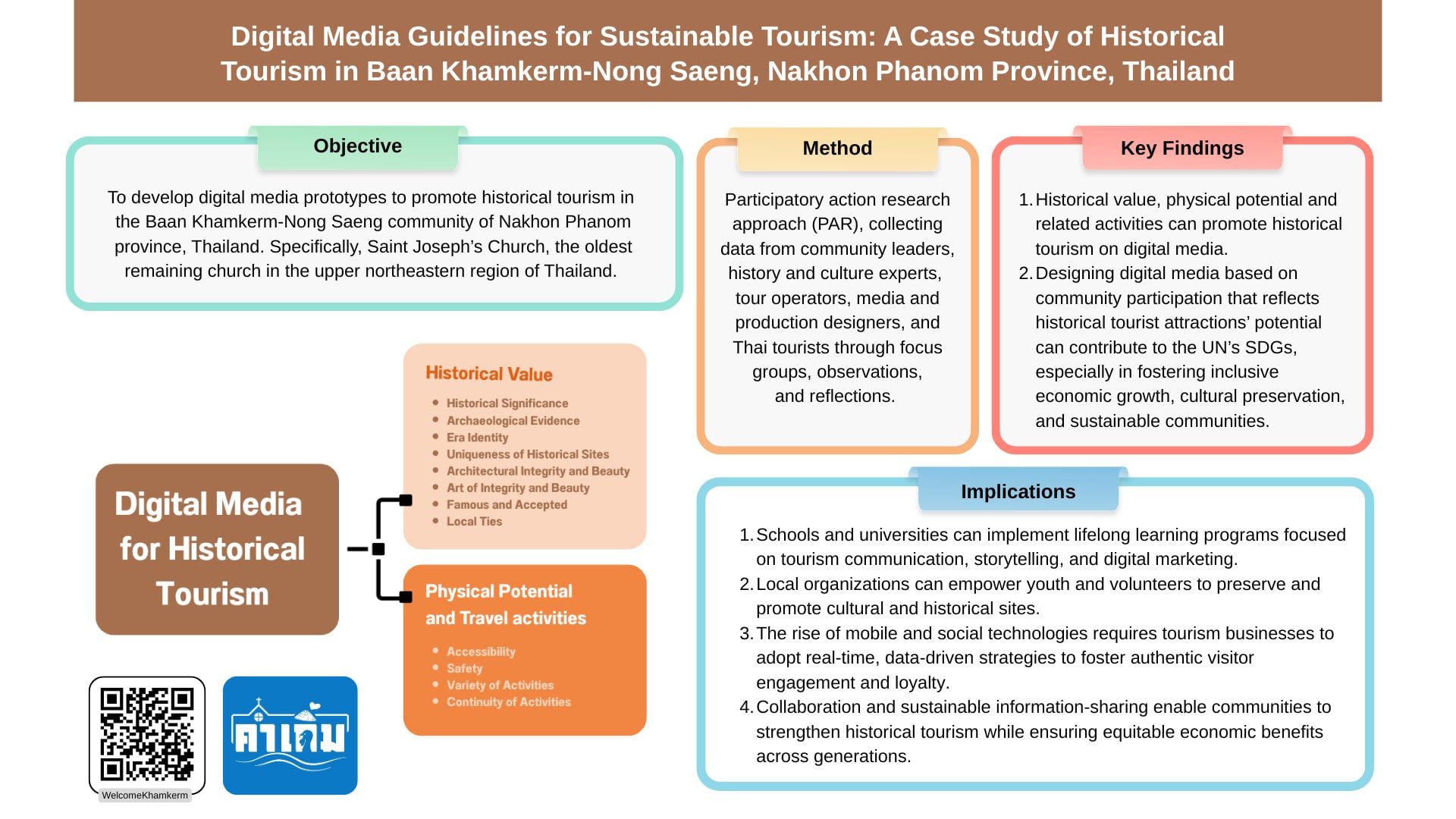
This study aims to develop digital media prototypes to promote historical tourism in the Baan Khamkerm-Nong Saeng community of Nakhon Phanom province, Thailand. It focuses specifically on Saint Joseph’s Church, the oldest remaining church in the upper northeastern region of Thailand, which has the potential to be developed as a historical tourist attraction. However, maintaining its tourist attractions’ history and values proves challenging because of the community’s limitations in identity communication and public relations. The study applied a participatory action research approach, collecting data from community leaders, history and culture experts, tour operators, media and production designers, and Thai tourists through focus groups, observations, and reflections. Data were analysed and developed into images, video clips, infographic, and text presented on Facebook, which were used to convey identity and historical values. The results showed that historical value, physical potential, and activities can promote historical tourism using digital media. Designing digital media based on the community's participation that reflects the historical tourist attractions’ potential can contribute to the United Nation’s Sustainable Development Goals, especially in fostering inclusive economic growth, cultural preservation, and sustainable communities. Incorporating cognitive response theory, audience perceptions, and message evaluations were considered throughout content development. However, to ensure sustainability, historical tourism and media development, it must be passed on to future generations via continuous learning, local capacity building and youth engagement.
Downloads
Article Details

This work is licensed under a Creative Commons Attribution-NonCommercial-NoDerivatives 4.0 International License.
All rights reserved. Apart from citations for the purposes of research, private study, or criticism and review,no part of this publication may be reproduced, stored or transmitted in any other form without prior written permission by the publisher.
References
Akeroyd, S. (2019, August 29). Thailand towards 2030: It’s time to get smart when it comes to tourism. Amadeus. https://amadeus.com/en/insights/blog/thailand-towards-2030
Almuhrzi, H. M., & Al-Azri, H. I. (2019). Conference report: Second UNWTO/UNESCO world conference on tourism and culture: Fostering sustainable development. International Journal of Culture, Tourism and Hospitality Research, 13(1), 144–150. https://doi.org/10.1108/IJCTHR-07-2018-0091
Ampansirirat, A., & Wongchaiya, P. (2017). The participatory action research: Key features and application in community. Journal of Humanities and Social Sciences Mahasarakham University, 36(6), 192–202. [in Thai]
Armstrong, G., Adam, S., Denize, S., & Kotler, P. (2014). Principles of marketing. Pearson.
Auksondee, N., & Darawong, C. (2024). Benefits, challenges, and key success factors of community-based tourism management in Thailand: An exploratory study of 3 destinations in Thailand. Journal of Business, Innovation and Sustainability (JBIS), 19(3), 169–181. https://so02.tci-thaijo.org/index.php/BECJournal/article/view/269729
Bamroongcheep, U., & Phosri, P. (2021). The digital storytelling innovation for transmission process of gems cutters wisdom development towards creative economy of Chantaburi province. Burapha University.
Bangkokbiznews. (2020, November 26). Booking.com reveals trends in Thai tourist behavior after COVID-19. https://www.bangkokbiznews.com/tech/909641 [in Thai]
Bayet, G. (1984). The history of the propagation of Christianity in Northeastern Thailand and Laos (M. Kian Samoepitak, Trans.). Rernkaew Printing House. (Original work published in Thai as Prawat kan poeiprae prasasana nai pakisan lae pratetlao)
Beerli-Palacio, A., & Martín-Santana, J. D. (2020). Explaining the gap in the image of tourist destinations through the content of and exposure to secondary sources of information. Current Issues in Tourism, 23(20), 2572–2584. https://doi.org/10.1080/13683500.2019.1658726
Camilleri, M. A. (2018). Travel marketing, tourism economics, and the airline product. Springer International Publishing.
Chen, X., Cheng, Z., & Kim, G.-B. (2020). Make it memorable: Tourism experience, fun, recommendation and revisit intentions of Chinese outbound tourists. Sustainability, 12(5), Article 1904. https://doi.org/10.3390/su12051904
Chonmaitree, T., Joneurairatana, E., & Jamuni, P. (2022). Virtual historical sense of place in multimedia web tourism: A case of Bang Lamphu. Humanities, Arts and Social Sciences Studies, 22(3), 648–662. https://so02.tci-thaijo.org/index.php/hasss/article/view/259256
Dai, X., & Wang, J. (2023). Effect of online video infotainment on audience attention. Humanities and Social Sciences Communications, 10, Article 421. https://doi.org/10.1057/s41599-023-01921-6
Díaz-Pacheco, Á., Guerrero-Rodríguez, R., Álvarez-Carmona, M. Á., Rodríguez-González, A. Y., & Aranda, R. (2024). Quantifying differences between UGC and DMO’s image content on Instagram using deep learning. Information Technology & Tourism, 26(2), 293–329. https://doi.org/10.1007/s40558-023-00282-9
El-Said, O., & Aziz, H. (2022). Virtual tours a means to an end: An analysis of virtual tours’ role in tourism recovery post COVID-19. Journal of Travel Research, 61(3), 528–548. https://doi.org/10.1177/0047287521997567
Fischer, D., Lüdecke, G., Godemann, J., Michelsen, G., Newig, J., Rieckmann, M., & Schulz, D. (2016). Sustainability communication. In G. Heinrichs, P. Martens, G. Michelsen, & A. Wiek (Eds.), Sustainability science: An introduction (pp. 139–148). Springer. https://doi.org/10.1007/978-94-017-7242-6_12
Frick, V., Matthies, E., Thøgersen, J., & Santarius, T. (2021). Do online environments promote sufficiency or overconsumption? Online advertisement and social media effects on clothing, digital devices, and air travel consumption. Journal of Consumer Behavior, 20(2), 288–308. https://doi.org/10.1002/cb.1855
Garzón-Paredes, A.-R., & Royo-Vela, M. (2023). Emotional and cognitive responses to cultural heritage: A neuromarketing experiment using virtual reality in the tourist destination image model context. Journal of Positive Psychology and Wellbeing, 7(2), 630–651.
Glaser, M., & Reisinger, H. (2022). Don’t lose your product in story translation: How product–story link in narrative advertisements increases persuasion. Journal of Advertising, 51(2), 188–205. https://doi.org/10.1080/00913367.2021.1973623
Goebel, K., Camargo-Borges, C., & Eelderink, M. (2020). Exploring participatory action research as a driver for sustainable tourism. International Journal of Tourism Research, 22(4), 425–437. https://doi.org/10.1002/jtr.2346
González-Rodríguez, M. R., Domínguez-Quintero, A. M., & Paddison, B. (2020). The direct and indirect influence of experience quality on satisfaction: The importance of emotions. Current Issues in Tourism, 23(22), 2779–2797. https://doi.org/10.1080/13683500.2019.1668917
Han, H., Nguyen, H. N., Song, H., Lee, S., & Chua, B.-L. (2019). Impact of functional/cognitive and emotional advertisements on image and repurchase intention. Journal of Hospitality Marketing & Management, 28(4), 446–471. https://doi.org/10.1080/19368623.2019.1531803
Holbert, R. L., & Park, E. (2020). Conceptualizing, organizing, and positing moderation in communication research. Communication Theory, 30(3), 227–246. https://doi.org/10.1093/ct/qtz006
Isaacs, M.-A., Tondeur, J., Howard, S., Claro, M., & van Braak, J. (2024). Digital storytelling as a strategy for developing 21st-century skills: A systematic review of qualitative evidence. Technology, Pedagogy and Education, 33(5), 573–593. https://doi.org/10.1080/1475939X.2024.2343929
Joshi, A., Kale, S., Chandel, S., & Pal, D. K. (2015). Likert scale: Explored and explained. British Journal of Applied Science & Technology, 7(4), 396–403. https://doi.org/10.9734/BJAST/2015/14975
Kalinić, Č., & Vujičić, M. D. (2022). Social media analytics: Opportunities and challenges for cultural tourism destinations. In L. Oliveira (Ed.), Handbook of research on digital communications, internet of things, and the future of cultural tourism (pp. 385–410). IGI Global Scientific Publishing. https://doi.org/10.4018/978-1-7998-8528-3.ch021
Kemp, S. (2023, February 13). Digital 2023: Thailand. DataReportal. https://datareportal.com/reports/digital-2023-thailand
Khaenamkhaew, D., Onjun, P., Damrongwattana, J., & Prathum, B. (2023). The participation of community leaders for sustainable tourism development: A case study in Phipun district, Nakhon Si Thammarat province, Thailand. Cogent Social Sciences, 9(1), Article 2229172. https://doi.org/10.1080/23311886.2023.2229172
Khairani, A., & Fachira, I. (2022). The influence of cognitive and emotional engagement on digital content marketing in the tourism industry. Journal of Tourism Leisure and Hospitality, 4(1), 14–29. https://doi.org/10.48119/toleho.995179
Kumar, N., Panda, R. K., & Adhikari, K. (2022). Transforming tourists’ intentions through destination engagement: Insights from transformative learning theory. The Service Industries Journal, 42(9–10), 688–715. https://doi.org/10.1080/02642069.2022.2062327
Lambert, J. (2013). Digital storytelling: Capturing lives, creating community (4th ed.). Routledge.
Lasswell, H. D. (1958). Communications as an emerging discipline. Audio Visual Communication Review, 6(4), 245–254. http://www.jstor.org/stable/30216866
Lertpatcharapong, R., & Sukorn, K. (2021). The study of cultural tourism development framework for sustainable tourism: Case study of Lampang province. Psychology and Education Journal, 58(1), 3844–3853. https://doi.org/10.17762/pae.v58i1.1416
Liberato, P., Pereira, D., Liberato, D., & Lopes, M. C. (2023). Technology applications in the competitiveness of tourism destinations. In J. V. Carvalho, A. Abreu, D. Liberato, & J. A. D. Rebolledo (Eds.), Advances in tourism, technology and systems (pp. 471–482). Springer. https://doi.org/10.1007/978-981-99-9758-9_37
Middleton, V. T., & Clarke, J. R. (2012). Marketing in travel and tourism. Routledge.
Ministry of Tourism and Sports. (2014). Manual for evaluating quality standards of historical tourist attractions. Department of Tourism. https://www.dot.go.th/storage/ebooks/February2019/PLpogKmbYidrDzxTZ5K1.pdf [in Thai]
Ministry of Tourism and Sports. (2023). National tourism development plan no. 3 (2023–2027). https://online.anyflip.com/zzfck/rptc/mobile/index.html [in Thai]
Money & Banking. (2022, December 21). Tourism value added: Creating value for the Thai tourism sector. https://moneyandbanking.co.th/en/2022/13187
Nakhon Phanom Provincial Office. (2021). Nakhon Phanom provincial development plan 2023–2027. http://www2.nakhonphanom.go.th/news/detail/602 [in Thai]
Nikulina, O., van Riel, A. C. R., Lemmink, J. G. A. M., Grewal, D., & Wetzels, M. (2024). Narrate, act, and resonate to tell a visual story: A systematic review of how images transport viewers. Journal of Advertising, 53(4), 605–625. https://doi.org/10.1080/00913367.2024.2309921
Olsen, D. H., & Timothy, D. J. (2022). The Routledge handbook of religious and spiritual tourism. Routledge.
Olsson, D., Gericke, N., & Boeve-de Pauw, J. (2022). The effectiveness of education for sustainable development revisited - A longitudinal study on secondary students’ action competence for sustainability. Environmental Education Research, 28(3), 405–429. https://doi.org/10.1080/13504622.2021.1990881
Petrosyan, A. (2024, March). Age distribution of internet users worldwide 2024. Statista. https://www.statista.com/statistics/272365/age-distribution-of-internet-users-worldwide/
Petty, R. E., Ostrom, T. M., & Brock, T. C. (Eds.). (1981). Cognitive responses in persuasion. Lawrence Erlbaum Associates.
Richards, G. (2020). Designing creative places: The role of creative tourism. Annals of Tourism Research, 85, Article 102922. https://doi.org/10.1016/j.annals.2020.102922
Riyadi, S., Susilo, D., Sufa, S. A., & Putranto, T. D. (2019). Digital marketing strategies to boost tourism economy: A case study of Atlantis Land Surabaya. Humanities & Social Sciences Reviews, 7(5), 468–473. https://doi.org/10.18510/hssr.2019.7553
Rodrigues, C., Liberato, D., Esteves, E., & Liberato, P. (2022). Scientific narratives on creative tourism: A theoretical framework. In V. Katsoni (Ed.), Tourism, travel, and hospitality in a smart and sustainable world (pp. 253–277). Springer. https://doi.org/10.1007/978-3-031-26829-8_16
Rodrigues, V., Eusébio, C., & Breda, Z. (2023). Enhancing sustainable development through tourism digitalisation: A systematic literature review. Information Technology & Tourism, 25(1), 13–45. https://doi.org/10.1007/s40558-022-00241-w
Saiyasak, C. (n.d.). A look at the initial expansion of Roman Catholic Christianity in the Isan region of Northeast Thailand. https://www.academia.edu/4795127
Selby, M., & Morgan, N. J. (1996). Reconstruing place image: A case study of its role in destination market research. Tourism management, 17(4), 287–294. https://doi.org/10.1016/0261-5177(96)00020-9
Shafiee, S., Ghatari, A. R., Hasanzadeh, A., & Jahanyan, S. (2021). Smart tourism destinations: A systematic review. Tourism Review, 76(3), 505–528. https://doi.org/10.1108/TR-06-2019-0235
Shafiee, S., Ghatari, A. R., Hasanzadeh, A., & Jahanyan, S. (2022). Developing a model for smart tourism destinations: An interpretive structural modelling approach. Information Technology & Tourism, 24(4), 511–546. https://doi.org/10.1007/s40558-022-00236-7
Styvén, M. E., Mariani, M. M., & Strandberg, C. (2020). This is my hometown! The role of place attachment, congruity, and self-expressiveness on residents’ intention to share a place brand message online. Journal of Advertising, 49(5), 540–556. https://doi.org/10.1080/00913367.2020.1810594
Thongyam, P. (2021). Transport guidelines, marketing, media usage for selling products of behind the roman temple community Chanthaburi province under the coronavirus disease 2019 situation. Sripatum Chonburi Academic Journal, 18(2), 96–113. [in Thai]
Toemsungnoen, H., Ananto, S., & Kachentaraphank, P. (2023). The use of online media for tourism in Petchabun province. Journal of Communication Arts Review, 27(2), 88–99. [in Thai]
Toongsuwan, N. (2018). Using of digital content and the promotion of experiences to inspire in tourism. Journal of Management Science Nakhon Pathom Rajabhat University, 5(2), 189–200. https://doi.org/10.14456/jmsnpru.2018.31 [in Thai]
United Nations. (2024). The 17 goals. United Nations. https://sdgs.un.org/goals
United Nations World Tourism Organization (UNWTO). (2021). Tourism in the 2030 agenda. UNWTO. https://www.unwto.org/tourism-in-2030-agenda
Voorveld, H. A. M., van Noort, G., Muntinga, D. G., & Bronner, F. (2018). Engagement with social media and social media advertising: The differentiating role of platform type. Journal of Advertising, 47(1), 38–54. https://doi.org/10.1080/00913367.2017.1405754
Welcome Khamkerm. (n.d.). Home [Facebook page]. https://www.facebook.com/WelcomeKhamkerm [in Thai]
Wiranti, F. H. T. (2023). Interpersonal communication and customer loyalty: A case study at a travel agency. Asian Journal of Management, Entrepreneurship and Social Science, 3(01), 283–293. https://mail.ajmesc.com/index.php/ajmesc/article/view/121
World Tourism Organization. (2020). Supporting jobs and economies through travel and tourism – A call for action to mitigate the socio-economic impact of COVID-19 and accelerate recovery. UNWTO. https://doi.org/10.18111/9789284421633
