
An integrated active learning model focused on learning outcomes for schools in Thailand
Article Sidebar
Main Article Content
Abstract
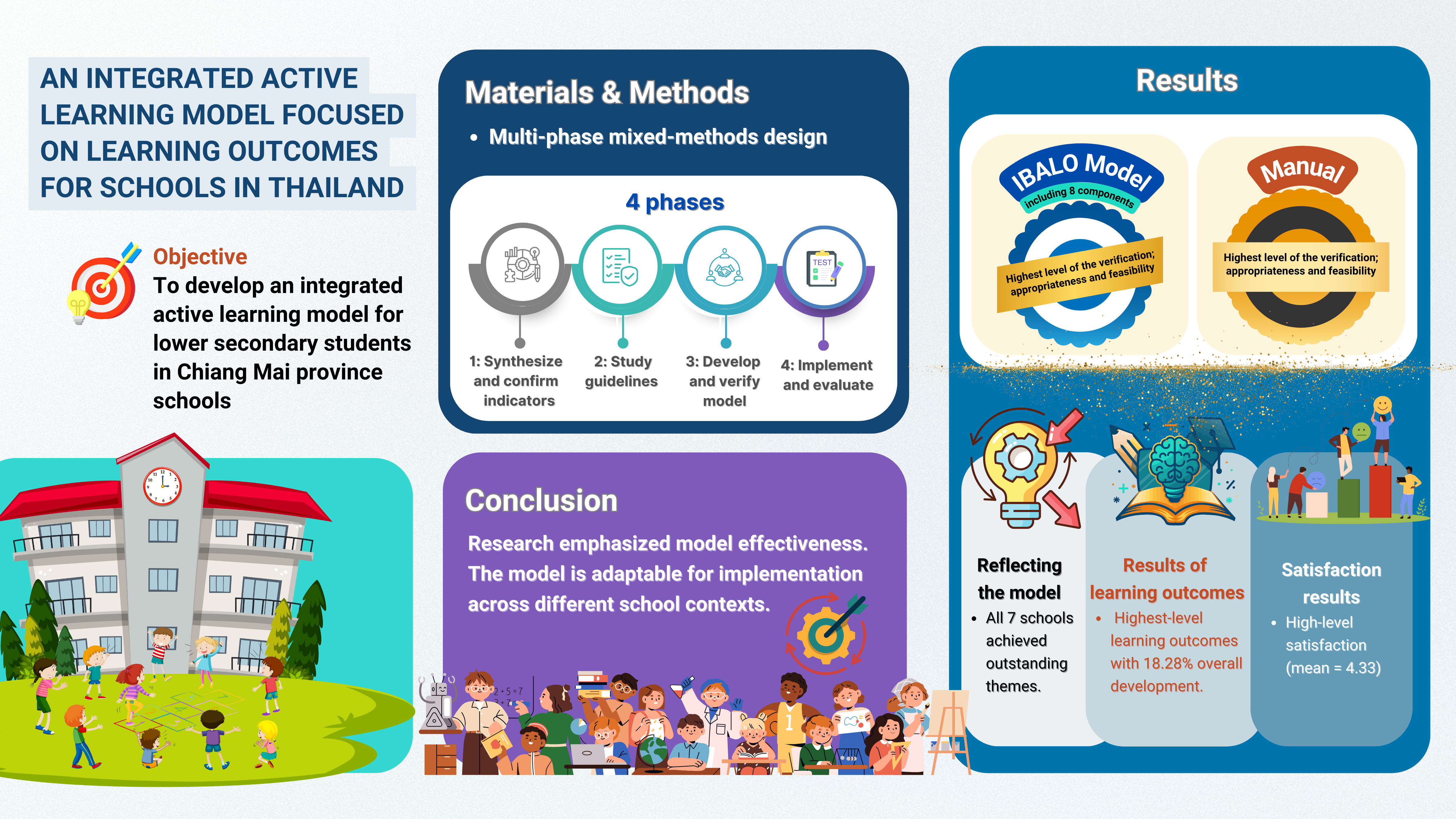
This study proposed the development and implementation, as well as evaluation of the integrated active learning model focused on learning outcomes for lower secondary students in schools under local administrative organizations in Chiang Mai province, Thailand. The research had a multi-phase mixed-methods research method to develop the learning model to provide guidelines for schools, teachers, and stakeholders to identify themes that were consistent with local policies and contexts. There was also the learning management that students’ practice could be applied in everyday life and had commercial potential. The evaluation results indicated that improvement was significant in all aspects of students' learning outcomes. This model consisted of principles and concepts, objectives, systems and mechanisms, guidelines and activities for integrated outcome-based active learning management, success indicators, success conditions for model implementation, forms and documentation, and terminology and supporting explanations. The research results emphasized the effectiveness of this model, making it an example model for other schools. Although there were some concerns about the selection of themes, overall, there was a good trend in the implementation of the integrated active learning model focused on learning outcomes. The comparison results of student learning outcomes before and after model implementation indicated that the mean of the post-test was more than the pre-test, overall developed at 18.28 percent.
Downloads
Article Details

This work is licensed under a Creative Commons Attribution-NonCommercial-NoDerivatives 4.0 International License.
All rights reserved. Apart from citations for the purposes of research, private study, or criticism and review,no part of this publication may be reproduced, stored or transmitted in any other form without prior written permission by the publisher.
References
Bonwell, C. C., & Eison, J. A. (1991). Active learning: Creating excitement in the classroom. ASHE-ERIC Higher Education Reports.
Dato, B., Gleizes, M. P., & Migeon, F. (2021, February 4–6). A local active learning strategy by cooperative multi-agent systems. In A. P. Rocha, L. Steels, & J. van den Herik (Eds.), 13th International Conference on Agents and Artificial Intelligence (ICAART 2021) (pp. 406–413). SCITEPRESS – Science and Technology Publications, Lda.
Duangmanee, K., & Waluyo, B. (2023). Active learning and professional development: A case of Thai Chinese teachers. Social Sciences, 12(1), Article 38. https://doi.org/10.3390/socsci12010038
IDEO. (2012). Design thinking for educators toolkit (Version 2.0). IDEO LLC.
Jaroenpool, J., Suwanbamrung, C., Sukkaew, N., & Dadras, M. (2023). Students’ reflections on an integrated research subject using a research-based learning online model during the COVID-19 pandemic: A qualitative study in Thailand. Humanities, Arts and Social Sciences Studies, 23(3), 695–707. https://so02.tci-thaijo.org/index.php/hasss/article/view/261231
Kongrat, C. (2024). Active learning: Discourse in education for student development. Journal of Education Studies, 52(1), Article EDUCU5201002. https://doi.org/10.14456/educu.2024.2 [in Thai]
Kotchasit, S., Sereerat, B., Arunwong, R., Pichayakul, T., Nilnopkoon, P., Phanthalert, C., Panomwan Na Ayuthaya, S., Borirasontikul, K., Panyatip, D., & Chitrangsan, N. (2019). Ways of leading the national education standard to practice. Journal of Graduate Studies Valaya Alongkorn Rajabhat University, 13(3), 192–203. https://so02.tci-thaijo.org/index.php/JournalGradVRU/article/view/230194 [in Thai]
Local Administrative Organization in Chiang Mai Province. (2022, March). Educational development plan 2023-2027 for local administrative organizations in Chiang Mai province. http://edu.chiangmaipao.go.th [in Thai]
Matinho, D., Pietrandrea, M., Echeverria, C., Helderman, R., Masters, M., Regan, D., Shu, S., Moreno, R., & McHugh, D. (2022). A systematic review of integrated learning definitions, frameworks, and practices in recent health professions education literature. Education Sciences, 12(3), Article 165. https://doi.org/10.3390/educsci12030165
OECD. (2022). Programme for International Student Assessment (PISA). https://www.oecd.org/en/publications/pisa-results-2022-volume-iii-factsheets_041a90f1-en/thailand_ff214311-en.html
Office of the Education Council. (2018). National education standards B.E. 2561 (2018). Office of the Education Council. https://backoffice.onec.go.th/uploads/Book/1659-file.pdf
Office of the National Economic and Social Development Council. (2022). The 13th national economic and social development plan (2023–2027). https://www.nesdc.go.th/main.php?filename=plan13 [in Thai]
Orhan, T. Y., & Sahin, N. (2018). The impact of innovative teaching approaches on biotechnology knowledge and laboratory experiences of science teachers. Education Sciences, 8(4), Article 213. https://doi.org/10.3390/educsci8040213
Salam, M., Jafar, & Prajono, R. (2020). Effectiveness of integrative learning models in improving understanding of mathematical concept. Journal for the Education of Gifted Young Scientists, 8(3), 1005–1014. https://doi.org/10.17478/jegys.666875
Sinnayah, P., Rathner, J. A., Loton, D., Klein, R., & Hartley, P. (2019). A combination of active learning strategies improves student academic outcomes in first-year paramedic bioscience. Advances in Physiology Education, 43, 233–240. https://doi.org/10.1152/advan.00199.2018
Siswoyo, A. A. (2023). Implementation of active learning model with integrated digital learning media of Madura local culture. Widyagogik: Jurnal Pendidikan dan Pembelajaran Sekolah Dasar, 10(2a), 520–530. https://journal.trunojoyo.ac.id/widyagogik/article/view/21684
Srilertthanikul, R. (2024). Development of active learning outcomes on current situation of Europe of students of secondary 2 at Watraikhingwitthaya school Samphran district Nakhonpathom province. Journal of MCU Buddhasothorn Review, 4(2), 118–132. https://so02.tci-thaijo.org/index.php/JMBR_sothorn/article/view/275672/183681 [in Thai]
Srisapan, M., Puthaprasert, C., Yaboonthong, Y., & Rupavijetra, P. (2020). The model of integrated learning management to develop learning in the 21st century for students of northeast sports school. Interdisciplinary Research Review, 15(5), 46–54. https://ph02.tci-thaijo.org/index.php/jtir/article/view/240591
Teachers’ council of Thailand regulations on professional licenses (No. 2) 2564 B.E. (2022, April 21). Royal Thai Government Gazette. No. 139 Special section 233 D. pp. 57–58. [in Thai]
United Nations. (n.d.). 4 Quality education. Sustainable Development Goals. https://www.un.org/sustainabledevelopment/education/
Vodovozov, V., Raud, Z., & Petlenkov, E. (2021). Challenges of active learning in a view of integrated engineering education. Education Sciences, 11(2), Article 43. https://doi.org/10.3390/educsci11020043
Worathadasawat, W., Chaowachai, S., & Kornpuang, A. (2024). Factor analysis of active learning management of secondary school teachers under the office of the basic education commission. Journal of Education and Innovation, 26(4), 302–311. https://so06.tci-thaijo.org/index.php/edujournal_nu/article/view/266211 [in Thai]
Yulkifli, Y., Yohandri, Y., & Azis, H. (2022). Development of physics e-module based on integrated project-based learning model with Ethno-STEM approach on smartphones for senior high school students. Momentum: Physics Education Journal, 6(1), 93–103. https://doi.org/10.21067/mpej.v6i1.6316
