
Exploring the design factors shaping the gaming experience for Generation Alpha
Article Sidebar
Main Article Content
Abstract
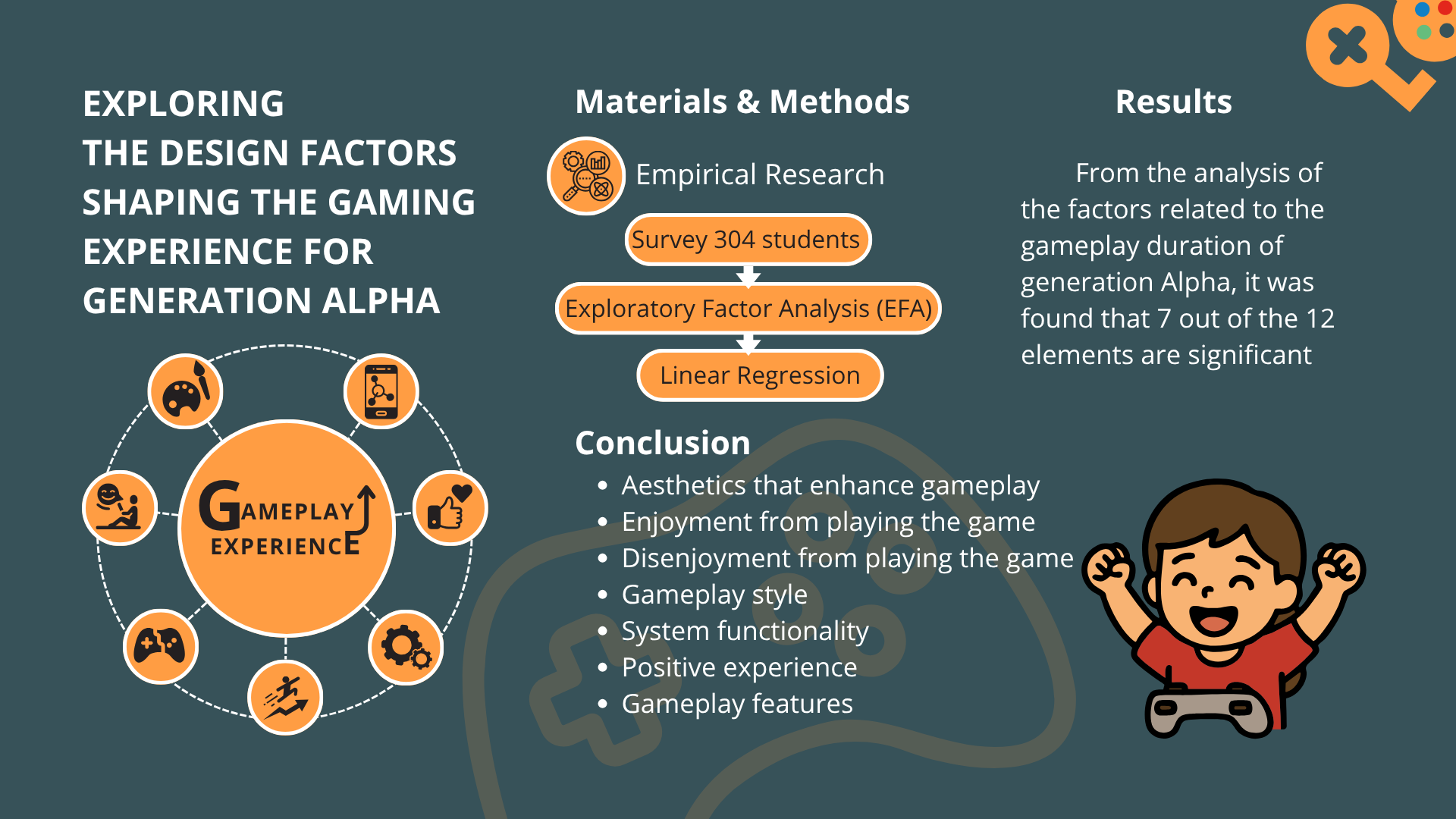
Generation Alpha is the first generation to grow up in a fully digital environment. They learn through play, especially gaming, and are the drivers of the current and future gaming industry. To ensure game design aligns with the characteristics and preferences of generation Alpha, this study focuses on exploring and analyzing the gaming elements favored by this generation. The purposive sampling method was chosen to specifically target primary school students who actively engage in gaming, ensuring that the data collected would be relevant and representative of this demographic's preferences. The data for analysis was collected from 681 primary school students at Assumption College Nakhon Ratchasima Thailand during the first semester of the 2023 academic year. Out of these, 304 students were purposively selected to respond to a questionnaire regarding 47 game factors that influence the gaming experience, with a Cronbach’s Alpha Coefficient of 0.910, indicating high reliability. Exploratory factor analysis (EFA) with Varimax rotation was employed to cluster the game design elements, as it is an effective method for identifying underlying factor structures in complex datasets. Linear regression analysis was used to verify the relationship between game design elements and user preference. The research results found that the extracted components had an Eigen value greater than 1.00 and could explain all the variables by 59.921 percent, with 12 components. However, when the coefficients of game design components and game playing time of generation Alpha were calculated, there were 7 components: 1) aesthetics that enhance gameplay, 2) enjoyment from playing the game, 3) disenjoyment from playing the game, 4) gameplay style, 5) system functionality, 6) positive experience, and 7) gameplay features. The results of this research help game designers and developers use the obtained factors as an important basis for game design and development.
Downloads
Article Details

This work is licensed under a Creative Commons Attribution-NonCommercial-NoDerivatives 4.0 International License.
All rights reserved. Apart from citations for the purposes of research, private study, or criticism and review,no part of this publication may be reproduced, stored or transmitted in any other form without prior written permission by the publisher.
References
Areekul, C. (2019). Alternative education: The important learning model for Generation Alpha. Journal of MCU Social Science Review, 8(3), 270–283. https://so03.tci-thaijo.org/index.php/jssr/article/view/204999 [in Thai]
Boone, H. N., Jr., & Boone, D. A. (2012). Analyzing Likert data. The Journal of Extension, 50(2), Article 48. https://doi.org/10.34068/joe.50.02.48
Darawuttimaprakorn, N. (2020). Z-Alpha in numbers: Z-Alpha information and statistics. Institute for Population and Social Research, Mahidol University.
Egami, H., Rahman, M. S., Yamamoto, T., Egami, C., & Wakabayashi, T. (2024). Causal effect of video gaming on mental well-being in Japan 2020–2022. Nature Human Behaviour, 8(10), 1943–1956. https://doi.org/10.1038/s41562-024-01948-y
Fernando, P. A., & Premadasa, H. K. S. (2024). Use of gamification and game-based learning in educating Generation Alpha: A systematic literature review. Educational Technology & Society, 27(2), 114–132. https://www.jstor.org/stable/48766166
Hunicke, R., LeBlanc, M., & Zubek, R. (2004). MDA: A formal approach to game design and game research. In Proceedings of the AAAI Workshop on Challenges in Game AI (Vol. 4, No. 1, pp. 1722–1726). AAAI Press. https://aaai.org/papers/ws04-04-001-mda-a-formal-approach-to-game-design-and-game-research
Jha, A. K. (2020). Understanding Generation Alpha. SSRN. https://ssrn.com/abstract=3634094
Kong, Y. M.-Y. (2023). Gamifying higher education for Generation Alpha: Aligning cognitive behavioral needs with business value through a human-centered approach [Doctoral dissertation, Massachusetts Institute of Technology]. MIT Libraries. https://hdl.handle.net/1721.1/151565
Lovell, N. (2019). The pyramid of game design. CRC Press.
McCrindle, M. (2020). Generation Alpha: Understanding Generation Alpha. McCrindle Research Pty Ltd. https://www.academia.edu/43549036/GENERATION_ALPHA
Meehan, O. (2023, November 8). New free report: How and why different generations engage with video games in 2023. Newzoo. https://newzoo.com/resources/blog/how-and-why-different-generations-engage-with-video-games-in-2023
Newzoo. (2022, September 28). Gen Alpha & Gen Z – The future of gaming | Newzoo gamer insights report. https://newzoo.com/resources/trend-reports/gen-alpha-gen-z-the-future-of-gaming-free-report
Newzoo. (2024, February 8). Newzoo’s global games market report 2023. https://newzoo.com/resources/trend-reports/newzoo-global-games-market-report-2023-free-version
Price-Mitchell, M. (2013). Effects of video games: More good than bad for youth development? Roots of Action. https://www.rootsofaction.com/video-games-for-kids-more-good-than-bad-for-development
Roctec Global. (2022, March 24). What is Generation Alpha, and why is it the most influential generation in CX? https://www.roctecglobal.co.th/en/28474
Rungsoongnern, P., & Tirakoat, S. (2025). Factors affecting mobile game preference for Alpha Generation with MDA games analysis framework. Journal of Applied Informatics and Technology, 7(1), 137–152. https://ph01.tci-thaijo.org/index.php/jait/article/view/255494 [in Thai]
Samokhina, D., & Lertputtarak, S. (2017). Motivating undergraduate students in the faculty of logistics to learn English. Silpakorn University Journal of Social Sciences, Humanities, and Arts, 17(3), 267–286. https://so02.tci-thaijo.org/index.php/hasss/article/view/107005
Sürücü, L., Yıkılmaz, İ., & Maşlakçı, A. (2022). Exploratory factor analysis (EFA) in quantitative researches and practical considerations. Gümüşhane Üniversitesi Sağlık Bilimleri Dergisi, 13(2), 947–965. https://doi.org/10.37989/gumussagbil.1183271
Thongsuk, W., (2022, December 27). Insights into Gen Alpha, the largest customer group of the future! Talka Talka. https://talkatalka.com/blog/gen-alpha-insight [in Thai]
Tirakoat, S. (2020). The perception of the players toward the computer game design. Journal of Technology Management Rajabhat Maha Sarakham University, 7(1), 88–101. https://ph02.tci-thaijo.org/index.php/itm-journal/article/view/221467 [in Thai]
Tirakoat, S. (2021). The study of educational game design components by factors analysis of players’ perception. Journal of Graduate Studies Valaya Alongkorn Rajabhat University, 15(3), 222–234. https://so02.tci-thaijo.org/index.php/JournalGradVRU/article/view/242165 [in Thai]
Tootell, H., Freeman, M., & Freeman, A. (2014). Generation Alpha at the intersection of technology, play and motivation. In 2014 47th Hawaii international conference on system sciences (pp. 82–90). IEEE. https://doi.org/10.1109/HICSS.2014.19
Tripathi, S. (2019). The digital youth’s personality and conscience versus their vision adjustment. Journal of Early Childhood Education Management, 1(1), 90–100. https://doi.org/10.14456/jecem.2019.8
Wibowo, T., & Hardiwinata, H. (2023). Challenging gameplay and its impact on player motivation in gaming. Pixel: Jurnal Ilmiah Komputer Grafis, 16(2), 124–132. https://doi.org/10.51903/pixel.v16i2.1437
Zaki, H. O., Jamaludin, N. A., & Ghazali, A. W. (2023). The influence of social media on Gen Alpha’s purchasing decisions. In O. Dastane, A. Aman, & N. Bin Mohd Satar (Eds.), Digital natives as a disruptive force in asian businesses and societies (pp. 110–119). IGI Global Scientific Publishing. https://doi.org/10.4018/978-1-6684-6782-4.ch006
