
Advancing vocational education and training for persons with disabilities in Lao PDR: Empowering local initiatives to address a global imperative of inclusion for all
Article Sidebar
Main Article Content
Abstract
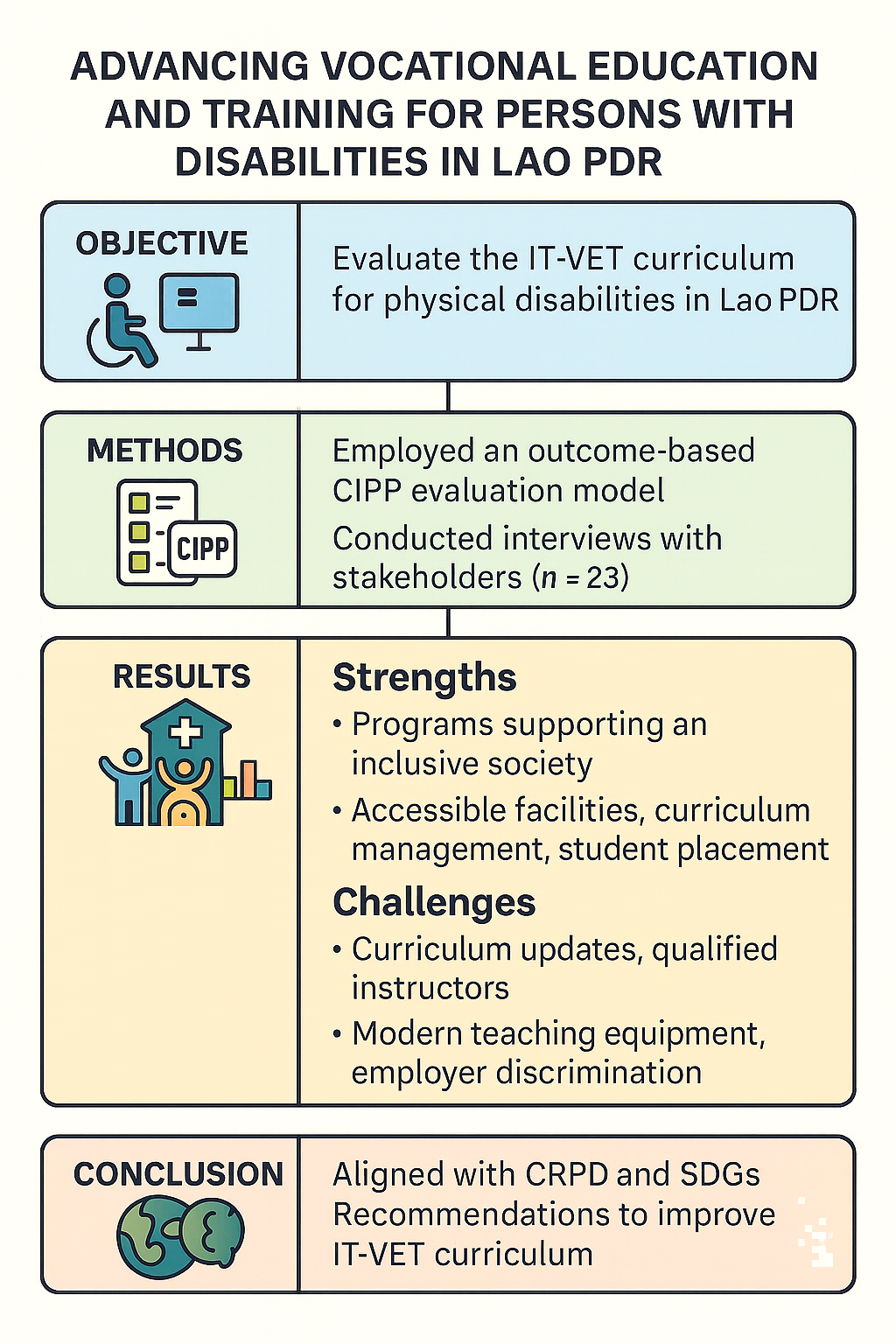
This study aims to examine the vocational education and training (VET) curriculum in information technology (IT) for individuals with physical disabilities in the Lao People's Democratic Republic (Lao PDR). The study used an outcome-based approach and the Context, Input, Process, and Product (CIPP) evaluation model to evaluate the curriculum's effectiveness. The evaluation focused on several areas: the policies and context affecting the curriculum, the available learning resources, the teaching methods applied, and the results for students in the program. The researchers interviewed 23 key stakeholders in the education system, including policymakers, teachers, former and current school directors, employers, graduates, and current students who had experience with the curriculum. The interviews revealed both strengths and challenges in the current IT-VET curriculum. Strengths included programs that support an inclusive society and recognize the contributions of individuals with disabilities. The study also noted accessible facilities, supportive learning environments, effective curriculum management, and successful student job placements. However, it identified several challenges, including the need for continuous curriculum updates to keep pace with technological advances and labour market demands, a shortage of qualified teachers, a lack of modern teaching equipment, and employer discrimination against graduates with disabilities, which hinders their job prospects. The findings are consistent with international standards such as the Convention on the Rights of Persons with Disabilities (CRPD) and the Sustainable Development Goals (SDGs), and they align with related studies in other regions. The study provides key recommendations to improve the VET curriculum, ensuring individuals with physical disabilities receive the necessary support and are not excluded from vocational education and training in Lao PDR and beyond.
Downloads
Article Details

This work is licensed under a Creative Commons Attribution-NonCommercial-NoDerivatives 4.0 International License.
All rights reserved. Apart from citations for the purposes of research, private study, or criticism and review,no part of this publication may be reproduced, stored or transmitted in any other form without prior written permission by the publisher.
References
Adom, D., Adu-Mensah, J., & Dake, D. A. (2020). Test, measurement, and evaluation: Understanding and use of the concepts in education. International Journal of Evaluation and Research in Education, 9(1), 109–119. https://doi.org/10.11591/ijere.v9i1.20457
American Psychological Association. (2022). Guidelines for assessment and intervention with persons with disabilities. https://doi.org/10.1037/e502822022-001
Asai, K., Kuroda, A., & Aerarunchot, S. (2024). Development of a training course to enhance the morality and ethics of student teachers at Champasack University, Lao People’s Democratic Republic. Humanities, Arts and Social Sciences Studies, 24(2), 303–312. https://doi.org/10.69598/hasss.24.2.263372
Asch, D. A., Nicholson, S., Srinivas, S. K., Herrin, J., & Epstein, A. J. (2014). How do you deliver a good obstetrician? Outcome-based evaluation of medical education. Journal of the Association of American Medical Colleges, 89(1), 24–26. https://doi.org/10.1097/ACM.0000000000000067
Aziz, S., Mahmood, M., & Rehman, Z. (2018). Implementation of CIPP model for quality evaluation at school level: A case study. Journal of Education and Educational Development, 5(1), 189–206. https://doi.org/10.22555/joeed.v5i1.1553
Beck, C. T. (1993). Qualitative research: The evaluation of its credibility, fittingness, and auditability. Western Journal of Nursing Research, 15(2), 263–266. https://doi.org/10.1177/019394599301500212
Bredgaard, T., & Salado-Rasmussen, J. (2021). Attitudes and behaviour of employers to recruiting persons with disabilities. Alter, European Journal of Disability Research, 15(1), 61–70. https://doi.org/10.1016/j.alter.2020.04.004
Brown, T. (2025). Skill India’s unmet promises: Raising expectations for financial assistance in training for informal sector livelihoods. Journal of Vocational Education and Training, 77(2), 322–342. https://doi.org/10.1080/13636820.2023.2211968
Bruin, M., Tutlys, V., Ümarik, M., Loogma, K., Kaminskiené, L., Bentsalo, I., Väljataga, T., Sloka, B., & Buligina, I. (2025). Participation and learning in vocational education and training—A cross-national analysis of the perspectives of youth at risk for social exclusion. Journal of Vocational Education and Training, 77(3), 706–727. https://doi.org/10.1080/13636820.2023.2283745
Bulat, J., Hayes, A. M., Macon, W., Tichá, R., & Abery, B. H. (2017). School and classroom disabilities inclusion guide for low- and middle-income countries. RTI Press. https://doi.org/10.3768/rtipress.2017.op.0031.1701
Cheang, M., & Yamashita, G. L. (2023). Employers’ expectations of university graduates as they transition into the workplace. European Journal of Education, 6(2), 22–32. https://doi.org/10.2478/ejed-2023-0013
Chen, P., Goncharova, A., Pilz, M., Frommberger, D., Li, J., Romanova, O., & Lin, Y. (2021). International curriculum comparison in vocational education and training: A collaborative development of an analysis instrument. International Journal for Research in Vocational Education and Training, 8(4), 16–43. https://doi.org/10.13152/IJRVET.8.4.2
Chuppunnarat, Y., Sangvanich, K., Laovanich, V., Achayutthakan, M., Saibunmi, S., & Suwanphithak, W. (2020). The influence of external cultures on art, music, and dance education students: A case study of Thailand and Lao PDR. Humanities, Arts and Social Sciences Studies, 20(2), 582–603. https://so02.tci-thaijo.org/index.php/hasss/article/view/200563
ESCAP. (2020). Employment of persons with disabilities in Asia and the Pacific: Trends, strategies and policy recommendations. https://www.unescap.org/sites/default/d8files/knowledge-products/Employment_of_Persons_with_Disabilities_final_0.pdf
European Training Foundation. (2014). Quality assurance in vocational education and training: A collection of articles. https://www.etf.europa.eu/sites/default/files/m/270970490A6E9327C1257CA800407038_Quality%20assurance%20in%20VET.pdf
European Training Foundation. (2017). Tracing secondary vocational and tertiary education graduates in the former Yugoslav Republic of Macedonia: 2016 tracer study results. https://www.etf.europa.eu/sites/default/files/m/370594378AEE2242C12581C90068FE63_2016%20Tracer%20study%20results%20MK.pdf
Grenier, M., Patey, M., Lieberman, L., & Brian, A. (2020). A collaborative approach for engaging students with severe disabilities in physical education. European Journal of Adapted Physical Activity, 13(2), Article 12. https://doi.org/10.5507/euj.2020.007
ILO. (2016). Including persons with disabilities in technical and vocational education and training. https://www.ilo.org/publications/including-persons-disabilities-technical-and-vocational-education-and
Iqbal, Z., Anees, M., Khan, R., Wadood, A., & Malik, S. (2021). A comparative analysis of the efficacy of three program-evaluation models–A review on their implication in educational programs. Humanities and Social Sciences Reviews, 9(3), 326–336. https://doi.org/10.18510/hssr.2021.9333
Jannok, A., & Suppasetseree, S. (2020). An analysis of the teacher’s and the blind student’s needs toward an English instruction for the blind in Thai context. Humanities, Arts and Social Sciences Studies, 20(2), 515–540. https://so02.tci-thaijo.org/index.php/hasss/article/view/171821
Lejeune, A. (2023). Fighting for sheltered workshops or for inclusive workplaces? Trade unions pursuing disability rights in Belgium. Disability and Society, 38(2), 228–246. https://doi.org/10.1080/09687599.2021.1921702
Marinaci, T., Russo, C., Savarese, G., Stornaiuolo, G., Faiella, F., Carpinelli, L., Navarra, M., Marsico, G., & Mollo, M. (2023). An inclusive workplace approach to disability through assistive technologies: A systematic review and thematic analysis of the literature. Societies, 13(11), Article 231. https://doi.org/10.3390/soc13110231
Martínez, G. R., Pinta, D. A., & Santacruz, L. Á. B. (2018). CIPP model to evaluate the principles applied to develop the input skills in the bachelor degree program of EFL. International Journal of Education and Learning Systems, 3, 117–128. https://iaras.org/iaras/filedownloads/ijels/2018/002-0018(2018).pdf
McNamara, S. W. T., Silliman-French, L., Morgan, V., & Stephens-Pisecco, T. L. (2019). Overcoming adapted physical education barriers through collaboration among special educators and administrators. Journal of the American Academy of Special Education Professionals, 94–105.
Monk, D., Molebatsi, P., McGrath, S., Metelerkamp, L., Adrupio, S., Openjuru, G., Robbins, G., & Tshabalala, T. (2025). Revisiting VET research paradigms: Critical perspectives from the south. Journal of Vocational Education and Training, 77(3), 683–705. https://doi.org/10.1080/13636820.2023.2280972
Mwebi, B. M. (2015, May 18–20). 21st century students’ knowledge, skills and attitudes: Implication for teacher education reform [Paper presentation]. International Conference on ‘Re-Engineering Education for Sustainable Development’. Kenyatta University Conference Centre (KUCC) Nairobi, Kenya. http://ir-library.ku.ac.ke/handle/123456789/12824
National Assembly. (2015). The national constitution of Lao PDR (Amended Volume). https://www.constituteproject.org/constitution/Laos_2015
National Assembly. (2019). The vocational education law. https://na.gov.la/wp-content/uploads/2021/11/125-vocatiobnal-wducateion-law24_7_2019.pdf [in Lao]
Nokkaew, J., Subsandee, P., & Khwanriang, P. (2024). Shaping community-based curriculum of local wisdom on palmyra palm at Huai Krot community in Chai Nat province of Thailand: Initial design processes. Humanities, Arts and Social Sciences Studies, 24(3), 581–595. https://doi.org/10.69598/hasss.24.3.265118
Soliman, S. (2025). Vocational education and training (VET) development and social dialogue in Egypt: A historical institutional perspective. Journal of Vocational Education and Training, 77(3), 531–562. https://doi.org/10.1080/13636820.2023.2258496
Stufflebeam, D. L., & Zhang, G. (2017). The CIPP evaluation model: How to evaluate for improvement and accountability. The Guilford Press. https://www.routledge.com/The-CIPP-Evaluation-Model-How-to-Evaluate-for-Improvement-and-Accountability/Stufflebeam-Zhang/p/book/9781462529230
Suhonen, R., Rajala, A., Cantell, H., & Kallioniemi, A. (2024). From training workers to educating global citizens: How teachers view their opportunities of addressing controversial global issues in vocational education. Journal of Vocational Education and Training, 76(2), 354–380. https://doi.org/10.1080/13636820.2023.2266727
Sumaya, A. A., & Ortega-Dela Cruz, R. A. (2023). Evaluating the outcomes of technical-vocational education and training towards developing skills for the tourism sector. Humanities, Arts and Social Sciences Studies, 23(2), 284–296. https://so02.tci-thaijo.org/index.php/hasss/article/view/263577
Tarat, S. (2020). Education and cultural capital accumulation: The life course of blind people. Journal of Mekong Societies, 16(2), 96–115. https://so03.tci-thaijo.org/index.php/mekongjournal/article/view/239959
Theerathammakorn, S., Soontornchai, S., & Amornrit, P. (2024). A competency-based learning model for distance education in the post-COVID-19 era: Sustainable manufacturing systems and the circular economy. Humanities, Arts and Social Sciences Studies, 24(2), 490–502. https://doi.org/10.69598/hasss.24.2.267798
Tomblin, M. J., & Haring, K. A. (1999). Vocational training for students with learning disabilities: A qualitative investigation. Journal of Vocational Education and Training, 51(3), 357–370. https://www.tandfonline.com/doi/abs/10.1080/13636829900200093?src=recsys
United Nations. (2006). Convention on the rights of persons with disabilities. https://www.ohchr.org/en/instruments-mechanisms/instruments/convention-rights-persons-disabilities
United Nations. (2015). Sustainable Development Goals (SDGs). https://unric.org/en/united-nations-sustainable-development-goals/
Vadevelu, K., & Arunberkfa, N. (2021). Workplace discrimination of transgender youth during gender transition. Humanities, Arts and Social Sciences Studies, 21(1), 171–178. https://so02.tci-thaijo.org/index.php/hasss/article/view/233664
Vreuls, J., van der Klink, M., Koeslag-Kreunen, M., Stoyanov, S., Boshuizen, H., & Nieuwenhuis, L. (2025). Responsive curriculum development: Which factors support breaking through institutional barriers? Journal of Vocational Education and Training, 77(3), 582–610. https://doi.org/10.1080/13636820.2023.2270470
Wafa, A., Singh, J. S. K., & Singh, D. K. S. (2020). Challenges faced and employability skills that employers seek in fresh graduates in a third world country. International Journal of Psychosocial Rehabilitation, 24(2), 735–748. https://www.psychosocial.com/index.php/ijpr/article/view/1584/1430
Wang, S., Zhu, Q., & Zheng, X. (2022). Nurturing "double-qualified" teachers in vocational colleges using campus resources. Scientific and Social Research, 4(12), 7–12. https://doi.org/10.26689/ssr.v4i12.4544
Wang, V. (Ed.). (2011). Assessing and evaluating adult learning in career and technical education. IGI Global. https://doi.org/10.4018/978-1-61520-745-9
Zhang, L., & Sun, L. (2022). The strategies for the construction of “double-qualified” teachers in higher vocational colleges. International Journal of Education and Humanities, 5(2), 149–152. https://doi.org/10.54097/ijeh.v5i2.2128
Zhou, N., & Tigelaar, D. E. H., & Admiraal, W. (2022). Vocational teachers' professional learning: A systematic literature review of the past decade. Teaching and Teacher Education, 119, Article 103856. https://doi.org/10.1016/j.tate.2022.103856
