
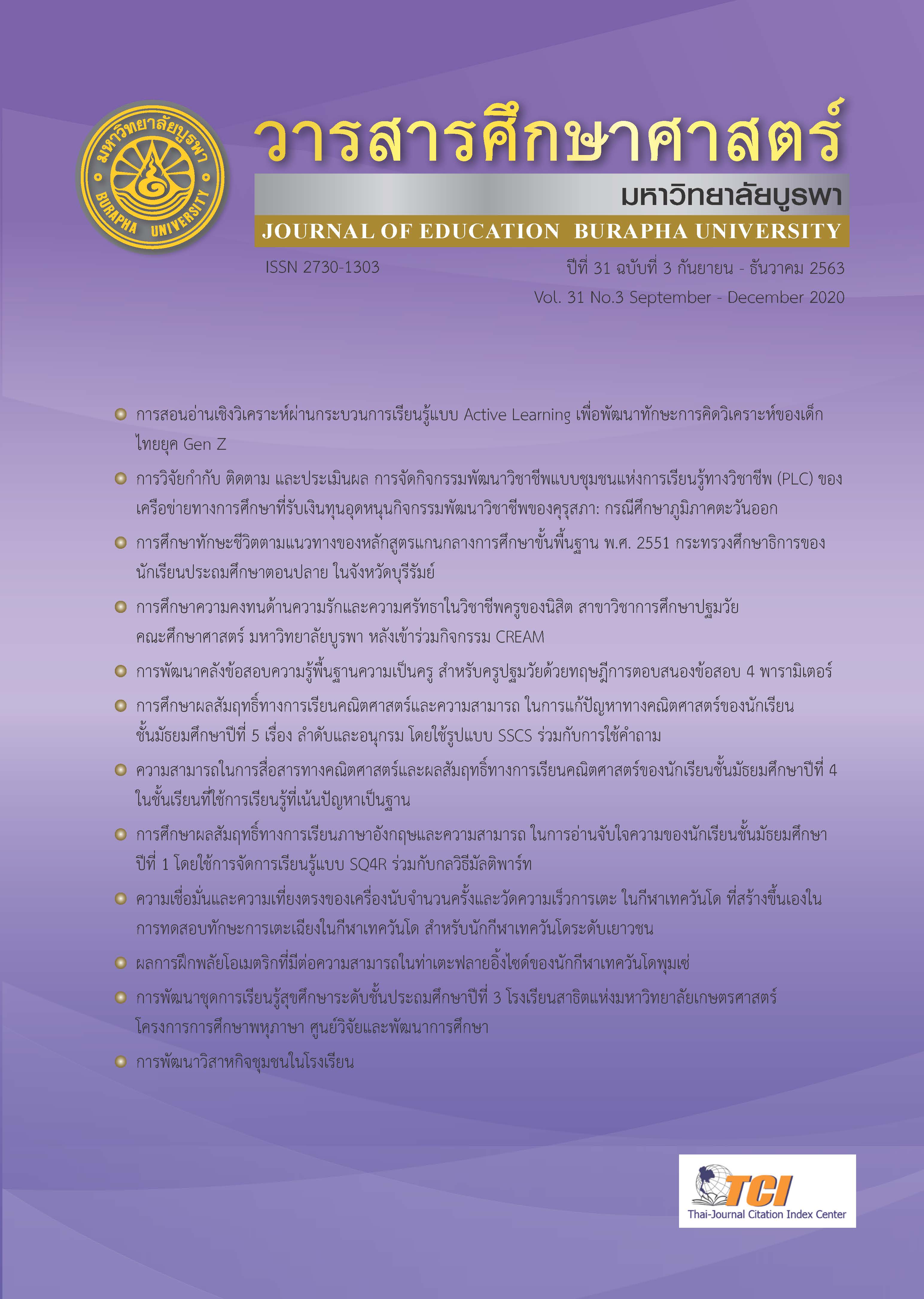
ความสามารถในการสื่อสารทางคณิตศาสตร์และผลสัมฤทธิ์ทางการเรียนคณิตศาสตร์ของนักเรียนชั้นมัธยมศึกษาปีที่ 4 ในชั้นเรียนที่ใช้การเรียนรู้ที่เน้นปัญหาเป็นฐาน
คำสำคัญ:
การเรียนรู้ที่เน้นปัญหาเป็นฐาน, ความสามารถในการสื่อสารทางคณิตศาสตร์, ผลสัมฤทธิ์ทางการเรียนคณิตศาสตร์บทคัดย่อ
การวิจัยนี้มีวัตถุประสงค์เพื่อศึกษาความสามารถในการสื่อสารทางคณิตศาสตร์และผลสัมฤทธิ์ทางการเรียนคณิตศาสตร์ โดยมีนักเรียนกลุ่มเป้าหมายเป็นนักเรียนชั้นมัธยมศึกษาปีที่ 4 จำนวน 45 คน (1 ห้องเรียน) ในห้องเรียนที่ใช้การเรียนรู้ที่เน้นปัญหาเป็นฐาน ในภาคเรียนที่ 2 ปีการศึกษา 2562 เครื่องมือที่ใช้ในการวิจัยได้แก่ 1) แผนการจัดการเรียนรู้โดยใช้ปัญหาเป็นฐาน เรื่องความสัมพันธ์และฟังก์ชัน จำนวน 8 แผน 2) ผลงานของผู้เรียน 3) แบบบันทึกหลังการสอนของครู 4) แบบสะท้อนคิดของนักเรียน 5) แบบวัดความสามารถในการสื่อสารทางคณิตศาสตร์ และ 6) แบบวัดผลสัมฤทธิ์ทางการเรียนคณิตศาสตร์ สถิติที่ใช้ในการวิเคราะห์ข้อมูล คือ ค่าเฉลี่ย ร้อยละ และส่วนเบี่ยงเบนมาตรฐาน
ผลวิจัยพบว่า จากแบบวัดความสามารถในการสื่อสารทางคณิตศาสตร์ทั้ง 3 ชุดใช้วัดความสามารถในการสื่อสารทางคณิตศาสตร์ ในช่วงต้น ช่วงกลาง และช่วงท้ายของการจัดการเรียนการสอนที่ใช้การเรียนรู้ที่เน้นปัญหาเป็นฐาน พบว่า นักเรียนมีความสามารถในการสื่อสารทางคณิตศาสตร์เป็นดังนี้ ชุดที่ 1 อยู่ในระดับพอใช้ ชุดที่ 2 อยู่ในระดับดี และชุดที่ 3 อยู่ในระดับดี ตามลำดับ โดยความสามารถในการสื่อสารทางคณิตศาสตร์ทั้ง 3 ด้านประกอบด้วย 1) การเขียนอธิบายจากกราฟ 2) การวาดกราฟ และ 3) การเขียนอธิบายโดยใช้ภาษาหรือสัญลักษณ์ทางคณิตศาสตร์ โดยรวมแล้วพบว่า ด้านการเขียนอธิบายโดยใช้ภาษาหรือสัญลักษณ์ทางคณิตศาสตร์เป็นด้านที่มีคะแนนเฉลี่ยสูงที่สุด ในขณะที่ ด้านการเขียนอธิบายจากกราฟนักเรียนมีคะแนนเฉลี่ยต่ำที่สุด
ด้านผลสัมฤทธิ์ทางการเรียนคณิตศาสตร์พบว่านักเรียนมีคะแนนจากการทำแบบวัดผลสัมฤทธิ์ทางการเรียนคณิตศาสตร์เฉลี่ยเป็น 15.81 คะแนน จากคะแนนเต็ม 20 คะแนน (คิดเป็น 88.89%) และมีส่วนเบี่ยงเบนมาตรฐาน 2.28 โดยนักเรียน (มากกว่า 80%) มีผลสัมฤทธิ์ทางการเรียนคณิตศาสตร์ผ่านเกณฑ์ 60%
เอกสารอ้างอิง
กุลจิรา ฝุ่นวัง. (2561). การสร้างลักษณะเฉพาะของข้อสอบวัดผลสัมฤทธิ์ทางการเรียนกลุ่มสาระการเรียนรู้คณิตศาสตร์ ชั้นประถมศึกษาปีที่ 1. วารสารศึกษาศาสตร์ มหาวิทยาลัยบูรพา, 29(3), 174-189.
จตุรงค์ เลิศชูวงศา. (2559). การใช้การเรียนรู้ที่เน้นปัญหาเป็นฐานเพื่อส่งเสริมอภิปัญญาและผลสัมฤทธิ์ทางคณิตศาสตร์ของนักเรียนชั้นมัธยมศึกษาปีที่4 (วิทยานิพนธ์ปริญญามหาบัณฑิต). เชียงใหม่: มหาวิทยาลัยเชียงใหม่.
ณัฐพร เอี่ยมทอง. (2561). การเปรียบเทียบผลสัมฤทธิ์ทางการเรียนคณิตศาสตร์และความสามารถในการคิดวิเคราะห์ของนักเรียนระดับชั้นมัธยมศึกษาปีที่ 5 ที่เรียนโดยรูปแบบ Problem-based Learning กับรูปแบบการสอนปกติ. วารสารราชพฤกษ์, 16(2). 53-60.
ดวงหทัย กาศวิบูลย์. (2552). กลยุทธ์การส่งเสริมทักษะการสื่อสารในชั้นเรียนคณิตศาสตร์. วารสาร มหาวิทยาลัยราชภัฏยะลา, 4(1). 38-51.
นภสร เรือนโรจน์รุ่ง. (2558). การจัดการเรียนรู้โดยใช้ปัญหาเป็นฐานเพื่อพัฒนาผลสัมฤทธิ์ทางการเรียน ทักษะ การแก้ปัญหาคณิตศาสตร์ในชีวิตประจำวัน และเจตคติต่อการเรียนวิชาคณิตศาสตร์ ของนักเรียนชั้นประถมศึกษาปีที่ 2. สืบค้นจาก คณะครุศาสตร์ จุฬาลงกรณ์มหาวิทยาลัย เว็บไซต์: http://cuir.chula.ac.th/dspace/bitstream/123456789/47689/3/Noppasorn_Ru.pdf
บุญชม ศรีสะอาด. (2556). วิธีการทางสถิติสำหรับการวิจัย เล่ม 1 (พิมพ์ครั้งที่ 5). กรุงเทพฯ: สุวีริยาสาส์น.
ปภัสชญา เสมา. (2560). ผลของการจัดกิจกรรมการเรียนรู้คณิตศาสตร์โดยใช้รูปแบบการร่วมมือแบบสืบสอบที่มีต่อความสามารถในการให้เหตุผลและการสื่อสารทางคณิตศาสตร์ของนักเรียนมัธยมศึกษาปีที่ 2. An Online Journal of Education, 12(4), 666-680.
พรทิพา เมืองโคตร. (2559). ความสามารถในการแก้ปัญหาทางคณิตศาสตร์โดยการจัดการเรียนรู้โดยใช้ปัญหาเป็นฐานของนักเรียนชั้นมัธยมศึกษาปีที่ 3 เรื่องพื้นที่ผิวและปริมาตร. วารสารศึกษาศาสตร์, 27(3), 122-132.
มนตรี วงษ์สะพาน. (2560). การพัฒนาชุดกิจกรรมการเรียนรู้เสริมทักษะกระบวนการทางคณิตศาสตร์โดยใช้สื่อการเรียนรู้จากท้องถิ่น สาหรับนักเรียนระดับชั้นมัธยมศึกษาตอนต้น. วารสารศึกษาศาสตร์ มหาวิทยาลัยนเรศวร, 19(2), 71-82.
สถาบันทดสอบทางการศึกษาแห่งชาติ (สทศ.). (2561). รายงานผลการทดสอบทางการศึกษาระดับชาติขั้นพื้นฐาน (O-NET) ปีการศึกษา 2562. สืบค้น 5 มีนาคม 2563, จากhttps://www.niets.or.th/
สถาบันส่งเสริมการสอนวิทยาศาสตร์และเทคโนโลยี. (2560). คู่มือการใช้หลักสูตรกลุ่มสาระการเรียนรู้คณิตศาสตร์ (ฉบับปรับปรุง พ.ศ. 2560). กรุงเทพฯ: สถาบันส่งเสริมการสอนวิทยาศาสตร์และเทคโนโลยี.
อัมพร ม้าคนอง. (2553). ทักษะและกระบวนการทางคณิตศาสตร์ การพัฒนาเพื่อพัฒนาการ. พิมพ์ครั้งที่ 1. กรุงเทพฯ: โรงพิมพ์แห่งจุฬาลงกรณ์มหาวิทยาลัย.
Fatade, A. O., Mogari, D., & Arigbabu, A. A. (2013). Effect of Problem-Based Learning on Senior Secondary School Students' Achievements in Further Mathematics. Acta Didactica Napocensia, 6(3), 27-44.
Firdaus, H. P. E. (2017). Analysis of Mathematical Communication Skills Students in Mathematics Education at Study Course Junior High School Mathematics. International Conference on Education (IECO), 1(1), 344-351.
Habsah, F. (2017). Developing Teaching Material Based on Realistic Mathematics Andoriented to the Mathematical Reasoning and Mathematical Communication. Jurnal Riset Pendidikan Matematika, 4(1), 43-55.
Kaur, B. (2019). Evolution of Singapore’s school mathematics curriculum. In C. Vistro-Yu, & T.L. Toh (Eds.) School mathematics curricula: Asian perspectives and glimpses of reform (pp. 21-38). New Delhi: Springer.
Kuntari, T. A., & Rosnawati, R. (2016). The Effect of Problem Based Learning (PBL) Model to Mathematical Communication Skills and Problem Solving 7 th Grade Students of Junior High School in MERGANGSAN DISTRICTS of YOGYAKARTA. Journal Pendidikan Matematika-S1, 5(4), 1-10.
National Council of Teachers of Mathematics. (2000). Principles and standards for school mathematics. Reston, VA: Author.
Othman, H., Salleh, B. M., & Sulaiman, A. (2013). 5 ladders of active learning: An innovative learning steps in PBL process. In K. M. Yusof, M. Arsat, M. T. Borhan, E. D. Graaff, A. Kolmos, & F. A. Phang (Eds.), PBL across cultures (pp. 245-253). Aalborg, Denmark:
Aalborg University Press.
Paridjo, W., & St. B. (2017). Analysis Mathematical Communication Skills Students In The Matter Algebra Based NCTM. Journal of Mathematics, 13(1), 60-66.
Perwitasari, D., & Surya, E. (2017). The Development of Learning Material Using Problem Based Learning to Improve Mathematical Communication Ability of Secondary School Students. International Journal of Sciences: Basic and Applied Research
(IJSBAR), 33(3), 200-207.
Surya, E., Syahputra, E., & Jumiati, N. (2018). Effect of Problem Based Learning Toward Mathematical Communication Ability and Self-Regulated Learning. Journal of Education and Practice, 9(6), 14-23.
Tiffany, F., Surya, E., Panjaitan, A., & Syahputra, E. (2017). Analysis Mathematical Communication Skills Student At The Grade IX Junior High School. IJARIIE-ISSN (O)-2395-4396, 3(2), 2160-2164.
ดาวน์โหลด
เผยแพร่แล้ว
รูปแบบการอ้างอิง
ฉบับ
ประเภทบทความ
สัญญาอนุญาต
ลิขสิทธิ์ของบทความที่ปรากฏในวารสารศึกษาศาสตร์ มหาวิทยาลัยบูรพา เป็นของวารสารศึกษาศาสตร์ มหาวิทยาลัยบูรพา ทั้งนี้บทความทุกเรื่องผ่านการตรวจสอบความถูกต้องทางวิชาการจากผู้ทรงคุณวุฒิ ข้อความและข้อมูลของบทความในวารสารฯ เป็นแนวคิดของผู้แต่ง มิใช่เป็นความคิดเห็นของกองบรรณาธิการ และมิใช่ความรับผิดชอบของคณะศึกษาศาสตร์ มหาวิทยาลัยบูรพา ไม่สงวนลิขสิทธิ์การนำไปใช้ประโยชน์ทางวิชาการแต่ต้องอ้างอิงแสดงแหล่งที่มาและอยู่ในขอบเขตของกฎหมายลิขสิทธิ์


