
การพัฒนาบทเรียนออนไลน์เพื่อเสริมสร้างความสามารถในการจัดทำแผนการเรียนรู้สำหรับนักศึกษาหลักสูตรศึกษาศาสตรบัณฑิต
Article Sidebar
Main Article Content
บทคัดย่อ
งานวิจัยนี้มีวัตถุประสงค์เพื่อ 1) พัฒนาบทเรียนออนไลน์เพื่อเสริมสร้างความสามารถในการจัดทำแผนการเรียนรู้สำหรับนักศึกษาหลักสูตรศึกษาศาสตรบัณฑิต 2) ประเมินความสามารถในการจัดทำแผนการเรียนรู้ของนักศึกษาหลังใช้บทเรียนออนไลน์เพื่อเสริมสร้างความสามารถในการจัดทำแผนการเรียนรู้สำหรับนักศึกษาหลักสูตรศึกษาศาสตรบัณฑิต และ 3) ศึกษาความพึงพอใจของนักศึกษาที่มีต่อการใช้บทเรียนออนไลน์เพื่อเสริมสร้างความสามารถในการจัดทำแผนการเรียนรู้สำหรับนักศึกษาหลักสูตรศึกษาศาสตรบัณฑิต กลุ่มเป้าหมาย คือ นักศึกษาชั้นปีที่ 2 ปีการศึกษา 2567 จำนวน 136 คน เครื่องมือวิจัย ได้แก่ 1) บทเรียนออนไลน์เพื่อเสริมสร้างความสามารถในการจัดทำแผนการเรียนรู้ สำหรับนักศึกษาหลักสูตรศึกษาศาสตรบัณฑิต 2) แบบประเมินความสามารถในการจัดทำแผนการเรียนรู้ และ 3) แบบสอบถามความพึงพอใจของนักศึกษาที่มีต่อการใช้บทเรียนออนไลน์เพื่อเสริมสร้างความสามารถในการจัดทำแผนการเรียนรู้ วิเคราะห์ข้อมูลสถิติ ค่าร้อยละ ค่าเฉลี่ย และค่าความเบี่ยงเบนมาตรฐาน
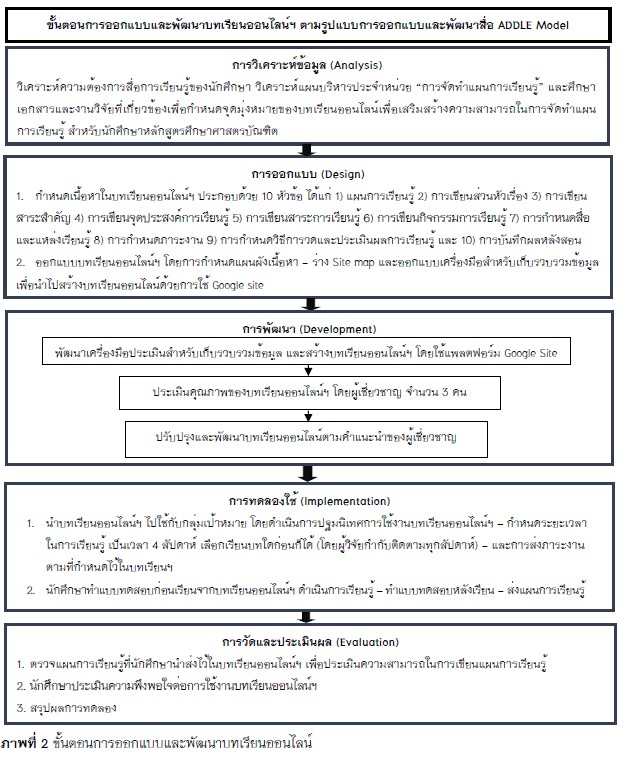
ผลการวิจัยพบว่า บทเรียนออนไลน์เพื่อเสริมสร้างความสามารถในการจัดทำแผนการเรียนรู้ สำหรับนักศึกษาหลักสูตรศึกษาศาสตรบัณฑิต พัฒนาบนเว็บไซต์ Google ประกอบด้วยหัวข้อ 1) แผนการเรียนรู้ 2) การเขียนส่วนหัวเรื่อง 3) การเขียนสาระสำคัญ 4) การเขียนจุดประสงค์การเรียนรู้ 5) การเขียนสาระการเรียนรู้ 6) การเขียนกิจกรรมการเรียนรู้ 7) การกำหนดสื่อและแหล่งเรียนรู้ 8) การกำหนดภาระงาน 9) การกำหนดวิธีการวัดและประเมินผลการเรียนรู้ และ 10) การบันทึกผลหลังสอน มีคุณภาพอยู่ในระดับมากที่สุด ( = 4.80, S.D. = 0.40) ความสามารถในการจัดทำแผนการเรียนรู้ของนักศึกษาหลังใช้บทเรียนออนไลน์เพื่อเสริมสร้างความสามารถในการจัดทำแผนการเรียนรู้ (μ = 60.23) คิดเป็นร้อยละ 86.04 ความพึงพอใจของนักศึกษาที่มีต่อ การใช้บทเรียนออนไลน์เพื่อเสริมสร้างความสามารถในการจัดทำแผนการเรียนรู้ อยู่ในระดับมากที่สุด (μ = 4.56, σ = 0.58)
Downloads
Article Details

อนุญาตภายใต้เงื่อนไข Creative Commons Attribution-NonCommercial-NoDerivatives 4.0 International License.
เอกสารอ้างอิง
Branson, R. K., Rayner, G. T., Cox, J. L., Furman, J. P., King, F. J., & Hannum, W. H. (1975). Interservice procedures for instructional systems development (TRADOC Pam 350–30 NAVEDTRA 106A). U.S. Army Training and Doctrine Command. https://www.kroobannok.com/35953
Chuairatchakan, S., Dathawi, P. P., Daengchat, D., Khlairung, K., Khutchuang, S., Thongmeesri, S., & Kamonrojsiri, P. (2022). The satisfaction towards online learning of teacher education college students Phranakhon Rajabhat University. Journal of Educational Research and Innovation Phranakhon Rajabhat University, 2(1), 1–17. https://so04.tci-thaijo.org/index.php/RESEARCH_INNOVTION_IN_EDUCATION/article/view/256834/175785 [In Thai]
Faculty of Art Education. (2019). Bachelor of education program in music education. Bunditpatanasilpa Institute of Fine Arts. [In Thai]
Haneef, A. (2025). Impact of online learning on higher education students: A systematic review. Researchgate. https://www.researchgate.net/publication/397539623
Insa-ard, S. (2018). Designing on e-learning lessons for developing in higher-order thinking skills. Se-ed Book. [In Thai]
Jarmonmarn, S., & Sirawong, N. (2023). The development of online learning to promote using skills of digital technology for undergraduate students in education programs at Srinakharinwirot University. Journal of Education Research, Faculty of Education, Srinakharinwirot University, 18(1), 15–30. https://ejournals.swu.ac.th/index.php/jre/article/view/15171/12383 [In Thai]
Martin, F., & Boliger, D. U. (2023). Designing online learning in higher education. In Handbook of Open, Distance and Digital Education (pp. 1217-1236). https://www.researchgate.net/publication/367420843
Ministry of Education. (2019, March 6). The standards of bachelor's degree qualifications for Bachelor of Education and Bachelor of Arts in Education (Four-Year Program), B.E. 2562. Royal Thai Government Gazette, 136(56 ง), 12. [In Thai]
Notification of the Teachers’ Council of Thailand. (2022, May 7). Details of standards of knowledge and professional experience for teachers in accordance with the Teachers’ Council of Thailand Regulations on Professional Standards (No. 4), B.E. 2562 (2019). Royal Thai Government Gazette, 137(109 ง), 10–14. [In Thai]
Pakdeeteva, S., & Bangthamai, E. (2021). New era learning and online instruction in higher education institutions. Sukhothai Thammathirat Open University Journal. https://so05.tci- thaijo.org/index.php/stouj/article/view/250473/171899 [In Thai]
Petthai, S. (2017). Online lessons in website design and development by using e-learning. In Proceedings of the 3rd Pibulsongkram National Research Conference (pp. 74–81). Pibulsongkram Rajabhat University. https://research.kpru.ac.th/research2/pages/filere/26012018-05-31.pdf [In Thai]
Srisang, C. (2021). Gratification toward online instructional management and students’ appropriate learning behavior: Case study of Princess of Naradhiwas University [Master’s independent study, Thammasat University]. TU Digital collections. DOI: 10.14457/TU.the.2021.932 [In Thai]
Standard criteria for undergraduate studies programs, B.E. 2565. (2022, March 31). Royal Thai Government Gazette, 139(20 ก), 3–11. [In Thai]
Tamilarasan, P., Vijayakumar, S., & Anupama, C. G. (2021). ADDIE model of instructional design in an online course at higher education. Turkish Online Journal of Qualitative Inquiry (TOJQI), 12(6), 8394–8401. https://tojqi.net/index.php/journal/article/download/3294/2233/3626
Udomthanateera, K. (2020). E-learning element. https://www.iok2u.com/article/information-technology/e-learning-e-learning-element [In Thai]
Wongsapan, M. (2023). Fundamentals of research in curriculum and instruction (2nd ed.). Takasila Publishing. [In Thai]
