
องค์ประกอบของรูปแบบการนิเทศผสมผสานแบบยืดหยุ่นเพื่อส่งเสริมการเรียนการสอนโค้ดดิ้งของครู
Article Sidebar
Main Article Content
บทคัดย่อ
ในปัจจุบันการเรียนรู้เรื่องโค้ดและระบบการเขียนโค้ด หรือโค้ดดิ้ง (Coding) ไม่ใช่แค่การเรียนรู้ของผู้เรียนที่ต้องการจะเป็นโปรแกรมเมอร์เท่านั้น แต่ผู้เรียนทุกคนควรได้เรียนรู้โค้ดดิ้ง ซึ่งไม่เพียงแต่เพิ่มทางเลือกในการประกอบอาชีพในอนาคตเท่านั้น แต่ยังช่วยให้ผู้เรียนรู้จักวิธีคิดอย่างเป็นระบบอีกด้วย อย่างไรก็ตาม การเรียนการสอนโค้ดดิ้งในประเทศไทยยังมีความท้าทายและข้อจำกัดบางประการ การวิจัยนี้จึงมีความสำคัญในการค้นหาและสร้างนวัตกรรมสำหรับการส่งเสริมการเรียนการสอนโค้ดดิ้งด้วยการนิเทศการศึกษา โดยมีวัตถุประสงค์เพื่อ 1) ศึกษาองค์ประกอบของรูปแบบการนิเทศผสมผสานแบบยืดหยุ่นเพื่อส่งเสริมการเรียนการสอนโค้ดดิ้งของครู 2) ศึกษาความเหมาะสมและความเป็นไปได้ของรูปแบบและคู่มือการใช้รูปแบบการนิเทศผสมผสานแบบยืดหยุ่นเพื่อส่งเสริมการเรียนการสอนโค้ดดิ้งของครู และ 3) ประเมินความสอดคล้องเชิงเนื้อหาของรูปแบบและคู่มือการใช้รูปแบบการนิเทศผสมผสานแบบยืดหยุ่นเพื่อส่งเสริมการเรียนการสอนโค้ดดิ้งของครู แหล่งข้อมูล ได้แก่ 1) ผู้มีส่วนเกี่ยวข้อง 13 คน และ 2) ผู้เชี่ยวชาญ จำนวน 5 คน เครื่องมือที่ใช้ทำการวิจัยประกอบด้วย 1) แบบบันทึกการสังเคราะห์เอกสารและงานวิจัยที่เกี่ยวข้อง 2) แบบบันทึกการสนทนากลุ่ม และ 3) แบบประเมินความสอดคล้องเชิงเนื้อหาของรูปแบบและคู่มือการใช้รูปแบบการนิเทศผสมผสานแบบยืดหยุ่นเพื่อส่งเสริมการเรียนการสอนโค้ดดิ้งของครู การวิเคราะห์ข้อมูลใช้การวิเคราะห์เนื้อหาและสถิติที่ใช้วิเคราะห์ ได้แก่ ค่าเฉลี่ย () และค่าเบี่ยงเบนมาตรฐาน (S.D.)
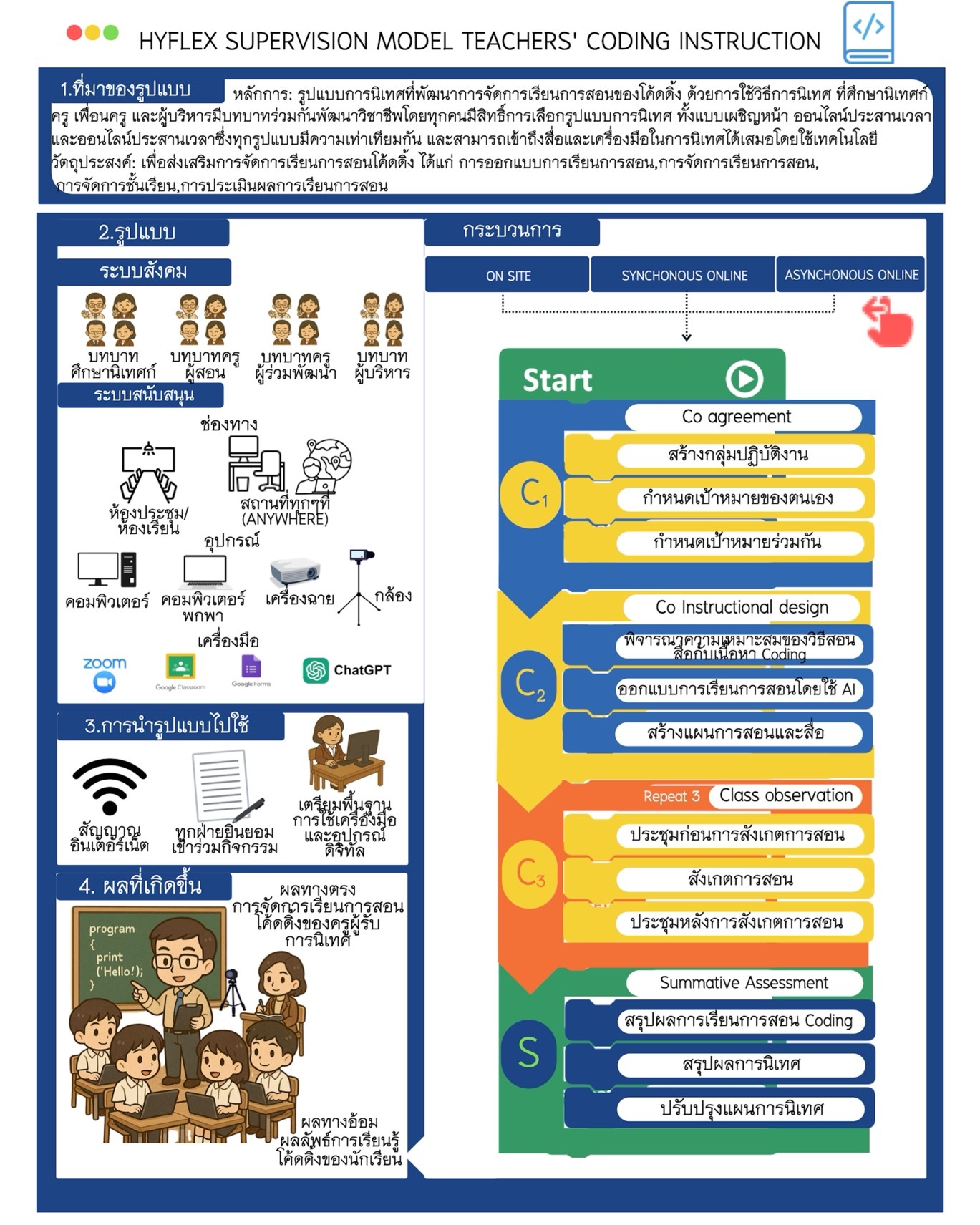
ผลการวิจัยพบว่า 1) รูปแบบการนิเทศผสมผสานแบบยืดหยุ่นเพื่อส่งเสริมการเรียนการสอนโค้ดดิ้งของครู มี 4 องค์ประกอบ ดังนี้ องค์ประกอบที่ 1 ที่มาของรูปแบบ ได้แก่ 1) หลักการของรูปแบบ และ 2) วัตถุประสงค์ของรูปแบบ องค์ประกอบที่ 2 รูปแบบของการนิเทศ ได้แก่ 1) กระบวนการของรูปแบบ คือ กระบวนการนิเทศผสมผสานแบบยืดหยุ่น (3C1S) ประกอบด้วย 4 ขั้นตอน ได้แก่ (1) การสร้างข้อตกลงและสัมพันธภาพที่ดี (Co Agreement) (2) การร่วมออกแบบการจัดการเรียนการสอน (Co Instructional Design) (3) การสังเกตการสอน (Class Observation) และ (4) การประเมินผล (Summative Assessment) 2) ระบบสังคม และ 3) ระบบสนับสนุน องค์ประกอบที่ 3 การนำรูปแบบไปใช้ และองค์ประกอบที่ 4 ผลที่เกิดขึ้นจากการนิเทศ 2) รูปแบบและคู่มือการใช้รูปแบบการนิเทศผสมผสานแบบยืดหยุ่นเพื่อส่งเสริมการเรียนการสอนโค้ดดิ้งของครู มีความเหมาะสมและเป็นไปได้ในการนำไปใช้ และ 3) รูปแบบการนิเทศผสมผสานแบบยืดหยุ่นเพื่อส่งเสริมการเรียนการสอนโค้ดดิ้งของครูมีความสอดคล้องเชิงเนื้อหาในระดับมาก ส่วนคู่มือการใช้รูปแบบการนิเทศผสมผสานแบบยืดหยุ่นเพื่อส่งเสริมการเรียนการสอนโค้ดดิ้งของครูมีความสอดคล้องเชิงเนื้อหาในระดับมากที่สุด
Downloads
Article Details

อนุญาตภายใต้เงื่อนไข Creative Commons Attribution-NonCommercial-NoDerivatives 4.0 International License.
เอกสารอ้างอิง
Amirova, A., Zhumabayeva, A., Zhunusbekova, A., Kalbergenova, S., Nygymanova, N., & Arenova, A. (2023). Effect of using hyflex technology learning on preservice teachers' success and attitudes. International Journal of Education in Mathematics, Science and Technology, 11(3), 623-642. https://doi.org/10.46328/ijemst.3309
Beatty, B. (2019). Hybrid-flexible course design. EdTech Books.
Buosonte, R. (2020). Research and development of educational innovation (2nd ed.). Chulalongkorn University Press. [In Thai]
Burton, W. H., & Brueckner, L. J. (1965). Supervision: A social process (3rd ed.). Appleton Crofts.
Chaiwong, N. (2017). Development of a supervision model based on the blended learning concept to improve classroom research ability of teachers under the Office of Nakhon Phanom Primary Education Service Area 1 [Doctoral Dissertation, Sakon Nakhon Rajabhat University]. https://gsmis.snru.ac.th/e-thesis/thesis_detail?r=55632227108 [In Thai]
Choi, J., & Kang, W. (2019). Sustainability of cooperative professional development: Focused on teachers’ efficacy.
Sustainability, 11(3), 585. https://doi.org/10.3390/su11030585
Glatthorn, A. A. (1997). Differentiated supervision. Association for supervision and curriculum development (ASCD).
Glickman, C. D. (1990). Supervision of instruction a developmental approach (2nd ed.). A Division of Simon and Schuyter.
Institute for the Promotion of Teaching Science and Technology. (2019). Curriculum manual for technology (computer science) Science learning area (2017 revised edition) for primary and secondary levels. SCIMATH. https://www.scimath.org/ebook-technology/item/8376-2560-2551 [In Thai]
Kamjan, P. (2022). The future of educational supervision for supervisors under the primary education service area office in the next decade: in case of technology content (Computing Science) [Doctoral dissertation, Naresuan University]. https://nuir.lib.nu.ac.th/dspace/handle/123456789/5495 [In Thai]
Khummanee, O. (2021). The supervision model promoting the implementation of education quality assurance system development based on ministerial regulations for education quality assurance 2018 for educational institutions under Hua Hin Municipality, Thailand. International Journal of Crime, Law and Social Issues, 8(1), 44-60. https://ssrn.com/abstract=3921646
Koskinen, M. (2018). Understanding the needs of adult graduate students: An exploratory case study of a Hyflex learning environment [Doctoral dissertation, Northeastern University]. https://repository.library.northeastern.edu/files/neu:m044c738v/fulltext.pdf
Laowreandee, W. (2010). Supervision of teaching. Silpakorn University Printing. [In Thai]
Mette, I. M., Range, B. G., Anderson, J., Hvidston, D. J., & Nieuwenhuizen, L. (2015). Teachers' perceptions of teacher supervision and evaluation: A reflection of school improvement practices in the age of reform. Education Leadership Review, 16(1), 16-30. https://eric.ed.gov/?id=EJ1105545
Ministry of Education. (2017). Indicators and concepts in Science subject. (Revision B.E.2560). According to basic education core curriculum B.E. 2551. The agricultural co-operative federation of Thailand printing house. [In Thai]
Office of the Education Council, Ministry of Education. (2020). Lesson learned: Coding teaching and innovation: developing students to have the desired characteristics of Thai people 4.0 according to national education standard. 21 Century Co., Ltd. [In Thai]
Office of the Teacher Civil Service and Educational Personnel Commission. (2021). Guidelines for implementing the criteria and methods for evaluating the positions and academic qualifications of teachers and educational personnel in the teacher position. Office of the Teacher Civil Service and Educational Personnel Commission. https://otepc.go.th/images/00_YEAR2564/03_PV1/1Mv9-2564.pdf [In Thai]
O'Neill, D. K. (2016). 21st century bunkum: What do we value about kids learning to code, and why?. Teacher Learning and Professional Development, 1(2), 111 – 116. https://tlpd.journals.publicknowledgeproject.org/tlpd/index.php/tlpd/article/view/14/pdf
Paje, S. (2021). Principles and theories of instructional design. Muang Phrae Printing. [In Thai]
Paniagua, A., & Istance, D. (2018). Teachers as designers of learning environments: The importance of innovative pedagogies. Educational Research and Innovation, OECD Publishing. https://doi.org/10.1787/9789264085374-en
Piyasinchart, A. (2022). Coding is more valuable than developing the ability of Thai youths to learn programming to control robots skillfully. Journal of Mass Communication Technology, RMUTP. 7(2), 85-96. https://so05.tci-thaijo.org/index.php/jmctrmutp/article/view/261223/176770 [In Thai]
Richey, R. C. (2005). Validating instructional design and development models. In J. M. Spector, C. Ohrazda, A. Van Schaack, & D. A. Wiley (Eds.), Innovations in instructional technology: Essays in honor of M. David Merrill (pp. 171–185). Lawrence Erlbaum Associates Publishers.
Rojas-López, A., Rincón-Flores, E. G., Mena, J., García-Peñalvo, F. J., & Ramírez-Montoya, M. S. (2019). Engagement in the course of programming in higher education through the use of gamification. Universal Access in the Information Society, 18(3), 583-597. https://doi.org/10.1007/s10209-019-00680-z
Wade, D. T. (2009). Goal setting in rehabilitation: An overview of what, why and how. Clinical Rehabilitation, 23(4), 291-295. https://doi.org/10.1177/0269215509103551
Walsh, K. (2010). Differentiating teacher supervision: The disconnect between beliefs and behaviors. New Jersey Journal of Supervision and Curriculum Development. 54, 72–78.
Wing, J. M. (2006). Computational thinking. Communications of the ACM, 49(3), 33-35. https://www.cs.cmu.edu/~15110-s13/Wing06-ct.pdf
Worathadasawat, W. (2025). The mixed educational supervision model to enhance active learning management of secondary school teachers [Doctoral dissertation, Naresuan University]. https://nuir.lib.nu.ac.th/dspace/handle/123456789/5835 [In Thai]
