
พฤติกรรมกิจกรรมทางกายของนักศึกษา มหาวิทยาลัยราชภัฏนครราชสีมา
Article Sidebar
Main Article Content
บทคัดย่อ
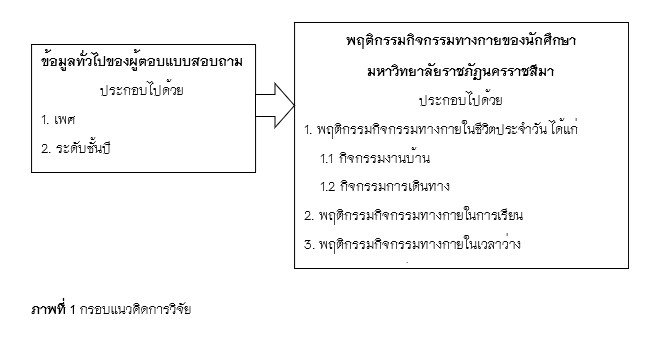
การวิจัยครั้งนี้มีวัตถุประสงค์เพื่อ 1) ศึกษาพฤติกรรมกิจกรรมทางกายของนักศึกษา มหาวิทยาลัยราชภัฏนครราชสีมา 2) เปรียบเทียบพฤติกรรมกิจกรรมทางกายตามตัวแปรเพศและระดับชั้นปี กลุ่มตัวอย่าง จำนวน 400 คน เป็นนักศึกษาประจำปีการศึกษา 2566 ใช้วิธีการสุ่มตัวอย่างตามสะดวก เครื่องมือที่ใช้ในการวิจัย คือ แบบสอบถามพฤติกรรมกิจกรรมทางกายของนักศึกษา มหาวิทยาลัยราชภัฏนครราชสีมา วิเคราะห์ข้อมูลด้วยการหาค่าความถี่ ค่าร้อยละ ค่าเฉลี่ย (𝑥̅) ค่าส่วนเบี่ยงเบนมาตรฐาน (S.D.) independent t-test วิเคราะห์ความแปรปรวนทางเดียว (ANOVA) และเมื่อพบความแตกต่างจึงใช้การเปรียบเทียบรายคู่ โดยใช้วิธีของ Fisher's Least Significant Difference (LSD)
ผลการวิจัย พบว่า 1) พฤติกรรมกิจกรรมทางกายในชีวิตประจำวัน ส่วนใหญ่ คือ กวาดบ้าน และกิจกรรมการเดินทาง คือ โดยรถจักรยานยนต์ พฤติกรรมกิจกรรมทางกายในการเรียน พบว่า นักศึกษาได้มีการลงทะเบียนเรียนรายวิชาที่เกี่ยวกับการออกกำลังกายหรือ การเล่นกีฬา และใช้เวลาในการเคลื่อนไหวในแต่ละครั้งใช้เวลาเฉลี่ย 2 ชั่วโมง 35 นาที และกิจกรรมการเดินเรียน ใช้เวลาเฉลี่ย 14.47 นาที/วัน/สัปดาห์ พฤติกรรมกิจกรรมทางกายในเวลาว่าง ส่วนใหญ่ คือ เดินเล่น และพฤติกรรมเนือยนิ่ง ส่วนใหญ่ คือ เล่นโซเชียล/เกมออนไลน์ในโทรศัพท์มือถือ 2) ผลการเปรียบเทียบตัวแปรเพศ พบว่า พฤติกรรมกิจกรรมทางกายในชีวิตประจำวัน และการเรียนแตกต่างกันอย่างไม่มีนัยสำคัญทางสถิติที่ระดับ .05 แต่ในเวลาว่างเพศชายและหญิงมีกิจกรรมวิ่งเหยาะ ๆ และเล่นกีฬาหรือออกกำลังกายแตกต่างกันอย่างมีนัยสำคัญทางสถิติที่ระดับ .05 และพฤติกรรมเนือยนิ่งเพศชายและหญิงมีการเล่นเกมคอมพิวเตอร์และนั่ง/นอนคุยโทรศัพท์แตกต่างกันอย่างมีนัยสำคัญทางสถิติที่ระดับ .05 ผลการเปรียบเทียบตัวแปรระดับชั้นปี พบว่า พฤติกรรมกิจกรรมทางกายในชีวิตประจำวัน การเรียน และในเวลาว่างแตกต่างกันอย่างไม่มีนัยสำคัญทางสถิติที่ระดับ .05 แต่พฤติกรรมเนือยนิ่งในการอ่านหนังสือแตกต่างกันอย่างมีนัยสำคัญทางสถิติที่ระดับ .05 เมื่อเปรียบเทียบความแตกต่างเป็นรายคู่โดยใช้วิธีการ LSD พบว่า ค่าเฉลี่ยพฤติกรรมเนือยนิ่งในการอ่านหนังสือชั้นปีที่ 4 มากกว่าชั้นปีที่ 2 ชั้นปีที่ 3 และชั้นปีที่ 1 ตามลำดับ
Downloads
Article Details

อนุญาตภายใต้เงื่อนไข Creative Commons Attribution-NonCommercial-NoDerivatives 4.0 International License.
เอกสารอ้างอิง
Academic Promotion and Registration Office. (2023). Statistics/information services. https://apro.nrru.ac.th/apro/show_pages.php?pages=ad61ab143223efbc24c7d2583be6925. [In Thai}
Department of Health, Ministry of Public Health. (2018). Physical activity promotion plan 2018–2030. Ministry of Public Health. [In Thai}
Espada, M., Romero-Parra, N., Bores-García, D., & Delfa-De La Morena, J. M. (2023). Gender differences in university students’ physical activity levels and motivation. Education Sciences, 13(4), 340. https://doi.org/10.3390/educsci13040340
Hanpatchaiyakul, K., Butudom, A., Udmuangpia, T., Raksri, S., Thoin, P., & Muenthaisong, S. (2021). Game addiction behavior and impacts of game addiction in secondary and high school students in Khon Kaen municipality. Regional Health Promotion Center 9 Journal, 15(38), 561-573. https://he02.tci-thaijo.org/index.php/RHPC9Journal/article/view/251524/171689 [In Thai}
Institute for Population and Social Research, Mahidol University. (2022). Thai people’s health report: physical activity-How much is enough? (Part 1). https://www.thaihealthreport.com/th/showArticle.php?p=MTMz. [In Thai}
Kljajević, V., Stanković, M., Đorđević, D., Trkulja-Petković, D., Jovanović, R., Plazibat, K., Oršolić, M., Čurić, M., & Sporiš, G. (2021). Physical activity and physical fitness among university students: A systematic review. International Journal of Environmental Research and Public Health, 19(1), 158. https://doi.org/10.3390/ijerph19010158
Poomrapiporn, Y., & Phonsongkroh, N. (2022). Reading behavior and factors affecting social studies students’ reading, Faculty of Humanities and Social Sciences, Nakhon Pathom Rajabhat University. In Proceedings of the 14th National Academic Conference (pp. 2161–2172). Institute of Research and Development, Nakhon Pathom Rajabhat University. [In Thai}
Sae-Ung, K., Romchit, N., Kaewpratrrp, P., Kongchan, W., Nakwanon, W., & Batpimai, S. (2017). A study of online game playing behavior of students at Nakhon Ratchasima Rajabhat University (Research report). Nakhon Ratchasima Rajabhat University. [In Thai}
Semamon, W., & Tantikul, R. (2024). A study of fundamental data to develop a physical activity management model for undergraduate students. Journal of Institute of Trainer Monk Development, 7(3), 40-49. https://so06.tci-thaijo.org/index.php/tmd/article/view/270843/184938 [In Thai]
Thai Health Promotion Foundation [ThaiHealth]. (2022). Home physical activities for children in the new normal era. https://happychild.thaihealth.or.th/กิจกรรมทางกายประจำบ้าน/ [In Thai]
Thailand Physical Activity Knowledge Development Centre [TPAK]. (2020a). Recovering physical activities in the country after the COVID-19 crisis. Parbpim. [In Thai}
Thailand Physical Activity Knowledge Development Centre [TPAK]. (2020b). Home physical activity guide. Sahamit Printing and Publishing. [In Thai}
World Health Organization [WHO]. (2020). Global recommendations on physical activity for health. WHO.
World Health Organization [WHO]. (2024). Compendium of WHO and other UN guidance on health and environment: 2024 update (Chapter 9 Safe environments and mobility). WHO.
Yimaiem, W., Phenglee, N., & Boonchai, K. (2018). Exercise behavior and barriers to exercise among students of Kasetsart University [Unpublished Master’s thesis]. Kasetsart University. [In Thai}
Yamane, T. (1973). Statistics: An introductory analysis (3rd ed.). Harper & Row.
