
Development of Online Lessons to Enhance Lesson Planning Ability for Undergraduates in an Education Program
Article Sidebar
Main Article Content
Abstract
This research aimed to 1) develop online lessons to enhance lesson planning ability for undergraduate students in an education program, 2) evaluate students’ lesson planning ability after using the online lessons, and 3) investigate students’ satisfaction toward the online lessons. The sample group consisted of 136 second-year undergraduate students in the academic year 2024. The research instruments included 1) online lessons to enhance learning planning ability, 2) a lesson planning ability assessment form, and 3) a students’ satisfaction questionnaire. Data were analyzed using percentage, mean, and standard deviation.
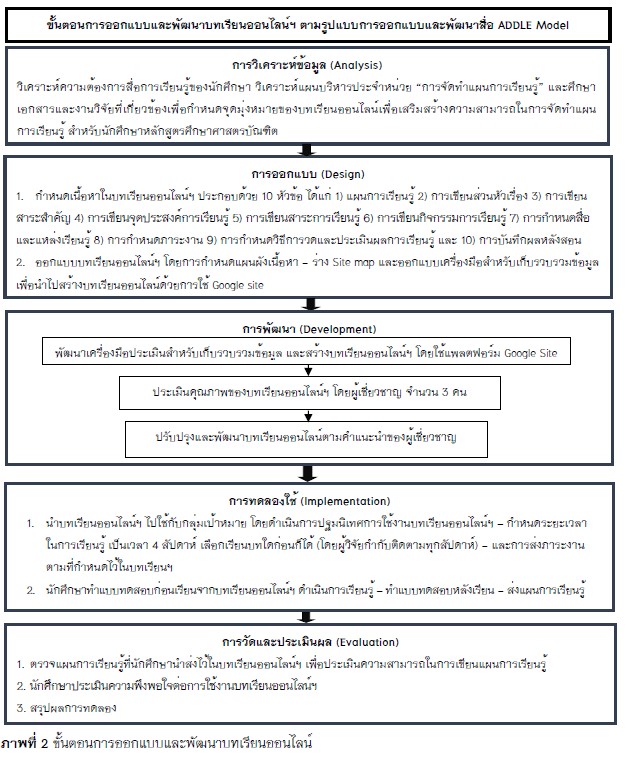
The research findings revealed that the online lessons, hosted on the Google website, comprised ten key components: learning plans overview, Heading Construction, Concept Formulation, Defining Learning Objectives, Content Selection, Instructional Activities Design, Learning media and Resources, Task Assignments, Assessment and Evaluation, Post-Instructional Reflection. The overall quality of the online lessons was the highest level ( = 4.80, S.D. = 0.40). Students’ lesson planning ability after using the online lessons had a mean score of 60.23, accounting for 86.04 percent. Moreover, students’ overall satisfaction of toward the online lessons was also at the highest level (μ = 4.56, σ = 0.58)
Downloads
Article Details

This work is licensed under a Creative Commons Attribution-NonCommercial-NoDerivatives 4.0 International License.
References
Branson, R. K., Rayner, G. T., Cox, J. L., Furman, J. P., King, F. J., & Hannum, W. H. (1975). Interservice procedures for instructional systems development (TRADOC Pam 350–30 NAVEDTRA 106A). U.S. Army Training and Doctrine Command. https://www.kroobannok.com/35953
Chuairatchakan, S., Dathawi, P. P., Daengchat, D., Khlairung, K., Khutchuang, S., Thongmeesri, S., & Kamonrojsiri, P. (2022). The satisfaction towards online learning of teacher education college students Phranakhon Rajabhat University. Journal of Educational Research and Innovation Phranakhon Rajabhat University, 2(1), 1–17. https://so04.tci-thaijo.org/index.php/RESEARCH_INNOVTION_IN_EDUCATION/article/view/256834/175785 [In Thai]
Faculty of Art Education. (2019). Bachelor of education program in music education. Bunditpatanasilpa Institute of Fine Arts. [In Thai]
Haneef, A. (2025). Impact of online learning on higher education students: A systematic review. Researchgate. https://www.researchgate.net/publication/397539623
Insa-ard, S. (2018). Designing on e-learning lessons for developing in higher-order thinking skills. Se-ed Book. [In Thai]
Jarmonmarn, S., & Sirawong, N. (2023). The development of online learning to promote using skills of digital technology for undergraduate students in education programs at Srinakharinwirot University. Journal of Education Research, Faculty of Education, Srinakharinwirot University, 18(1), 15–30. https://ejournals.swu.ac.th/index.php/jre/article/view/15171/12383 [In Thai]
Martin, F., & Boliger, D. U. (2023). Designing online learning in higher education. In Handbook of Open, Distance and Digital Education (pp. 1217-1236). https://www.researchgate.net/publication/367420843
Ministry of Education. (2019, March 6). The standards of bachelor's degree qualifications for Bachelor of Education and Bachelor of Arts in Education (Four-Year Program), B.E. 2562. Royal Thai Government Gazette, 136(56 ง), 12. [In Thai]
Notification of the Teachers’ Council of Thailand. (2022, May 7). Details of standards of knowledge and professional experience for teachers in accordance with the Teachers’ Council of Thailand Regulations on Professional Standards (No. 4), B.E. 2562 (2019). Royal Thai Government Gazette, 137(109 ง), 10–14. [In Thai]
Pakdeeteva, S., & Bangthamai, E. (2021). New era learning and online instruction in higher education institutions. Sukhothai Thammathirat Open University Journal. https://so05.tci- thaijo.org/index.php/stouj/article/view/250473/171899 [In Thai]
Petthai, S. (2017). Online lessons in website design and development by using e-learning. In Proceedings of the 3rd Pibulsongkram National Research Conference (pp. 74–81). Pibulsongkram Rajabhat University. https://research.kpru.ac.th/research2/pages/filere/26012018-05-31.pdf [In Thai]
Srisang, C. (2021). Gratification toward online instructional management and students’ appropriate learning behavior: Case study of Princess of Naradhiwas University [Master’s independent study, Thammasat University]. TU Digital collections. DOI: 10.14457/TU.the.2021.932 [In Thai]
Standard criteria for undergraduate studies programs, B.E. 2565. (2022, March 31). Royal Thai Government Gazette, 139(20 ก), 3–11. [In Thai]
Tamilarasan, P., Vijayakumar, S., & Anupama, C. G. (2021). ADDIE model of instructional design in an online course at higher education. Turkish Online Journal of Qualitative Inquiry (TOJQI), 12(6), 8394–8401. https://tojqi.net/index.php/journal/article/download/3294/2233/3626
Udomthanateera, K. (2020). E-learning element. https://www.iok2u.com/article/information-technology/e-learning-e-learning-element [In Thai]
Wongsapan, M. (2023). Fundamentals of research in curriculum and instruction (2nd ed.). Takasila Publishing. [In Thai]
